Robin Skylights · Nottingham
Sun tunnels in Nottingham
A small dome on the roof and a mirror-lined tube carry daylight into a landing, bathroom or hallway that has no window, and they go on working when the sky is flat and grey.

Daylight, piped to where the wall never reaches
Some rooms sit in the middle of the house with no outside wall to put a window in. A sun tunnel borrows the roof instead. The dome collects whatever light the sky is giving, and on a dull November morning that is still enough to turn a lamp-lit landing into a daylit one.
Sun tunnels: the full guide
The chapters follow the survey chat. They cover which rooms suit a tube of light, how the domes and tubes differ, what the roof and loft have to offer, what planning and Building Control expect, and how the work goes in. A sun tunnel is related to the skylight but behaves more like a light fitting than a window. A short answer sits alongside each chapter.
01
Where a sun tunnel suits, and what it gives a room
A room with no outside wall is the one this product was made for.
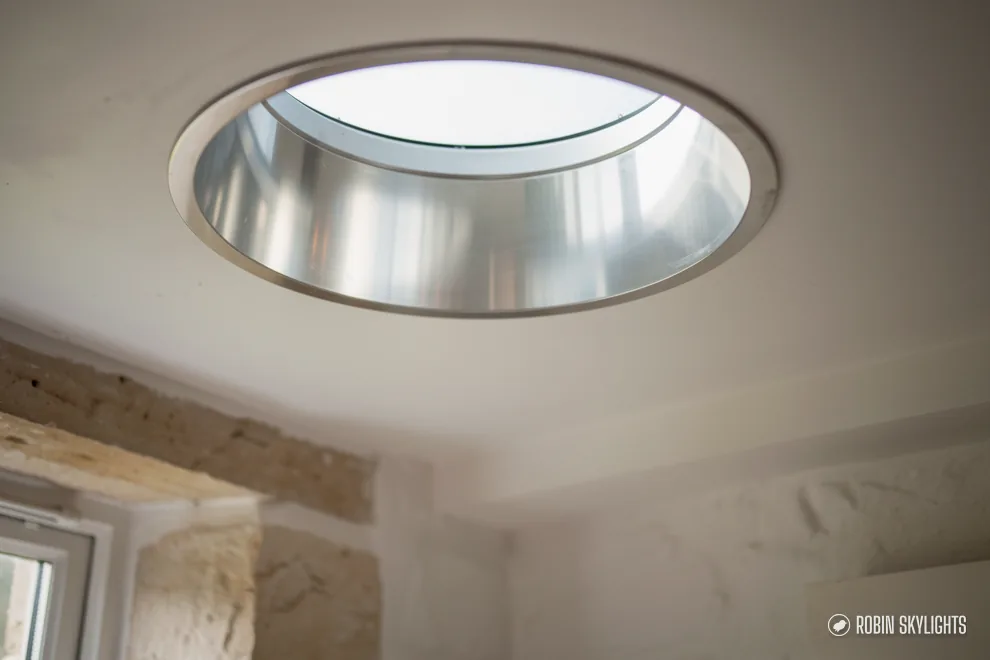
A sun tunnel is a small daylight pipe. A clear dome on the roof catches the light, a mirror-lined tube carries it down through the roof space, and a diffuser set into the ceiling spreads it across the room below. There is no frame to build into the ceiling and no deep shaft to line, which is why it reaches rooms that an ordinary skylight or roof window cannot.
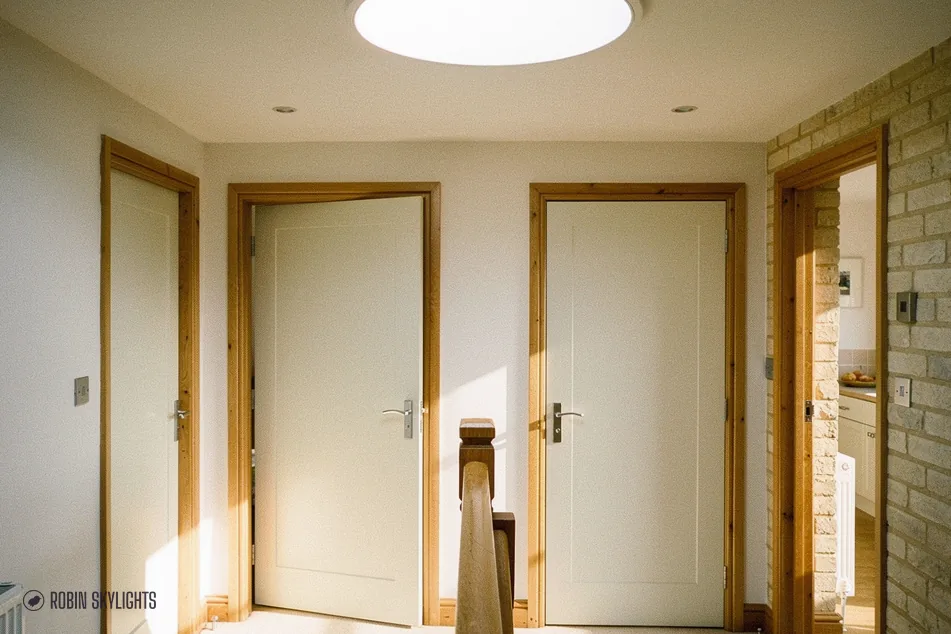
It is the product for a room with no outside wall. Think of the landing in the middle of a semi, an internal bathroom or cloakroom, a hallway that runs back from the front door, a walk-in wardrobe or a utility room tucked behind the kitchen. In each of those the choice is usually between a bulb that stays on from breakfast to bedtime and a tube that lets the sky do the work.
Benefits of natural light in a room with no window
Daylight shifts through the day and with the weather. Under cloud it turns a quiet grey-white, and in bright weather it reads sharp and almost white. Colours look truer, a bathroom mirror is kinder to everyone, and a landing stops feeling like a basement corridor.
It changes habits too. A hallway lit from above by day is one where nobody reaches for the switch at nine in the morning. We make no promise about the electricity bill, because that depends on the bulb you are replacing and how long it used to stay on, but the switch stays off for far more of the daylight hours.
Bedroom, bathroom, hallway or landing
Bathrooms and landings are the usual requests. A bathroom with no window usually runs on a ceiling light and an extractor fan; a tube gives it a brighter, calmer room in daytime. A hallway or stairwell benefits because the light falls on the stairs, where people most need to see their feet.
A bedroom is a different case. A tube over a small box room or a dressing room works well, because nobody is expected to look out of it. In a main bedroom people tend to want a view of the sky and some fresh air, and for that a roof window is the better answer.
Our work is residential first, in terraces, semis, bungalows and larger houses, and we take on small commercial jobs such as an office corridor or a staff toilet block. The guide on where sun tunnels work best goes room by room.
02
Tube types, widths, domes and finishes
Straight and wide beats long and bendy, but the loft decides how straight you get.
Every sun tunnel is built from the same three parts, and the choices inside each one change the result.
Rigid or flexible tube
A rigid tube is a polished aluminium pipe in straight lengths, with angled elbows where the route has to turn. Light bounces off the smooth wall with little loss, so it is the stronger performer over a straight drop. A flexible tube is a ribbed, stretchy duct that bends round whatever is in the way, at the price of more loss at each corrugation. Many lofts need a mix: rigid where the path is clear, flexible for the awkward last stretch. The guide to rigid or flexible sun tunnels sets out when each one suits.
| Tube | Best for | Over a long run | Loft notes |
|---|---|---|---|
| Rigid | Straight drops | Carries light well | Needs a clear line |
| Rigid with elbows | One or two turns | Loses a little per bend | Needs headroom at turns |
| Flexible | Awkward routes | Loses more light | Wraps round obstacles |
Sizes and widths
Tubes are sold in several widths, commonly from about a quarter of a metre up to just under half a metre across. A wider tube carries more light, but it has to fit between the rafters or trusses above the ceiling, so the loft sets the upper limit before taste does. The length of the drop matters as well, because every metre of tube and every elbow takes a little light with it. A short, wide, straight run is the best case. The tube length comes from measuring the roof void on the survey, never from a catalogue. A bathroom with a high ceiling needs a longer drop than a landing under the eaves, and that difference alone can decide between two widths.
Domes, diffusers and extras
The dome is usually clear acrylic or polycarbonate and sits in a flashing that matches the roof covering: one pattern for plain tiles, another for slate, another for a flat roof deck. The diffuser at the ceiling can be a flat opal disc or a shallow prismatic one, and it is the only part you see from inside. Some kits add a small electric light fitting in the tube so the same ceiling point gives light at night, and some take a small extractor unit. Either one needs a cable run, so decide before the plasterboard is finished.
Frames and flashings come in grey, black and brown finishes to sit quietly beside the tiles. Inside, the diffuser is white and simply looks like a ceiling light. If you would rather the ceiling carried a more decorative lamp, say so early; the diffuser type, the ring colour and any trim all change how the finished fitting reads.
03
How much light a sun tunnel gives, and what it does not do
A pool of daylight, a lot less than a window, a lot more than a bulb you leave off.
A sun tunnel gives a single, soft source of daylight in the ceiling. From below it resembles a ceiling spotlight, except that the source is the sky, so it moves with the weather. Over a landing, an en-suite or a wardrobe the pool of light usually reaches the walls. Over a big living space it fades before it gets there, and a lamp is still needed after dark.
Why grey days are the real test
Anything looks good under a blue June sky. What matters in Nottingham is the long run of overcast days between October and March, when the light is low, flat and short. A tube does not need direct sun. The dome collects light from the whole sky, which is brightest straight overhead even under cloud, so the diffuser keeps glowing when a window on the same house would look sad. The detail of tube width, length, bends and shade is in the answer on how much light a sun tunnel gives.
That is also why dome position matters more than people expect. A dome tucked under a chimney stack, a tall neighbour or an overhanging tree gets less sky than one on a clear slope. We look at what the dome can see, in winter terms, before marking the roof.
Ventilation is a separate question
A sun tunnel is sealed. It brings in light, not air, and the diffuser does not open. A bathroom still needs its own ventilation, whether that is an extractor fan or an opening window, and fitting a tube does not change that. If you want the room to breathe as well as brighten, there are two routes: a tube kit that carries a small extractor, or an opening rooflight. Our page on electric and opening rooflights covers the second, including electric or remote opening and rain sensors, and it is the right call where a room needs real airflow.
What a tube will not do
You will not see out of it, and you will not get a patch of sun on the floor. Those belong to windows and roof windows. Where the room is big, or you want something that changes the feel of the whole space, a flat rooflight or lantern is the better product, and we say so at the survey rather than sell the wrong one. A tube is also no substitute for task lighting: over a desk or a worktop, a lamp still does the work after dark.
04
The roof and loft a sun tunnel goes through
Pitched, flat, tiled or slate: the dome flashing and the tube route change with each.
A sun tunnel crosses three zones: the roof covering, the roof void and the ceiling. Each one needs a different decision, and the order matters because the position of the dome sets the whole route.
Pitched roof: tiles and slates
On a pitched roof the dome sits in a flashing that is dressed into the tiles or slates around it. The flashing is chosen for the covering, which is why a photo of the roof is never quite enough. Clay and concrete tiles, plain tiles and natural or fibre slate each take a different pattern. The opening is cut between rafters where we can, so structure is left alone. Where a rafter has to be trimmed, it is framed round properly. If the tube must pass a truss, we thread it between the members and never cut one.

Flat roof
A flat roof takes a different arrangement: the dome stands on a small upstand, usually an insulated base, and the waterproofing is lapped up to it. The fall of the roof matters, because water must drain away from the base rather than pond against it. A tube through a flat roof is short, since there is rarely much of a loft, and that makes it one of the brighter versions. We deal with the roof covering at the same time, whether it is felt, a single-ply membrane or something else, because the dome base has to be sealed into it correctly. A tired felt covering is worth renewing around the dome, since the seal is the first place an old roof fails.
- Dome
- The clear cap on the roof that collects daylight.
- Flashing
- The shaped weatherproof collar that seals the dome into tiles, slates or roof membrane.
- Diffuser
- The translucent panel in the ceiling that spreads the light into the room.
- Elbow
- An angled section of rigid tube used to turn the route.
- Truss
- A factory-made timber triangle that carries many modern roofs and must not be cut.
Through the loft
Most of the tube lives in the loft, out of sight. It can lean, shift sideways or fall plumb, depending on what shares the void: trusses, purlins, water tanks, pipework and cables. A wide tube needs a wide gap, so a cluttered loft can cap the diameter even when the ceiling below could take more. Where the loft has been boarded or converted, the picture changes, and the answer on running a sun tunnel through a loft explains the options. The cold section of tube is insulated so that it does not become a cold bridge or a place for condensation to form.
The ceiling hole is the last stage, and it is cut from the loft side once the dome position is final. The diffuser closes it from below, and a small plasterboard make-good and a coat of paint follow.
05
Planning and Building Regulations for a sun tunnel
Two separate questions, and a dome usually answers the first one easily.
0.15m
Class C ceiling on how far a rooflight may project from the roof slope
1.7m
floor-to-opening height beyond which a side-slope rooflight may open
31areas
areas designated as conservation areas by the city council
Two bodies look at a sun tunnel, for different reasons. The planning system cares about what shows from the street. Building Control cares about the roof as a piece of construction: structure, insulation, weathertightness. Passing one does not pass the other.
Planning permission
On a house, the dome usually falls within the permitted development rights for roof alterations, known as Class C (Part 1, Schedule 2) of the 2015 permitted development order. Two tests apply. The dome may not project further than 0.15 m from the surface of the existing slope, and it may not sit higher than the roof's highest point. A sun tunnel dome is a low shape, so it normally clears both comfortably. We still compare the actual dome with the actual roof before anything is ordered. A side-facing slope adds a third test: glazing there has to be frosted and shut, with one exception: a part that opens must be more than 1.7 m above the floor of that room. Domes are fixed and diffusers frosted, so this seldom bites, but we check.
The rights stop short of flats and maisonettes. Listed status means consent must be sought before any new rooflight goes in. An Article 4 direction can switch the rights off across a street or an estate. The planning-permission answer, sun tunnel planning rules, walks through each exception.
Conservation areas
Nottingham City Council lists 31 conservation areas, including the Arboretum, Canning Circus, Clifton Village, Old Lenton and Bulwell. Class C is not withdrawn there simply because of the designation, though an Article 4 direction can do it, so that is the first thing we check for a dome on a street-facing slope. A dome is small and can usually sit on a rear slope, so a tube is often the lightest way to brighten a protected house. We contact the council first rather than guess.
Building Regulations
A new sun tunnel breaks into the roof structure and the insulated envelope, which puts it under Building Regulations in the ordinary way, and a replacement counts as controlled work as well. Where the job is notifiable, the notification, to the council or to a registered building control approver, is ours to make, and the finished installation meets the current standard. England sets no minimum daylight level for houses, so the rules are not about how bright your hallway has to be. They concern the roof deck, the heat staying in and the rain staying out.
06
Replacing an old sun tunnel, and sun tunnels in loft conversions
A tired dome or a leaking collar is a reason to look at the whole tube, not only the top.
Sun tunnels are not rare in Nottingham. Plenty of landings and bathrooms were given an early tube years ago, and some of those are now showing their age. Look up at yours on a grey afternoon: a dim, yellowish glow is the first clue. A replacement is a more informed job than a first fit, because the opening, the route and the ceiling hole already exist.
Signs a sun tunnel is due for replacement
The dome may have yellowed, crazed or clouded, so less light gets in. The flashing may have lifted or the sealant failed, leaving a stain on the ceiling after wet spells. The diffuser may drip or hold condensation, which often means the cold section of tube was never insulated. An old flexible tube may have sagged or collapsed in the loft, pinching the light path. The choice between rigid and flexible tube, covered earlier, shapes what you get back.
What a replacement involves
We survey the existing unit from the roof and from inside the loft. If the opening is sound, the new dome and flashing go into the same hole, matched to the tile or slate and the current pitch of the roof. Where the old tube is poor, we replace it with a rigid length or a better flexible one and insulate the cold part. Often a wider tube can go in, if the structure permits, and that gives noticeably more light than the old one. Modern domes and diffusers also cut glare and heat in summer better than early units, which matters in a south-facing bathroom. The ceiling is then made good around the new diffuser.
Loft conversions
A loft conversion changes the question. The converted room needs its own light, and that is normally a roof window, because people want a view and, in a bedroom, fresh air. A sun tunnel still has a role for the landing and stairwell beneath the conversion, where it lights the stairs without taking floor area. If a conversion has already boxed in the roof, the tube may run through a sloping ceiling and a stud wall, and sometimes the better answer is a small roof window. We say which on the survey. Roof windows for conversions are covered on their own page.
07
Survey, quote and fitting day for a sun tunnel
The loft and the roof are looked at before a price is given.
Every job starts with a free survey. We go up into the loft, look at the roof from outside, and check the ceiling below. That is where the questions get answered: whether a straight run exists, what is in the way, which flashing suits the covering and where the dome will see most sky. A quote for a roof nobody has seen is a guess, so the number comes afterwards.
Cost and quotes
A sun tunnel is among the lighter jobs we do, but the price is not the same from house to house. It moves with the tube width and length, the number of bends, the type of roof covering, how easy the loft is to reach and whether a light fitting or extractor is added. A flat roof or a boarded loft adds work. Because those things show only on a visit, we do not quote from a photo, and we do not publish a figure that would mislead. Once we have been up there, the quote arrives in writing with a fixed figure that holds when we turn up to work. Many people ask whether a tube costs less than a rooflight. In general it can, because it is a smaller opening with less glazing and finishing, but a long or awkward run narrows the gap, so compare like with like. Our costs page explains what drives the number.
On the installation day
The sequence is the same each time. We protect the floor and the room below, mark the ceiling position from the loft, and cut the roof opening from the outside. The flashing and dome go in and are sealed into the covering. Then the tube is built up from the roof down, joined and taped, insulated through the cold section, and finished with the diffuser. Dust sheets go down, the plaster edge is made good, and we clear the loft and the roof of off-cuts. At survey we agree how the day will run, including access to the loft and who needs to be home.
Paperwork and cover
Where the job is notifiable, the paperwork for Building Control is ours. Workmanship is covered by a written 10-year guarantee, and the terms are on the guarantee page. We work across Nottingham and 30 miles around it by road, and we come to you; there are no public premises to visit.
08
Nottingham homes that suit a sun tunnel
Landings, hallways and bathrooms in the houses this city has most of.
Nottingham's housing runs from Victorian terraces near the city centre to inter-war semis in the suburbs and post-war estates beyond. Each has its own dark corners, and a sun tunnel suits several of them better than anything else.
In inter-war and post-war semis, the landing sits in the centre of the upper storey, hemmed in by bedroom doors, with no window of its own. That is the house a sun tunnel was made for. The stairwell is often the darkest part of the home, and a tube above it lights both the stairs and the landing at once. In West Bridgford, where many roofs are tiled pitches over simple loft spaces, the route from dome to ceiling is often direct.
Terraces near the centre and in parts of Sneinton, Bulwell and Lenton often have a narrow hallway and a bathroom added at the back, with no outside wall to put a window in. The loft is shallow, so a short, wide tube is possible, and the dome can sit on the rear slope out of sight from the street. In conservation areas that is a real advantage, and the planning chapter explains why we check with the council.
Bungalows around Beeston, Arnold, Carlton, Ruddington and Stapleford have the opposite arrangement. The roof void is generous and the landing is not an issue, but the hall and the internal bathroom are. A single tube over a hallway lights it in daylight without anyone cutting into a wall, and the saving in disruption is part of the appeal. Chalet bungalows often combine a converted room with a darkened passage below it, a good case for a mix of roof window above and tube below.
Extensions create their own problem. A rear extension on a pitched or flat roof often leaves a utility room or downstairs toilet in the dark, and a tube picks up the light that the extension took away from the old back wall. Lawns, driveways and mature trees all change how much sky a dome gets, so two houses on the same street can differ. If you are not sure where your house sits, see the full list of areas covered across Nottinghamshire, or the pages for West Bridgford and Beeston. For the wider work, our rooflight installation in Nottingham home page lists every product, and the flat roof rooflights page is the next step if a tube is too small for the room.



Sun tunnel questions from the survey visit
How much does a sun tunnel cost to install?
It depends on tube width and length, the number of bends, the roof covering and how easy the loft is to reach. A short run through a flat roof is a lighter job than a long, boarded loft. That is why we price after the free survey and hand over a firm written figure that stays put on the day. The costs page shows what moves the figure.
Are sun tunnels cheaper than skylights?
Often, because the opening is smaller and there is less glazing and finishing around it. The gap narrows when the tube is long, bendy or needs extras such as a light fitting. A sun tunnel is also a different product: it lights a pool of floor and gives no view or fresh air. Compare what you need, not only the price.
Are sun tunnels a good idea?
They are a good idea for a windowless landing, hallway, bathroom or wardrobe under a roof with a clear route. The drawbacks are real too: no view, no air, and less light than a rooflight of the same footprint. In a large room, or where you want to see the sky, a roof window or flat rooflight serves better.
Do sun tunnels reduce electricity costs for lighting?
They replace the lamp you would otherwise leave on in daytime, so the light is off for more of the day. How much that saves depends on the bulb, how long it ran and the season, so we do not put a figure on it. From October to March the daylight hours are short, which limits the benefit.
Do sun tunnels brighten a room effectively?
In a small room, yes. A landing, en-suite or wardrobe gets soft daylight that reaches the corners. In a large room the edges stay dim. Output depends on tube width, length, bends and the sky the dome sees, so a wide, short, straight run under open sky is the strongest arrangement.
Can a sun tunnel add value to a home?
We cannot promise a sale price, and no one can, but a light landing and a bright bathroom make a house easier to like on a viewing in November. Treat it as a better room to live in. A buyer will notice tidy finishing, and the paperwork for the work stays with the house.