Robin Skylights · Nottingham
Replacing misted rooflights in Nottingham
When the glass has clouded between the panes, the room loses the light you paid for. We survey the rooflight, the frame and the roof around it, then fit a new unit that stays clear through the grey months.
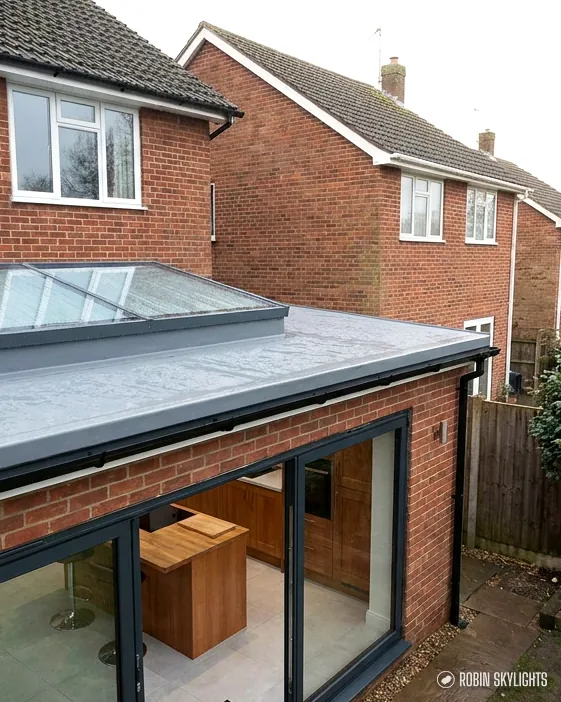
Get the sky back in the room
A misted pane does not just look tired. It turns bright cloud into milk and sends the room back towards the lamp switch. A new sealed unit gives the glass its job again, and a grey November afternoon feels noticeably lighter underneath.
Misted rooflight replacement: the full guide
This is the long version of what we cover on a survey when the glass in a rooflight or skylight has gone cloudy. It runs through what misting is, how we decide between changing one unit and changing the whole rooflight, what the new glazing should be, the rules, the roof around the opening and what happens on the day. Dip into whichever chapter matches your question.
01
What a misted rooflight is, and when it needs replacing
Haze between the panes is a seal that has gone, not dirt that can be cleaned.
Look closely at the glass of any rooflight and you are looking at a factory-made sandwich: two or three panes, a spacer round the rim and a sealed edge, with dry air or gas trapped inside. While the seal holds, the gap stays clear. When it lets go, damp air creeps in, the drying agent in the spacer fills up, and moisture settles on the cold inner faces of the glass as a haze, a cloud or a trail of droplets. People often call this a blown unit. You cannot wipe it away because it sits where no cloth reaches. Our guide on why rooflights mist up explains the causes in detail.
Misting or ordinary condensation?
Condensation is a film on the room-facing surface of the inner pane. It appears on cold mornings, clears as the room warms, and wipes off. Misting stays in the same place whatever the weather, looks like a stain or a cloud, and does not move when you touch the glass. If the marks are inside the sandwich, the unit has failed.
The tipping point
A misted skylight keeps the weather out and keeps the room dry, so nothing dramatic happens on the day the seal goes. The change is gradual: less daylight reaches the room, the glass loses its insulating edge, and the cloudy patch tends to spread. Whether it needs replacing straight away is a fair question, and we deal with it plainly in how urgent a misted unit really is.
The decision itself usually comes down to three things. How much of the glass is affected, whether the damage is confined to one pane of glass in a larger frame, and what condition the frame and the roof junction are in. A clouded unit in a sound frame is a straightforward swap. A clouded unit in a frame that is also dripping at the corners is a different job, because the glass was only the first thing to show it.
- Sealed unit
- The factory-made glass sandwich: panes, spacer and edge seal, closed around dry air or gas.
- Blown unit
- Trade slang for a sealed unit whose seal has failed and let moisture in.
- Spacer
- The strip round the edge that holds the panes apart and carries the drying agent.
- Desiccant
- The moisture-absorbing granules sealed inside the spacer.
Which rooms notice it first
The kitchen and living room, almost always. Steam and cooking heat load the air, and a room with a flat roof overhead and a rooflight above the table is the place where a hazy pane steals the most light. On a landing or a bathroom the effect is subtler but the lost brightness is just as real. In an extension, a misted unit above the dim middle of the room undoes the reason the rooflight went there at all.
02
The survey: how we judge the unit, the frame and the roof
The glass is only one of the things we look at on the roof.
Every job starts with a free survey, and a price appears only after that. For a misted rooflight the survey is mostly about answering one question: can the new glass go into what is already there, or does something bigger need to change with it?
The glass: replacement vs keeping the old unit
We measure the unit, note how many panes it has and look at the edge and the inner surface of the glass for how far the failure has gone. A single clouded pane in a small rooflight is a quick call. A row of rooflights on one extension roof, all with the same age and the same hazy look, tells us the same fault is waiting in the others.
The frame
Frames age at a different rate from glass. We check the bars and the sash for movement, seals that have gone hard, corrosion on metal parts and soft timber on older roof windows. If the frame is sound, new glass can sometimes go into it. If it is tired, a fresh glass unit in a worn frame only moves the problem on, and we say so in the quote. The question of swapping glass alone is covered in whether the glass alone can be swapped.
The roof round the opening
The upstand or kerb that holds a flat rooflight, and the flashings that close a roof window into slates or tiles, decide whether water stays outside. Stains on the ceiling edge, damp plaster in the reveal or lifted flashing at the top corners all tell us the problem may be more than the glass. Where a kerb is staying, the new unit has to match it, which is the subject of replacing a rooflight on an existing kerb.
Cost and quotes, in writing
When the survey is done you get a fixed quote in writing. It names the glazing specification, the frame, the finish and everything around the opening that is being renewed. There are no extras to discover on the day, because we have already looked at what lies under the old unit.
If the surrounding roof needs work that we cannot see from outside, we say where the limit of what the survey can tell us lies, rather than guess.
We also look at what the misting has already done. Water that has run off the inner pane for a few winters can stain the plaster reveal, soften the timber lining or rust the screws in an older frame. None of that is a reason to panic, but it changes the job: a reveal that needs replastering or a lining that needs replacing is written into the quote, so nothing surprises you once the old unit is out.
03
Choosing the new unit: glazing, frames, sizes and finish
Replacement is the chance to fix what the original got wrong.
Whatever sits above you today was specified once, and probably to the standard of its day. The new rooflight does not have to copy it. It has to fit the opening, and it can improve on the glazing.
Matching the opening
Sizes are set by what is already in the roof. We measure the existing frame, the upstand or the roof window opening and the joists around it, then the rooflight is made to measure so it seats properly. Where a kerb stays, the dimensions come from the kerb. Where a roof window is being replaced, the manufacturer's size code on the frame data plate tells us the width and height. Going bigger is a separate decision that involves the roof structure and Building Control.
| Choice | Keep as it was | Upgrade at replacement |
|---|---|---|
| Glass | Same double unit | Low-e or triple unit |
| Frame | Same material | Aluminium or timber |
| Finish | Original colour | Any RAL, dual colour |
| Opening | Fixed or manual | Electric with sensor |
Types and styles of rooflight, and the glazing in them
The glass is where a replacement helps most. A double unit with a low-e coating and an insulating edge spacer is the usual baseline for a home, and triple glazing suits a room that is heated all winter or sits on a north slope. A tint or a solar control coating reduces glare and summer heat gain, at a small cost to winter brightness, which is a trade-off we talk through. Our fuller advice on glazing is in energy efficient rooflights.
Frames and finishes
Frames are most often aluminium, uPVC or timber. Aluminium takes almost any RAL colour, in a different shade inside and out if you like. Timber gives the warm look of an older roof window and needs repainting over the years. uPVC is low maintenance but has a narrower choice of finish. For a flat rooflight, the frame style and the upstand finish are worth choosing together.
Fixed or opening
If the old rooflight opened, the new one can, with a manual handle or an electric motor and rain sensor. A fixed rooflight over a landing stays fixed. Venting above a kitchen or bathroom is worth keeping.
Roof lanterns
A misted pane in a roof lantern follows the same logic, with extra care over the bar layout and sealing along the ridge. Replacing a whole lantern is a larger job that we scope separately at survey.
04
Building Regulations, planning and your replacement
A like-for-like swap is still controlled work.
Changing a rooflight feels like a small job, and that is the reason the rules catch people out. Replacement windows and rooflights count as controlled work under the Building Regulations. Where a job is notifiable, we file the paperwork with Building Control ourselves, whether that is the council or a private approved body, and the glazing is fitted to the standards now in force.
What the energy rules ask for
Part L of the Building Regulations sets energy limits for replacement glazing in existing homes. For existing homes, Approved Document L (Volume 1) lets a rooflight lose heat at a rate of 2.2 W/m²K at most. The figure for a roof window is tighter at 1.4, although a Window Energy Rating in band B is accepted in its place. That is why many old units, installed to older standards, are replaced with better glass than they started with. The numbers are published limits for the product, not a promise about any single room.
2.2W/m²K
heat-loss ceiling for rooflight glazing
1.4W/m²K
heat-loss ceiling for a roof window (or a band B rating)
0.15m
greatest rise from the roof slope allowed under Class C
Planning permission
Householder rights under Class C of the 2015 General Permitted Development Order cover most rooflights. A swap that keeps the same opening, and does not push the rooflight any further out, leaves the look of the roof as it was. The conditions to know are a ceiling of 0.15 m on how far it may rise from the slope, no part above the ridge line, and on a side-facing slope obscure glass and a fixed pane, unless the part that opens is higher than 1.7 m from the floor. Flats and maisonettes have no such rights, and a council can switch them off street by street through an Article 4 direction.
Listed buildings and conservation areas
Listed buildings need their own consent. Nottingham has 31 conservation areas designated by the city council, and the Park, the Lace Market and Sneinton are three of them. Those rights usually survive there unless an Article 4 direction withdraws them, so we check the council's Article 4 list and the listing record before ordering anything. You can read the national rules at the Planning Portal.
Why it matters at handover
A compliance record for the new glass is the paper you want when the house is next sold, because a buyer's solicitor may ask who signed off the work.
05
Flat roofs, pitched roofs and keeping the weather out
The cloudy glass is where you see it, the leak is where you do not.
A glass unit is only as good as the junction that closes it into the roof. Most of the water ingress we meet when swapping a clouded unit comes from the edge, not the glass.
On a flat roof
A flat rooflight sits on a raised upstand, called a kerb, and the roof membrane is turned up its sides. Over the years the kerb can soften at the corners, the membrane can lift and the insulation inside the kerb can settle. When we lift the old unit we see all of that. A sound kerb is cleaned back, checked for level and re-lined; a poor one is rebuilt, and the membrane is renewed against it so the weatherproof seal is made new rather than patched into old.
Flat roofs also need falls, the slight slope that sends rain to the gutter. A rooflight set in a roof that holds standing water along its upstand will never stay dry, so we look at the fall as well as the opening.

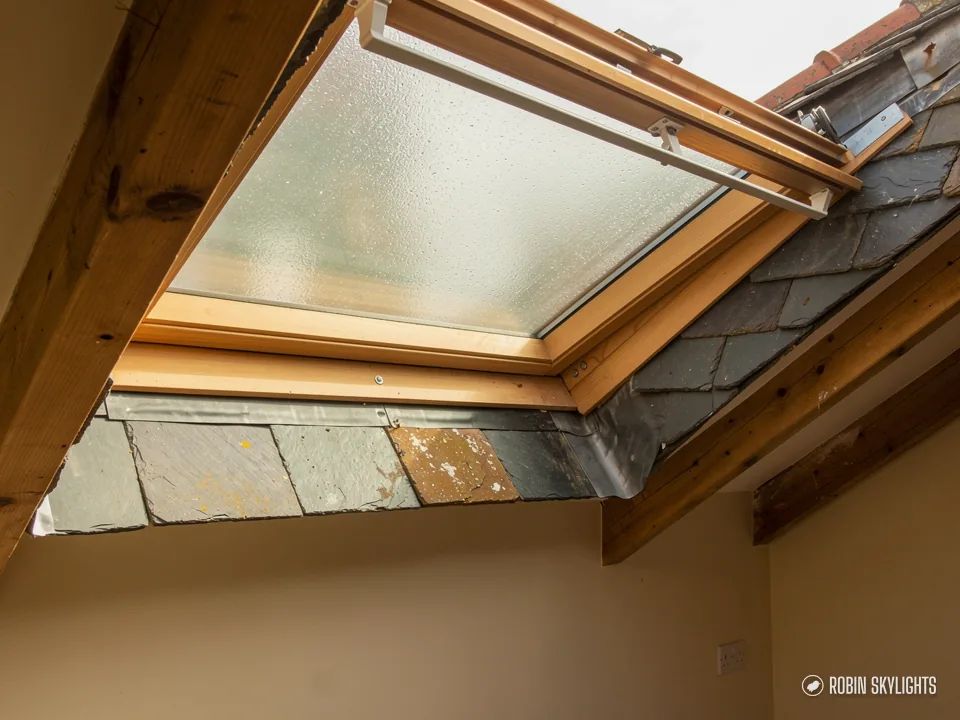
On a pitched roof
A roof window in slates or tiles is closed in by flashings and a soaker or gutter all round. Those parts are fitted to the old frame. A new window of the same size can often reuse the opening, but the flashing kit is normally renewed with it, because old lead and aluminium do not always reseat.
- Upstand (kerb)
- The raised frame on a flat roof that the rooflight sits on.
- Flashing
- Metal or flexible strip that seals the joint between a roof window and the slates or tiles.
- Fall
- The built-in slope of a flat roof that drains rain away.
- Soaker
- A folded sheet that sits under tiles at the side of a window to carry water down.
Sealing and insulation
The gap between frame and roof structure is filled with insulation and taped airtight. This prevents cold air flowing round the unit, and it is the detail that decides whether the new rooflight feels warm to stand under. Inside, the lining or splay of the opening is dressed back to match the ceiling.
Leaks that look like misting
Sometimes a wet-looking pane is not a failed seal at all: a leak at the flashing can run down inside a roof window and fog the inner face. We trace which it is before we quote.
06
Glazing and winter condensation after replacement
A new unit should leave the room warmer and the glass drier.
A new sealed unit will not stop condensation forming on the room side of the glass in a damp room. What it does is make that film less likely, because a modern unit keeps its inner pane warmer.
Why the inner pane matters
Moisture condenses where a surface is colder than the air's dew point. In a house with kitchen steam and drying laundry, the coldest pane of a single-glazed or tired double-glazed rooflight is the first to run with water. An efficient unit has a low-e coating on one of its inner faces and an insulating edge spacer, which together keep the room-side glass warmer, so the dew point is reached less often. A cold edge is where misting and mould usually begin, and a warm-edge spacer deals with it directly.
Glazing and energy performance
The U-value is how fast heat passes through a given area of glass. The lower it is, the better the pane holds heat in. Replacement rooflights have to meet the energy ceilings quoted in the regulations chapter, and many units now beat them comfortably. The extra insulation around the frame matters just as much as the glass, because a good pane in an uninsulated surround still leaks heat.
Benefits of natural light after the swap
Swapping hazy glass for clear glass adds natural light straight away. A tint or solar coating takes some of it back, so we recommend one only where a room truly overheats in summer, such as a south-facing extension. For most Nottingham homes the grey months matter more, and clear low-e glass is the better choice.
Keeping it clear
A new unit is low maintenance. Wash the outside with water and a soft cloth, keep leaves and moss from the upstand and keep trickle vents or an extractor working in damp rooms. If the house produces a lot of moisture, ventilation does more good than any glass.
The guarantee
The work comes with our 10-year workmanship guarantee, in writing.
07
Installation day, and the room afterwards
No surprises: the survey has already been through the hard parts.
Because the survey comes first, the day itself is mostly a matter of carrying out the quote. We do not turn up with a vague idea of the job.
Before we start
We agree where dust sheets go and how we reach the roof. Inside, we ask for the room under the rooflight to be cleared enough to work safely, and we cover what must stay. Outside, access is by ladder or scaffold, depending on the roof and the height.
Taking out the old unit
The old glass or whole frame comes out first. For a flat rooflight, that means releasing the fixings, lifting the unit off the upstand and checking what lies beneath. For a roof window, the flashings and the sash are removed with care so the slates or tiles around the opening stay in place. If anything is different from what the survey found, we explain it before going on, so the fixed price stays fixed.
Fitting the new one
The upstand or opening is prepared, insulated and made level, then the new rooflight is seated, fixed and sealed. On a flat roof the membrane is turned up the kerb and welded or bonded; on a pitched roof the flashing kit goes in layer by layer from the bottom up. This is the installation stage that must not be rushed, because it decides whether the weatherproof seal is good for years or only for the first storm.
The ceiling and the finish
Where the opening has a lining, it is made good, and the room is left tidy. Plaster that was cracked before we began stays a job for a decorator, but a straightforward like-for-like swap rarely disturbs the ceiling, which is the subject of what a swap leaves on the ceiling.
Why choose us: a signed-off job
Once the work is done we confirm with Building Control where notifiable, and you receive the guarantee in writing.
08
Where misted rooflights turn up around Nottingham
Residential first, with commercial roofs welcome.
Clouded glass is a feature of age and of conditions, so it appears wherever rooflights were fitted a while ago. The house types we most often meet it on are worth listing, because each has its own detail.
Extensions on terraces and semis
Rear extensions on the terraces of Sherwood, Sneinton and Carrington, and on the semis of Mapperley and Arnold, often carry flat rooflights or an early roof lantern set over the kitchen or dining space. Those roofs are low and warm, and the glass on them has seen a lot of cooking steam and a lot of sun. Our flat roof rooflights page describes the replacement units in detail.
Inter-war and post-war suburbs
Roof windows in loft rooms are common in the bungalows and chalets around West Bridgford, Beeston and Bramcote. Those windows tend to be older timber or early metal-framed designs with frames that have outlasted their glass, so they suit a straight replacement. Our page on roof windows sets out the options.
Conservation areas
Streets in the Park, Lace Market and Wollaton Village sit inside conservation areas, and a few of those carry Article 4 directions that remove the permitted right. A new unit that sits where the old one did, in a matching finish, suits an older roof, and we check the Article 4 list before ordering.
Commercial roofs
Small commercial buildings such as workshops, offices and units on trade estates sometimes have a row of flat rooflights above the work area. We take on commercial work alongside residential jobs, and the survey and fixed quote process is the same.
Areas covered
Our patch is Nottingham plus thirty miles by road. The full list is on our areas we cover page, with town pages such as West Bridgford and Beeston. If your house is somewhere between, send the postcode and we will tell you.
Guides and straight answers on replacing a clouded rooflight




Misted rooflight FAQs
How much does it cost to replace a misted rooflight?
It depends on the size, the glass, the frame and what the roof around it needs, so we do not quote from a photograph. Once we have surveyed the roof, at no charge, the quote arrives in writing at a fixed figure that holds on the day. Our cost guide sets out what moves the price from one job to the next.
Can I replace just the glass in a misted rooflight?
Sometimes. Where the frame is in good order and the glazing is a loose sealed unit, the glass alone may do. If the frame is tired or the unit is bonded in, the whole rooflight goes. We tell you which at the survey and put it in the quote.
Will a new skylight reduce energy bills?
Modern glass holds heat better than the unit it replaces, and the insulation around the frame helps as well. We cannot promise a figure for your house, because heating costs depend on much more than the roof glazing, but the room does feel warmer.
Does the guarantee cover replacement work?
Yes. The installation carries our written 10-year workmanship guarantee. The terms are on the guarantee page.
Do I need Building Regulations approval to replace a rooflight?
Replacement windows and rooflights are controlled work, so yes. Replacement rooflights count as controlled work. Where the job is notifiable, we make the filing with Building Control ourselves, to the council or a registered building control approver, and the new glass goes in to current standards.
Do you do commercial work as well as homes?
Yes. Residential jobs come first, and small commercial roofs such as offices and workshops are welcome. The process is identical: a free survey, then a fixed written quote.