Hucknall: 7.9 road miles out, north-north-west of Nottingham's centre
Rooflights and skylights for Hucknall homes
A former pit town on the Leen, with a great deal of housing and industrial estates along its south side. Plenty of rooms here sit under a roof and still stay dim from November to March.
Two pits sunk, and a town grew around them
The Hucknall Colliery Company sank its first shaft in 1861 and a second in 1866, and the last pit shut in 1986. The town grew up around that coal, and much of it was laid out for people, not for daylight.
Hucknall, from the pit head to the roof ridge
Hucknall is a market town in Ashfield with 35,848 people on record. It has its own tram stop, its own station and its own hill, so it does not feel like a suburb of anywhere. What follows runs through the pits and the housing they left, the setting on the Leen, the council, the road in, and what we usually recommend. If you want the wider picture first, read about skylight installation in Nottingham.
01
Pit town, then estates: the housing you find here
Coal made Hucknall. Top Pit was sunk off Watnall Road in 1861 and closed in 1943. Bottom Pit followed off Portland Road in 1866 and kept working until 1986. Branch lines and sidings once served the collieries and factories across the wider Ashfield district, and the town grew to house the people they employed.
Housing and several industrial estates run along the south side of the town, and the roofs above them vary a great deal. A survey here starts with the roof in front of us: its covering, its pitch, the line of the gutters and the way a ladder or scaffold can reach it.
Estates and what they do to a ground floor
Where a town grows by estate, the plans repeat. Rooms sit in the same places from house to house, and so do the dark spots: the middle of the ground floor, the landing, the bathroom that was pushed to the centre of the plan to leave outside walls for the bedrooms. A single rooflight in the right place can cure that, and because the layouts repeat, a neighbour's house is often a useful guide to what will work in yours.
Extensions are where the gain is
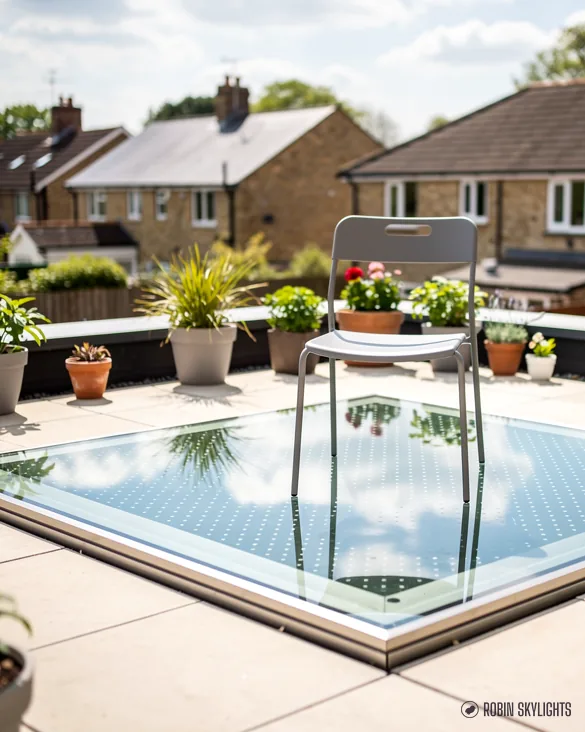
A kitchen pushed out into the garden gets deeper and darker as it goes. If the extension roof is flat, a flat rooflight set over the far end gives the back of the room its own daylight. Where the roof is pitched, a roof window in the slope does the same work. The page on flat roof rooflights shows how the kerb and glass are built up.
Before ordering, we measure the opening and trace how the roof is framed and drained. The quote comes last.
- Kerb
- The low timber box on a flat roof that raises the glass clear of puddles.
- Trimmer
- A short beam across a new opening that takes the ends of cut rafters.
- Infill
- New houses built on a gap or old plot between existing ones.
Weather on the ridge side
Hucknall roofs on the higher ground take wind-driven rain, and the ridge end of a slope takes the worst of it. We plan flashings with the exposed side in mind and note where a neighbour's chimney or gable sheds water across your slope. Once the unit is in, you should see little from the garden but a clean line of glass sitting level with the tiles, which is how it should look.
02
On the Leen, up to Long Hill
Height changes how a roof is exposed, and Hucknall climbs.
The town sits on the west bank of the Leen Valley, on land that rises from the Trent Valley in the south towards Kirkby-in-Ashfield in the north. The River Leen runs close to the centre. The highest point is Long Hill at 140 m above sea level, with views back over the city and the Trent Valley, which drops to around 22 to 24 m.
Nearby hills carry names too: Leiver's Hill and Misk Hill both lie within about 3 km. Open ground is close as well. Washdyke Recreation Ground and Titchfield Park are each 0.9 km from the centre, and The Ranges is 1 km away. Moorbridge Pond Nature Reserve and Springfield Corner sit about 3 km out.
Exposure on a hillside
A house high on a slope takes more wind and rain across its roof than one tucked into the valley floor. That matters at the edge of a rooflight, where the flashing meets tile or slate. On a pitched roof in an exposed spot we choose a flashing kit that matches the covering, and we make sure the lead or aluminium laps are generous enough for driven rain.
Light under a grey valley sky
On a damp day the valley holds cloud low, and the sky behind the house is the same flat white as the sky in front. That is useful for a rooflight. Because the light is even, a wide window in the roof lights a room evenly instead of throwing a bright patch onto the floor and leaving the corners dark. A larger opening is often worth more than a smaller one, and the extra glass is balanced by a good glazing unit that keeps the pane warm on winter nights.
03
Which council decides, and what is on the record
Your planning authority in Hucknall is Ashfield District Council. The town sits in Nottinghamshire, and the council covers the planning and Building Control questions that come up with a new opening in the roof.
Conservation and listing, as recorded
The closest conservation area recorded to the town centre point is Linby, about 1.4 km away. It was designated in 1972, contains 24 listed buildings, a pair at the higher II* grade, and takes its name from the neighbouring village, not from Hucknall. Historic England has nine listed buildings on record around the centre point, counted to 1.5 km, one at Grade II* and eight at Grade II.
Linby belongs to the neighbouring village rather than to Hucknall itself. If your house is listed, consent comes first; otherwise we check Ashfield's Article 4 list for your road before a rooflight is ordered.
9listed
listings found near the centre
1.4km
away, the nearest conservation area (Linby, 1972)
Rules that apply everywhere
The law on rooflights in houses, and the Building Regulations behind them, is the same in every English town. We keep it on one page, what permission a rooflight needs, so it stays correct. In Hucknall we supply the local part: the council, the slope and the paperwork route.
Should the job need a Building Control notice, we send it ourselves, through Ashfield or a registered building control approver, and the fit follows current regulations. You never chase a form.
04
Getting to you, by the B6009 and the bypass
Heading out of the city, Hucknall is about 7.9 miles by road to the north-north-west, and around 20 minutes' drive on a normal day. The B6009 runs close to the centre. The town used to stand on the A611, which now bypasses it to the west with a single carriageway and roundabouts, and a link to junction 27 of the M1 about 3 miles away.
Hucknall has a railway station and a NET tram stop, both about 0.5 km from the centre, with a second tram stop at Butler's Hill 1.5 km out. We come by van with ladders and glazing, so those serve you rather than us, but they tell you the town is well connected for the other end of the day, if you commute.
What the survey involves
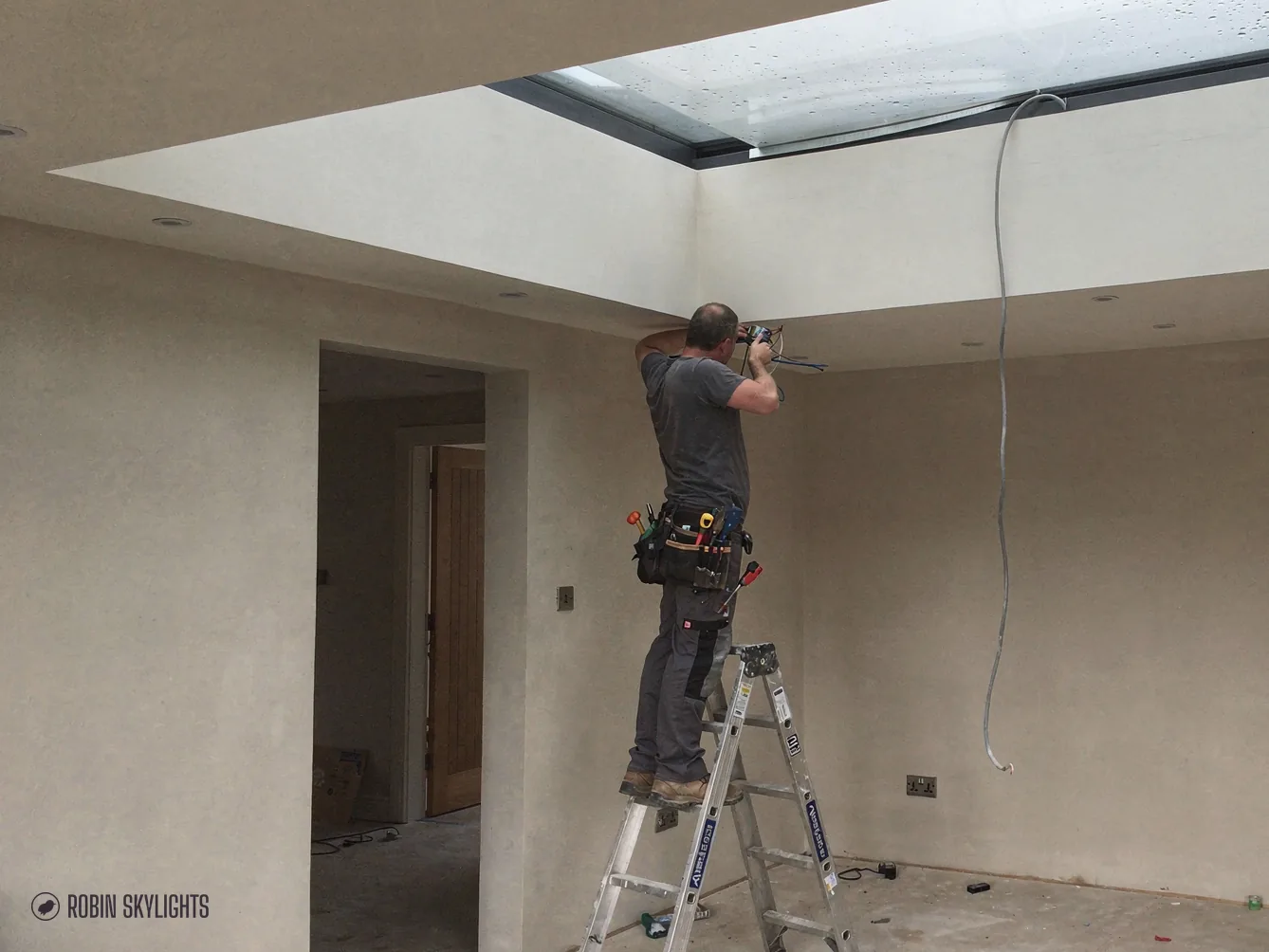
The free survey comes first. We look at the room and how the light falls through it, then at the roof: the covering, the structure and how rainwater leaves. Then we put a fixed quote in writing and hold to the figure. No price is named until we have seen the roof.
7.9miles
road miles to Hucknall
20minutes
drive, traffic allowing
Titchfield, Washdyke, Beardall Fields and the rest
Hucknall has many named parts, from Titchfield and Washdyke to Beardall Fields, Hillside, Farleys, Hazelgrove, Wighay and Broomhill. All of them are inside our 30-mile area, along with the surrounding villages. The areas we cover page maps the wider spread.
| Area | Type | Distance |
|---|---|---|
| Titchfield | Suburb | 0.7 km |
| Washdyke | Neighbourhood | 0.8 km |
| Beardall Fields | Neighbourhood | 0.8 km |
| Butlers Hill | Suburb | 1.2 km |
05
What tends to suit the houses here
In housing like this, three dark spots are worth checking first. Each starts with a dark spot and ends with a product that suits it.
The extension at the back
A deep kitchen or family room in a rear extension needs light from above because the garden window cannot reach the far end. A roof lantern takes sky from several sides and lifts the ceiling, and a large flat rooflight does a plainer version of the same job. Either one can be sized to the room, not to a catalogue.
The room in the roof
A loft bedroom or study under a pitched slope works best with a roof window. Set low enough to see out from a chair, it brings in sky as well as light. If you already have an old one that has misted or leaks, a new unit can often go straight into the old opening, and we will tell you on the survey whether that is the case.
The landing and the inside bathroom
Estate plans often leave these two with no window. A sun tunnel needs only a small dome on the roof and a tube down to the ceiling. If the room is directly beneath the slope, a small roof window is the other route.
The guarantee
Whatever goes in, we back the fitting with a written guarantee that runs for ten years. On installation day we cover the room below, keep the opening weathertight at the end of every working period, and leave the roof as watertight as we found it or better.
Questions we hear from Hucknall homes
Is it Ashfield or Nottingham that deals with a new rooflight in Hucknall?
In Hucknall the planning authority is Ashfield District Council. If your house is listed, or the street has an Article 4 direction, a new opening is treated differently, so the address matters. We check your address with Ashfield before ordering, and we handle the Building Control notification for you where the work is notifiable.
The back of our extension is always gloomy. Where should a rooflight go?
Usually over the part of the room furthest from the garden doors, because that is where the daylight gives out first. On a flat roof that means a flat rooflight or a lantern set over the far third of the room. We stand in the room on the survey and watch where the light stops before suggesting a position.
Our bathroom is in the middle of the house. Can it get daylight?
Often, yes. A room under a slope can take a small roof window. If there is a loft over it, a sun tunnel runs a reflective tube down through the roof space to a panel in the ceiling. The survey shows which fits.
Do you work in Titchfield and Beardall Fields as well as the town centre?
Yes. Every part of Hucknall is within our 30-mile area by road, and so are the villages around it. We come to your home for the survey, which costs nothing, and there is no showroom for you to go to.