11.1 miles to the north-west, out past the A608
Skylights & rooflights in Brinsley
A village on the edge of Broxtowe that spills over into Ashfield, with walking country on its doorstep. Homes out here often have a dim room or two that never earn a second look until winter.
A village that keeps its headstocks
The Friends of Brinsley Headstocks have worked on turning the headstocks area into a nature reserve, and walkers explore the countryside around it. Our interest is closer to home. A village house has a roof and a dark room under it, and a good rooflight turns that room into somewhere you choose to sit.
Brinsley, a village on two councils' maps
Brinsley is a village and civil parish of 4,514 people. It is divided: Old Brinsley falls within Broxtowe and New Brinsley within Ashfield. That single fact shapes the planning side of any job here, so the chapters begin with the road in and the boundary. After those come the setting, what roofs in a village need, and the products we would pick. If you have not met us before, start with skylight installation in Nottingham for the general picture.
01
One main road and no station
Only one classified road, the A608, runs close to the middle of Brinsley, and it is the route we take. Measured along roads from the heart of Nottingham the village is 11.1 miles off to the north-west, which is usually a drive of about 23 minutes. No railway station or tram stop lies within two kilometres on the map, so nobody visits us by train and we do not turn up on one either. The van does the work.
What distance means for a visit
For us eleven miles is an ordinary survey trip. We book a time that suits you and allow for the single main road, which can slow at short notice. What we can say is that we plan the day around the visit, and we give you notice of when to expect us.
A village survey also tends to be unhurried. At booking we ask about parking for the van and a side route to the back garden.
11.1miles
of road to the north-west
23minutes
average drive when roads are clear
0stations
rail or tram stops within 2 km on the map
What the survey covers
You pay nothing for it. We start in the room and mark the spot where the daylight gives up, then climb to the roof and check the slope, the covering, what the structure underneath is made of and how water leaves it. The quote that follows is written, and the price in it is fixed. If we cannot see why a rooflight would help, we will tell you so.
The neighbouring villages and towns on the same run are on our page of covered areas.
02
Two councils in one village
1979designated
Brinsley conservation area, 0.21 km from the centre
5Grade II
listings on the record across a 1.5 km radius
Most villages answer to one local authority. Brinsley answers to two. Old Brinsley is in the Broxtowe borough, and New Brinsley is in Ashfield. Broxtowe Borough Council is the planning authority for the village centre, but a house on the New Brinsley side belongs to Ashfield District Council instead. Before we recommend anything for a roof, we confirm which side of the line the address falls on.
That matters because the answer to a planning question comes from the council whose area you live in. The national permitted development conditions are the same everywhere in England and are explained on our planning permission guide. What differs by council is the local record: who holds it, and how they treat a particular street.
The conservation area and listed buildings
A conservation area called Brinsley was designated in 1979, and it sits just 0.21 km from the village centre point. The record shows no listed buildings inside it. Historic England lists five buildings across a 1.5 km radius, all of them Grade II.
If your home is one of the five, listed building consent comes before any cutting. A house inside the conservation area keeps its permitted development right unless an Article 4 direction removes it, so we check the right council's Article 4 list before any rooflight is ordered.
Building Control
When a job is notifiable, the notice is ours to send, whichever inspecting body takes the job, and we build to the regulations in force today.
03
Reserves, flashes and the Erewash
Open ground, wet weather and what weather does to a roof.
The countryside around Brinsley gets used. Leisure walkers explore it, and D.H. Lawrence Heritage organises walks here. The Friends of Brinsley Headstocks have worked on turning the headstocks area into a nature reserve, and it lies only 0.4 km from the centre. Aldercar Flash Nature Reserve is 1.2 km away and Colliers Wood 2.2 km. The River Erewash is near as well.
Open land and water nearby affect roofs, mostly through plain weather. There are fewer buildings to break the wind, and more of the damp that comes off wet ground on still mornings.
Exposure and the flashing
On a pitched roof, a roof window is sealed to the tiles or slates with a flashing kit, made to match the covering. When wind drives rain up the slope, the quality of that seal matters more than the glass. We fit the kit the manufacturer specifies for your covering and check the laps rather than relying on sealant.
Condensation in a damp setting
Damp ground means steam lingers indoors. Whatever room makes plenty of it will mist the coldest glass first. A sealed unit with warm edges keeps the inside pane warmer, and a rooflight that opens lets the room clear itself. Our guide to replacing misted rooflights explains how to tell a failing seal from ordinary surface condensation.
Walkers' boots and the hall
Muddy boots and wet dogs come in from the paths, and a hall or landing that dries slowly stays dim. Light from above helps a damp passage dry, and it makes the way to the back door easier to see. Pale paint on the hall walls carries that daylight further into the house.
04
Reading a village roof before we price it
Every roof here gets read from underneath before it is priced, which is how we work in any village. A single street can hold a bungalow, an older cottage, a pair of semis and a recent infill house, and each takes a rooflight differently.
Bungalows and chalets
A bungalow has a single storey, so rooms in the roof space can sometimes use a roof window for escape as well as light. That depends on the height of the floor above the ground and the size of the opening, and it is a point to settle on the survey. For a loft being converted, our guide to roof windows for loft conversions sets out what to decide first.
- Truss
- A factory-made frame of timber that spans the house and carries the roof.
- Rafter
- One of the sloping timbers that carry the covering down to the wall plate.
- Chalet bungalow
- A bungalow with rooms built into its roof space.
- Flashing kit
- The set of metal or rubber pieces that seal a roof window into its covering.
Older cottages
An older roof frame can be uneven. We measure the actual gaps between the timbers and pick a window that fits between two of them. Where an old beam blocks the wanted position, we move the opening a little rather than cut into the beam. Seen from the lane or the back garden, a new window in an old roof should sit flush with the tiles, with a flashing in a matching tone, so it looks as if it has always been there. Before we leave, we check the gutter line below the opening, because a tidy edge there keeps rain from tracking back under the tiles.
Newer infill houses
Modern roofs are often made of factory trusses. These are engineered as a set, and cutting one changes how the whole roof carries load. We plan around the trusses, or involve a structural engineer where an opening needs a member removed.
Why look at all
The reason for reading a roof properly is simple. A rooflight is an opening in the part of the house that must stay dry. If the work is planned before it is priced, there are no surprises once the covering is off.
05
Which rooflight suits which room
Work starts with the room and the light it lacks. Three products cover most of what a village home asks for.
A kitchen at the back
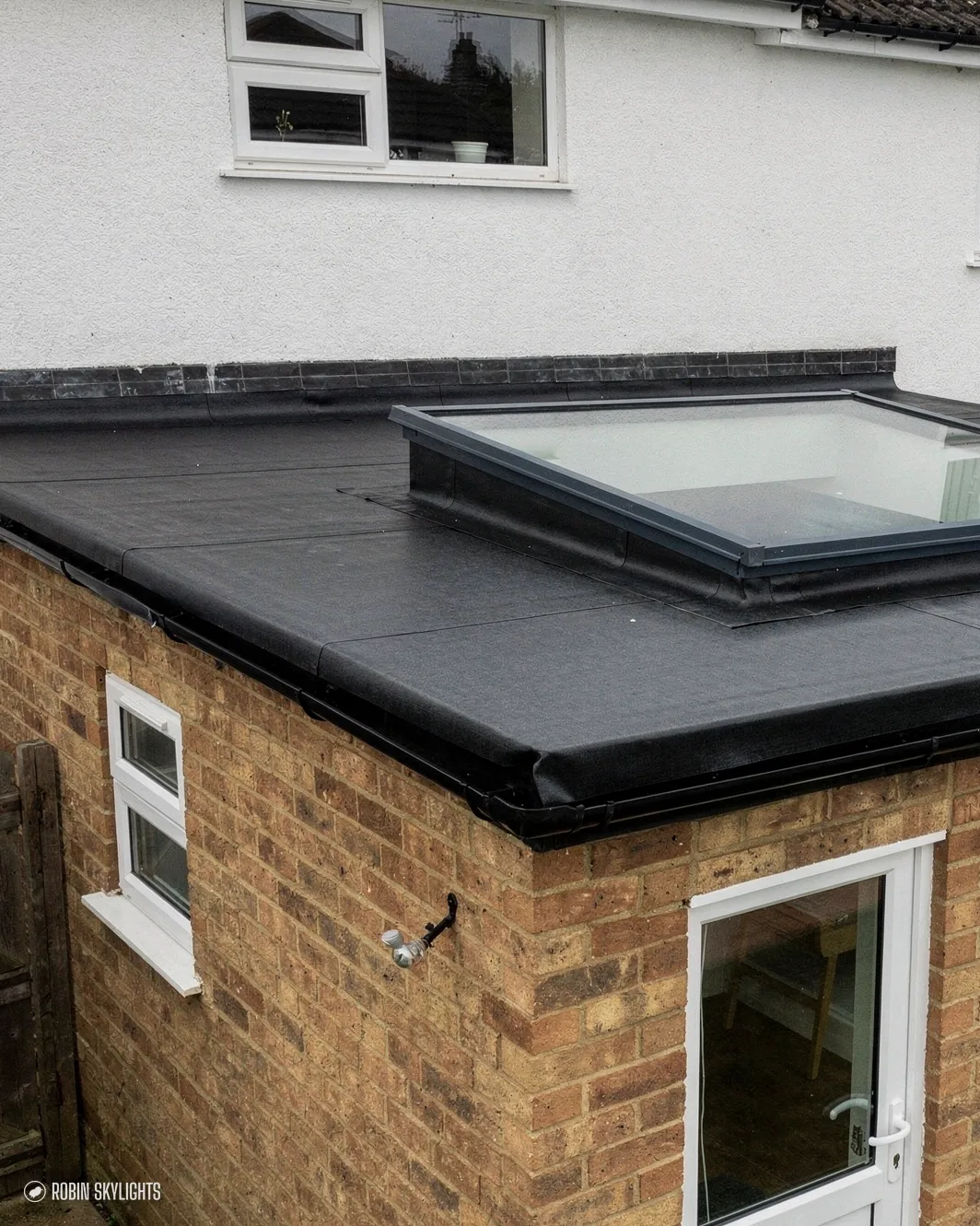
A flat-roofed rear extension is a common place for a long, dim kitchen. A flat rooflight sits over the far end, where the back doors give up, and spreads sky across the worktops. When the roof is wide enough, a lantern gives more height and more glazed faces. See roof lanterns for sizes and how they are kept watertight.
A bedroom in the roof
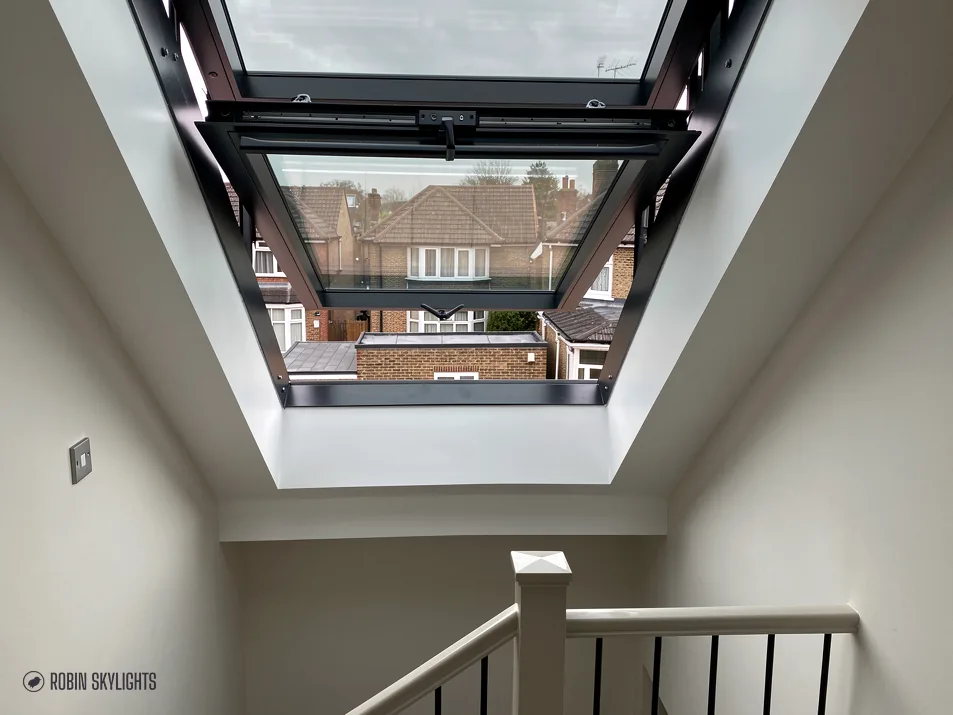
A roof window in the rear slope brings in sky and gives you an opening for fresh air. Choose a height that lets you see out when seated, and a blind will cope with bright summer mornings.
A landing without a window
A sun tunnel suits the centre of a house, where no outside wall exists. A small dome sits on the roof, a reflective tube runs down through the loft and a diffuser spreads the light across the landing ceiling.
When a Brinsley rooflight has fogged or tired
If an existing rooflight has fogged or the frame has aged, we can often fit a new one into the same opening. The decision is made on the survey, and the work carries a ten-year guarantee on workmanship, in writing.
The photographs below show how a finished unit looks from the garden and from the room underneath it.
Brinsley, Old and New: what people ask us
I live in New Brinsley. Does Broxtowe still decide my planning?
Not necessarily. New Brinsley sits in Ashfield, while the older part of the village is in Broxtowe. Send the address and we find out which council covers it before we advise. The permitted development conditions are the same either way, but the local records and the contact at the council are different.
Is the village conservation area likely to affect a rooflight?
Usually not. The Brinsley conservation area dates from 1979 and holds no listed buildings, and a house inside it keeps its permitted development right to a rooflight on any slope. Only an Article 4 direction changes that, so we check for one with the right council before ordering.
Can a bungalow roof space get a window that works as a fire escape?
Sometimes. It depends on how high the room's floor is above the ground and on the size of the opening, and these are Building Regulations points that we measure on the survey. We would rather tell you honestly after seeing the room than promise it from a phone call.
How do you handle a survey in a village with no train station?
We drive. Brinsley is 11.1 miles of road from the city centre, on the A608 route. The survey costs nothing. Tell us where the van can stand and how to reach the rear, and we will fit the visit around you. The price is written down and fixed afterwards.