Grantham sits due east, 24 road miles from Nottingham city centre
Skylights & rooflights in Grantham
Grid-plan Victorian terraces, Edwardian villas and garden-city estates, with a long list of protected buildings at the heart of it. Grantham's roofs ask for care, and its back rooms ask for light.

A market town on the Witham, with ironstone at its edges
The rising ground on Grantham's eastern and southern fringes carries marlstone, a sandstone rich in iron, and its streets carry Victorian brick, Edwardian villas and post-war estates. Every layer of building has its own kind of roof, and none of them were drawn with a rooflight in mind.
Grantham, from terrace to estate
Lincolnshire's Grantham counts 44,906 residents, a market town within the South Kesteven district and one of our longer drives. Its housing runs from planned Victorian terraces to estates drawn up under garden-city ideas. Below we go through each, then the heritage list, the high ground, the road out and the products that suit. To meet the firm first, read about skylight installation in Nottingham.
01
Workers' terraces, Edwardian villas and garden-city estates
Grantham's suburbs were built in distinct waves, and you can read them street by street.
South of the town centre, the housing is late-Victorian and Edwardian brick, in terraces and villas set out on a grid. It was first built for industrial workers, and these days a good part is privately owned or let. Streets cluster around the railway station and the retail and industrial units nearby, in the area called Spittlegate, as well as along Harlaxton Road, Wharf Road, London Road and Bridge End Road.
Round Belton Lane and Harrowby Lane the picture changes. The housing is low-density, a mixture of pre-First World War, inter-war and post-war homes. The large estate beyond, and the Cherry Orchard Estate, belong to the years just after the war. They were laid out at medium density on a plan inspired by the garden city movement. The housing estates west of the centre were green fields until the 1970s.
Reading a street before a survey
Streets laid on a grid have a regularity that helps us. Neighbouring houses often share a roof pitch, a ridge height and a rear addition, so what one roof tells us is a useful guide to the next. We still measure each one, because alterations over a century are rarely the same twice, but the survey goes faster when we know the pattern.
Green Hill, Earlesfield, Gonerby Hill Foot, Cherry Orchard, the Harrowby Estate, Beeden Park and Alma Park are the neighbourhoods recorded around the town point. All of them are inside our reach.
| Area | Km out |
|---|---|
| Green Hill | 0.7 km |
| Earlesfield | 1.4 km |
| Cherry Orchard | 1.7 km |
| Harrowby Estate | 1.7 km |
| Beeden Park | 1.9 km |
| Alma Park | 2.5 km |
What the terraces ask of a rooflight
A Victorian brick terrace usually has a long, narrow plan, a steep slope and a back addition behind it. The room at the end of that addition is the one that stays dark. An opening in the rear slope, or a flat rooflight over the extension, puts the light where the back door and a small window cannot.
What the estates ask
A later post-war house may have a shallower roof and trussed rafters. We cannot saw through those, so the survey identifies the roof frame before a size is named. A pitched roof of that kind can take a roof window between the trusses, but the layout has to be checked on site.
02
South Kesteven, two conservation areas and 179 listed buildings
157listed
buildings inside the Grantham conservation area
7Grade I
among them, the highest listing grade
179listed
listed buildings across the wider centre
Grantham is in Lincolnshire, so the planning authority is South Kesteven District Council. Nottingham's councils hold no authority here.
The scale of the list
The Grantham conservation area covers the town centre. Historic England records 157 listed buildings inside it: seven at Grade I, four at Grade II*, 144 at Grade II and two with no grade given. Seven of them hold Grade I, the top listing grade. Grantham St Anne's, a second area starting 0.38 km from the centre, adds four, all Grade II. Both lie within half a kilometre of the centre.
Widen the view and Historic England has 179 entries around the centre: seven Grade I, four Grade II*, 165 Grade II and three ungraded in the record.
What that means in practice
A listed roof needs consent before a roof opening is formed, and inside a conservation area we first establish whether your street is covered by an Article 4 direction. In a town with this much recorded, we do not assume. We ask which category your address falls in, then check with South Kesteven before ordering, and where no direction applies, the light in the room decides the slope.
The general rules for rooflights are in our planning permission guide, in one place so they remain accurate. If the job must be notified, we send the notice to South Kesteven or a registered approver, so you have nothing to file.
03
The Witham, the Vale of Belvoir edge and the hills round the town
A town on a river, fringed by high ground.
Grantham stands on the banks of the River Witham, which runs close to the town centre. On one side the town is close to the low-lying Vale of Belvoir, and above it an escarpment rises, in places to over 100 metres, forming the hills where Barrowby, Great Gonerby, Green Hill and Earlesfield are built, along with the business parks off Trent Road.
Close in are four parks: The Paddock, Alexandra Road Play Area, Wyndham Park and Dysart Park. Hall's Hill, Stubbock Hill and Mill Hill lie a little further out, and the Hills and Hollows nature reserve is about 1.8 km away.
Height, wind and wet
Houses on rising ground feel the weather more than houses in a hollow. A roof window on an exposed slope needs flashing cut to the tile or slate beneath it, and the fixings have to be firm. We pay particular attention to the edge detail where the covering meets the window frame, because wind-driven rain finds a weak seam.
- Escarpment
- A long slope of high ground, steep on one side, that rises above flatter land.
- Flashing
- The collar of metal or rubber that makes the join between a roof window and the tiles weathertight.
- Trussed rafters
- Prefabricated roof frames, found in many newer houses, that are not to be sawn through.
Light in a valley town
Rooms at the back of a terrace often look out onto a wall, a fence or the next extension. A rooflight lifts the opening above the nearest obstruction, and it reads brighter under cloud because it opens onto a wide piece of sky.
04
Getting to Grantham, one of our longer drives
Grantham lies 24 road miles from Nottingham city centre, due east, and the drive takes around 38 minutes. Three classified roads pass the middle of the town: the A52, the A607 and the B1174. Grantham station sits 0.7 km from the centre, though ladders and glass travel better in a van, so we come by road.
Distance is why we plan Grantham visits as a single outing and not a quick call. We agree a visit window with you and confirm it the day before.
The visit
Nothing is charged. We look at the room you want brighter, find where the light runs out, and then climb to the roof to examine the angle, the covering and the structure. After that you receive one price in writing, and it is the price on the day. Some streets have on-street parking only, so we ask where the van can wait.
24miles
by road from Nottingham city centre
38minutes
drive time when roads are clear
After the fitting
Work is done to current Building Regulations, and a ten-year written guarantee covers our workmanship.
Planning around the drive
Because the trip is longer, we try to bring everything for the survey in one go: ladder, tape, camera and notes. That way a single visit is enough to price the work.
The neighbours
Grantham is among the outer places in our 30-mile ring; the areas page lists the rest.
05
Which rooflight suits which Grantham house
The mix of housing here means no single answer. These are the rooms we would expect to look at first.
The back of a Victorian terrace
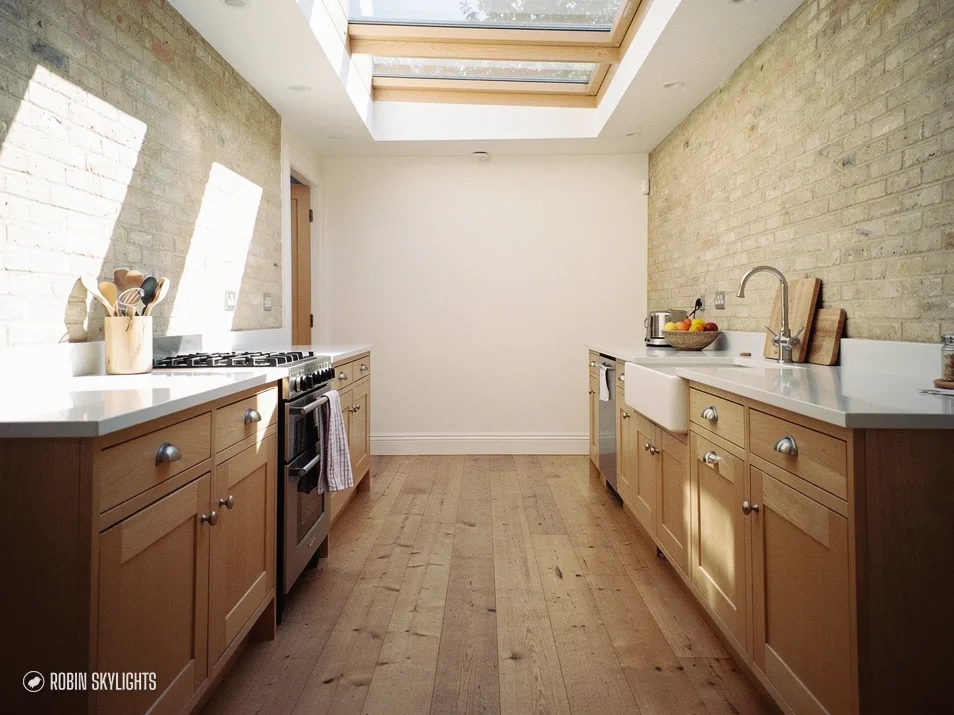
A narrow brick terrace often ends in a lean-to or a flat-roofed kitchen. Over the dark end, a flat roof rooflight brings daylight where the window cannot. If the extension is wide enough, a roof lantern lights it from several faces and draws sky in even under cloud.
A loft room in a villa or semi
Edwardian villas and inter-war semis have loft space that is easy to use. A roof window turns it from a store into a bedroom or study. Placed so you can see out when seated, it makes the room feel like part of the house.
A listed or conservation address
Is the address listed, or under an Article 4 direction? Then a slim, flush unit in a rear slope is the usual approach. Our page on conservation rooflights explains the glazing bars and the profile.
A bathroom or hallway with no window
Victorian terraces often have a bathroom stuck on the back of the house or a hallway that runs between two walls. A sun tunnel serves those without a new window, and it needs only a small opening in the roof and a neat one in the ceiling.
Replacing a tired unit
Yellowed domes and misted double glazing are common in houses that have been altered over decades. Where the opening and frame are in good order, a replacement unit needs no new cutting.
Questions we hear from Grantham householders
With so many listed buildings, will my house be allowed a roof window?
It depends on whether your own house is listed or in a conservation area, not on the town's total. If it is neither, national rules usually apply. If it is listed, South Kesteven District Council has to give listed building consent for a new opening; an unlisted house in a conservation area normally needs no application at all, unless the council has made an Article 4 direction. We check your address first.
Our terrace extension is dark even at midday. What would help?
Light from above the middle of the room, where the end window runs out of reach. A flat unit suits a flat roof, and a lantern suits a wider space. We stand in the room, then inspect the roof, and quote a fixed price in writing for the one that fits.
Is Grantham too far out for a survey?
No. The town is 24 road miles from the city centre, inside our 30-mile reach. Nobody is charged for the survey, and we come to you. Because the drive is longer, we agree a visit window with you in advance and confirm it the day before.
Can an old rooflight be replaced without cutting the roof again?
Often. With a sound frame and upstand, the new unit sits on what is already there. We tell you at the visit if the old kerb is worn or too small for what you want. New or replacement, a written ten-year guarantee covers our work.