East-north-east of Nottingham's centre by 5.2 road miles
Skylights & rooflights in Netherfield
Victorian rows packed between a railway line and an old dyke. The back rooms in those rows get what is left of the sky, and in November that is very little.
Wet ground and wide sky behind long brick rows
Lagoons, meadows and the Trent lie a short walk from Netherfield's streets, so the sky above is wide and often low. Down in the terraces, the back rooms see little of it. A rooflight is how that sky gets indoors.
Netherfield, from the pavement up to the ridge
In Nottinghamshire, Netherfield is a town in Gedling borough, close to the Trent. A railway line marked its edge before most of its houses existed. These five chapters follow the questions we ask before suggesting a rooflight here, starting with the trains and ending with the van. If you want the wider story of what we fit and where, begin with skylight installation in Nottingham.
01
A line, a dyke and very little spare room
The Midland Railway opened its Nottingham to Lincoln route in 1846, and the line became one side of what was later called Netherfield. The place gained its own ecclesiastical parish in 1885. Its other limits are watery. The Ouse Dyke parts it from Stoke Bardolph, and an abandoned course of the Trent once bounded the Hesgang pasture, which belonged for a long time to Radcliffe on Trent.
Take a map of that and you can see why the streets feel squeezed. Houses went up in tight runs between the line and the water, and each row leans on its neighbours for shelter and for shade. Shade is the problem. A window at the back of a terrace looks at a wall, or an extension, or a fence, and the sky above is a thin strip.
Why the roof beats the wall
A wall window can only see what stands in front of it. A roof window tilts up and looks past the chimney stacks at the open sky, so it gathers light that a side window never could. On a grey afternoon, when everything is soft and flat, the amount of sky a window can see matters more than the direction it faces.
Trains and glazing
Where a home sits close to the track and a slope faces that way, glazing becomes a choice worth talking through. On the survey we talk through what each build-up does for noise, so the glazing you choose suits the room it goes in.
A loft room in these rows is usually a job for a roof window. A flat-roofed back kitchen is better served by the flat roof rooflights we fit and replace.
02
Victorian brick rows and their back rooms
The oldest housing here sets the problem, and the rear slope offers the answer.
Much of the older housing in Netherfield is made up of rows of terraced Victorian houses. They are narrow and deep, and they run in long unbroken lines. The front room has the street. The back room has whatever squeezes between the rear wing and the neighbour's gable, which for months of the year is almost nothing.
One wartime event left its mark on these streets. A single bomb came down at the corner of Cross Street and Dunstan Street and flattened six houses. They were never rebuilt, and the plot became a children's play park. It tells us something useful: a street that looks uniform may hide gaps, repairs and altered roofs.
Reading a back slope
On a terrace, new daylight usually goes in the rear slope. We check the pitch, how the slates or tiles are laid, and where the rafters sit relative to each other. Older roofs often have timbers spaced by eye rather than to a plan, so we fit the opening to the real gaps and avoid cutting more timber than needed.
The extension behind the house
Where a kitchen or utility room has been built out at the back, that is the room that suffers most, because the extra depth pushes the far end well away from any window. A lantern over that far end lights the stretch the back door cannot reach. Our page on roof lanterns sets out how they are built.
If an older unit has clouded inside the glass, it can often be swapped on the same opening. The survey is where we find out which route fits your roof.
03
The council behind the decision, and what is on file
Planning here is handled by Gedling Borough Council. Netherfield sits inside that borough, so anything touching permission or Building Control goes through Gedling, not through the city.
Listed buildings and the town centre
No conservation area is mapped near the middle of Netherfield. Even so, we walk the street and ask Gedling before anything is ordered, because a quick check at the start beats a stopped job later. Ask three things of the house: is it a flat, is it listed, does an Article 4 direction cover it? Those checks settle most of it.
Historic England has eleven listed entries around the town centre: one Grade I, nine Grade II, and one with its grade not recorded. If you own one of them, listed building consent must come first for any roof opening, which means a conversation with Gedling well before a van turns up.
11listed
Historic England listings in the town's neighbourhood
Where the general rules sit
What a householder may do without applying, and what Building Regulations ask when a roof is opened up, is the same in Gedling as anywhere in England. We have gathered that in one guide to planning permission for rooflights, and we kept it separate on purpose so one page stays correct. On a Netherfield job, the local questions are narrower: which slope, which authority, and whether the council needs telling.
When it does, we send the notification, to whichever Building Control body is dealing with the job. The finished rooflight is built to current Building Regulations, and you get the paperwork afterwards.
04
Meadows, lagoons and damp air on the glass
Water is never far from Netherfield. The Trent is close, and so are green places to walk. The Meadow Nature Reserve is 1.2 km out, the Netherfield Lagoons 1.9 km, Gedling House Woods and Meadows 1.7 km, Colwick Woods 2.2 km and Skylarks 2.6 km. Closer in are Conway Road Recreation Ground at 0.4 km, Burton Road Public Garden and Jubilee Park, Willow Gardens and Colwick Rectory Recreation Ground.
Low wet ground and a lot of open sky is a combination that suits rooflights and tests them at once.
Condensation on cold panes
Of all the surfaces in a house, the glass runs coldest, so steam from a shower or a boiling pan lands there first. A warm-edge spacer in the glazing unit holds the inside pane closer to the temperature of the room. Letting damp air out is the cure: a roof window that opens, or a vent in the frame, sends steam outdoors before it can condense into drips. In a bathroom or kitchen, that detail is worth more than a bigger pane.
| Place | Kind | Distance |
|---|---|---|
| Conway Road Recreation Ground | Park | 0.4 km |
| The Meadow | Nature reserve | 1.2 km |
| Netherfield Lagoons | Nature reserve | 1.9 km |
What falls on the roof
Trees near parks drop leaves, and leaves clog the places where water should run. On a pitched roof we match the flashing set to your tile or slate, so water carries debris past the window. On a flat roof we raise the kerb so ponding stays well under the glass line, and we form the finish to fall away.
Wet seasons also bring moss. A light brush each autumn keeps a rooflight working properly, and we are happy to show you where to look at the end of a job.
05
Which of the three suits which room
We begin with the dark room, not with a catalogue. For housing like Netherfield's, three products cover most of what we are asked about.
Loft room or top bedroom
A roof window in the back slope brings a view of the weather and a way to let fresh air in. Set low on the slope so a seated person sees sky, it transforms nothing but makes a loft room easier to live in through short days.

Back kitchen or extension
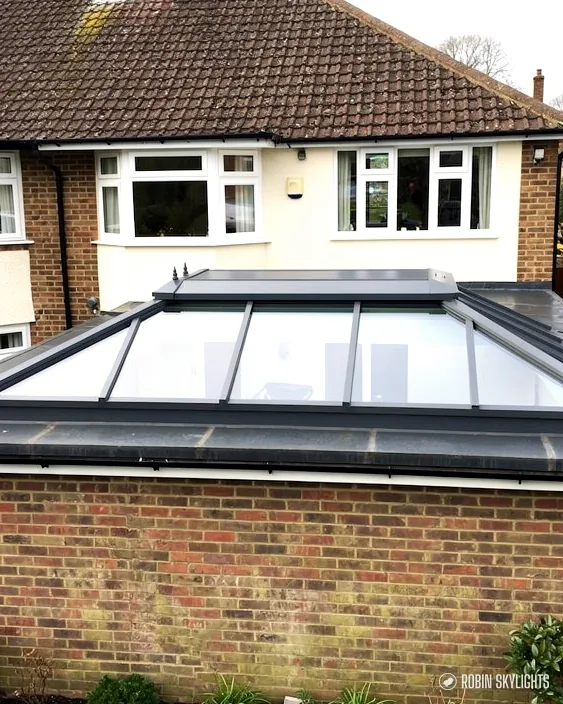
A flat rooflight, or a lantern if the ceiling can take one, draws light in from above and from several sides. That is why these read bright even under heavy cloud.
- Diffuser
- The frosted ceiling disc where a sun tunnel's light spreads into the room.
- Kerb
- The raised timber or insulated frame that lifts a flat-roof rooflight clear of the surface.
- Spacer
- The strip between two panes in a sealed glazing unit.
Landing or internal bathroom
A terrace landing often has no outer wall at all. A sun tunnel fits there: a dome on the slope, a mirrored tube below it, and a frosted disc in the ceiling. The roof barely changes. The landing does.
Getting a survey done
Netherfield and Carlton stations are both a few hundred metres from the centre, and the A612, A6211 and B686 pass close by. The drive from the city centre is 5.2 miles by road, around twelve minutes, traffic allowing. Our survey costs nothing. The room gets our attention first, then the roof, and a price is written afterwards. On the roof, we look at how the slope drains, what the covering is and whether the rafters sit where a frame needs them. That price is fixed in writing and stays fixed on the day, and the finished job is backed by our ten-year workmanship guarantee, which you receive on paper as well.
Neighbouring places such as Gedling, Bakersfield and Rivendell are on our areas we cover page.
One practical choice sits under all three: opening or fixed. A kitchen or bathroom gains from a unit that opens, since steam leaves through it. A landing sun tunnel has no sash at all and does not need one.
Questions from Netherfield before the survey visit
Do I go to Gedling or the city about a new rooflight?
Gedling. Netherfield belongs to that borough, so its council handles planning, and Building Control sign-off comes from the council's own surveyors or a registered approver. Most ordinary houses can take a rooflight without a planning application, while a listed house cannot. We look up your address with the council before ordering, and we send any notification the work calls for.
The back room of our terrace is gloomy all winter. What could help?
The roof above the room settles it. Under a flat extension roof, a flat rooflight or lantern placed at the dark end does the most. Under the main slope, a roof window is simpler. We check both on the survey and give you a single written price before any work starts.
Our old rooflight looks misty inside. Should I worry?
Mist between the panes means the seal around the glass has gone and it will not recover. It rarely lets rain in at once, but the unit insulates far less than before. Often we replace it on the same opening. If the frame has tired too, we say so, and the quote covers exactly what we find.
Is Rivendell or Bakersfield too far out for you?
No. Both are a short drive from the middle of Netherfield, and our reach runs to thirty miles around Nottingham by road. We travel to you, and the survey is free wherever you live inside that radius.