15.9 road miles from the city centre, north-east, past the Minster
Skylights & rooflights in Southwell
A minster town on the River Greet whose centre sits inside a conservation area holding 214 listed buildings. A rooflight here is a decision about the roof, the street and the council, and it deserves a careful survey first.
A cathedral for a small town, and roofs to match
Southwell Minster is Grade I listed and serves as the cathedral of the Anglican Diocese of Southwell and Nottingham. The town around it is small, old and protected, so the question is never only how much light a room needs. It is also a question of listing, and of any Article 4 direction on the house.
Southwell, from the Minster tower down to the slates
Southwell is a minster and market town of 7,405 people in the district of Newark and Sherwood. Its conservation area holds 214 listed buildings, which shapes everything about how we plan a rooflight here. Below, protection comes first, followed by the river, the buildings, the road and the products. For the service in general, see our skylight installation in Nottingham.
01
A conservation area that covers the centre of town
Start with the planning position, because in Southwell it comes before the product. Southwell's conservation area wraps the old centre and dates from 1 January 1970. Inside it stand 214 listed buildings: two at Grade I, four at Grade II* and 208 at Grade II. Extend the search to 1.5 km and the total is 225, with two at Grade I, five at Grade II* and 218 at Grade II.
Those figures are large for a town of this size, and they tell you what to expect. If your house stands in the centre, there is a real chance it is listed or sits beside a listed neighbour.
What that means for a rooflight
Cutting a new opening in a listed roof calls for listed building consent first. Within the conservation area, an Article 4 direction is the thing that could change the picture for a slope the street can see. Without one, a house in the conservation area can still add a rooflight on any slope under permitted development.
So the order of events matters. First we survey. Then we identify which slope is realistic and what size. Then we ask the council, before anything is ordered. Once that is clear, the fixed quote goes into writing.
214listed
buildings inside the Southwell Conservation Area
225listed
buildings in the wider 1.5 km search
Which council
The authority is Newark and Sherwood District Council, not Nottingham City Council. We deal with the local detail; the permitted development rules are explained once, in our rooflight planning guide. If Building Control must be told, we do the telling.
02
The river, the greens and the racecourse road
Open ground beside a protected town.
The town sits on the River Greet, the one named waterway close to the centre. Beside it, green space is never far. War Memorial Park, Burgage Green, Higgons Mead and the town playing fields are all 0.4 km from the middle, which makes the centre unusually open for a place with so many old buildings.
An old railway line also runs through the story. The trackbed towards Mansfield is now the Southwell Trail, a shared path for walkers and cyclists, and the stretch towards Rolleston Junction was built over by housing and survives as a private access road to Southwell Racecourse. That tells us the town has grown into its old railway land, with newer homes close to the historic core.
Wet air near water
Near a river the air holds moisture, and winter mornings make it visible. Cold glass is where steam from a bathroom or kitchen lands first, so a rooflight is often the first thing to run with condensation. We choose glazing whose inner pane stays closer to room temperature, and where possible a rooflight that opens so steam leaves the room before it turns to drops on the frame.
Leaves and green roofs of moss
Trees along the greens drop leaves onto roofs through the autumn. On a flat roof they settle against the upstand and keep the finish wet. On a slate roof moss grows where shade lies. We think about both when we choose a position and detail the flashing, since a rooflight that is easy to keep clear will stay watertight for longer.
03
Prebendal houses, a chapel over a right of way, and the roofs between
Southwell keeps many historical buildings, among them the prebendal houses in Church Street and Westgate, and the Methodist church, which has a right of way running beneath it so that the upper floor holds more seats than the lower. King John visited between 1207 and 1213, ostensibly to hunt in Sherwood Forest. None of that is a reason to hold back on daylight. It is a reason to be careful.
In an old town the roof tells its own story, so we read it on the survey. For air and a view, the headroom under the slope decides the window; for a room lived in after tea, the glass and a blind matter more. Either way the method for an old roof is the same: measure, look, then quote.
Reading an old roof
An older roof is rarely regular. Timbers may have been replaced piecemeal, spacing can wander, and the covering may be clay tile, slate or something that was laid to suit a repair. We take measurements at the rafters before choosing a size, and we look at the covering to decide how the flashing will lie.
- Glazing bar
- A thin strip dividing the glass into panes, found on many conservation rooflights.
- Prebendal house
- A house historically tied to a minster's clergy; several stand in Church Street and Westgate.
- Flush fit
- A rooflight set so that its glass lies close to the roof covering, with little stand-off.
Small and flush
On a listed roof, the rooflight a council tends to consider is a slim, flush-fitting one close to the slope with narrow glazing bars, and many conservation-area owners choose it too. It reads quietly from the street and still lets a lot of sky into the room below. We cover the choices on our conservation rooflights page.
Where the new light goes
Dark rooms in older houses are often the same few: a back stair, a landing with no window, a pantry or a bathroom pushed into the middle of the plan. That is where an opening in the roof does most good, and it is often on a slope no one in the street can see.
04
Sixteen miles out and no station: the road to Southwell
Southwell is north-east of the city centre, a drive of about 15.9 road miles, around 32 minutes. Two classified roads, the A612 and the B6386, run close to the middle of town. A C road that was once the A612 links Southwell to Newark and Nottingham, while the B6386 links it to north Nottingham and villages to the west. We come by van, as there is no station or tram stop inside 2 km.
The distance is comfortably inside the 30 miles we work to, and a Southwell address receives the same treatment as any other: a free survey, and the written fixed price afterwards.
What helps us on the day
In a town centre with so many listed buildings, parking can be the awkward part. When the visit is booked, tell us where a van can stop, whether the house has a rear lane or a passage, and whether the loft hatch is reachable. We would rather settle that in a short call than lose time on the morning.
15.9miles
road distance in from Nottingham
32minutes
by van, traffic allowing
Looking at the roof
The survey covers the room first: where the light fails and where you want it. Then the roof: the covering, the timbers under it, the position of any chimney and where water leaves. Only then do we agree on a size and a place. If the house is listed or within the conservation area, we raise that on the spot and explain what comes next.
Have the loft hatch clear if you can, because the timbers tell us as much as the slope does. The full list of places we reach is on the areas we cover.
05
The rooflights that suit a town like this
The right product depends on the roof and on what the council will accept, so the survey comes before any choice. These are the ones we reach for most often in a protected historic town.
Conservation rooflights for pitched roofs
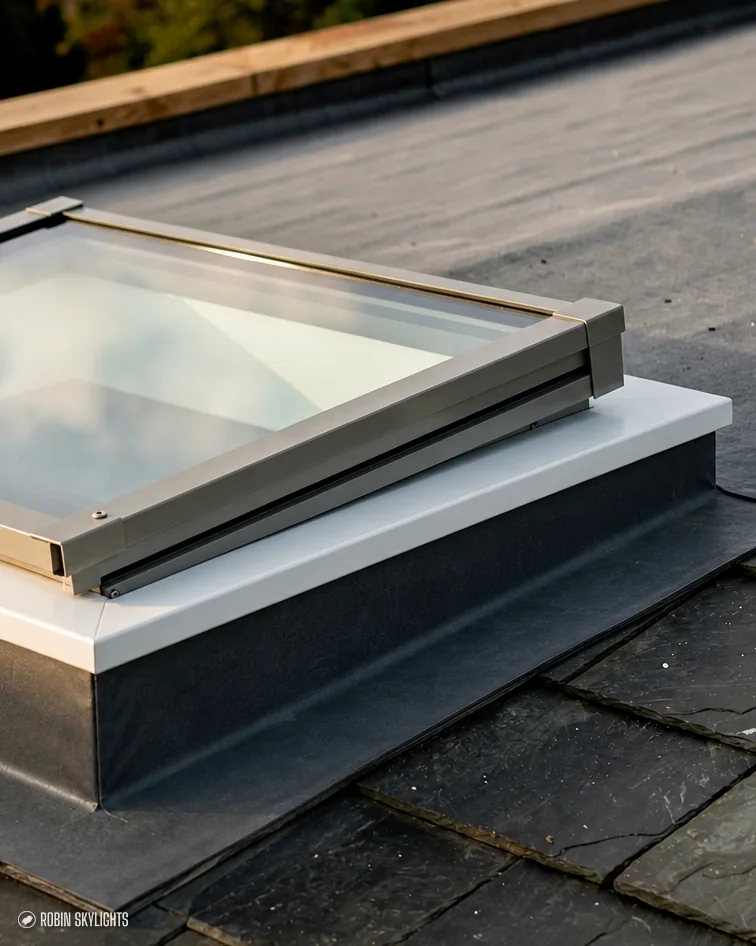
A conservation-style roof window sits low in the slope and carries slim bars. It is the sensible start where a roof is visible, and it is often the only version a council will consider on a listed building. Read about it on our conservation rooflights page.
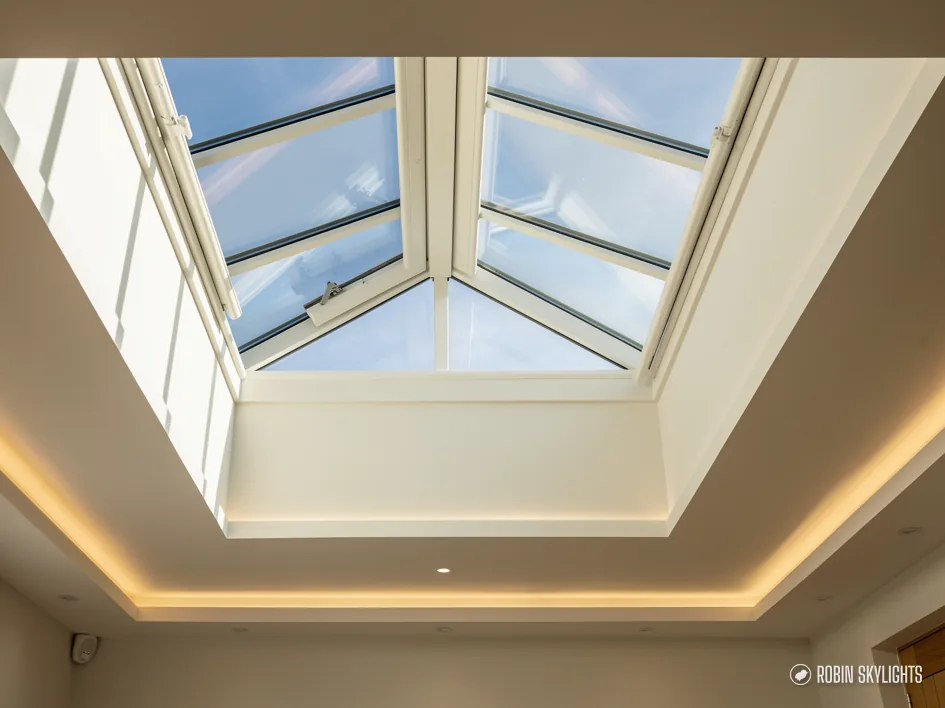
A lantern over a rear addition
Where a house has a flat-roofed extension to the back, a roof lantern can bring light into the deepest part of the room. Because it stands behind the main building, it is usually less of an issue from the street than anything on the front slope.
A flat rooflight, set low
If a lantern is too tall for the setting, a wide flat roof rooflight does much of the same job at a lower profile. It sits on an upstand, the raised frame that keeps water below the glass, and can be sized to the room.
When an older Southwell rooflight has failed
If a rooflight already in the roof has failed, fitting a new one in the same opening can avoid fresh structural work. Misted glass in a sound kerb and frame can often be dealt with by swapping the sealed unit alone. The survey tells us whether that is possible. That written price is fixed, and our ten-year workmanship guarantee, supplied on paper, stands behind the work.
Southwell: listing, consent and the practical bits
We live inside Southwell's protected centre. Is a rooflight realistic?
Often it is, with care. A slope that faces a street is where an Article 4 direction is most likely to matter, so a rear slope is usually an easier case. We survey the house, identify the realistic position, and contact Newark and Sherwood District Council before anything is ordered. You then receive a fixed written quote.
What if the house is listed?
Consent for a new opening in a listed roof is a separate application from ordinary planning. We tell you at the survey if we think consent will be required and what the council is likely to want to see, such as a slim, flush-fitting design. We do not order a rooflight until that is settled.
Is Southwell too far out for a survey?
No. Southwell, at 15.9 road miles, falls comfortably within the 30 miles we cover, and the free survey comes to your door. We come to your home, and the price is written down once we have looked at the roof.
Who deals with Building Control?
We do. Where a notification is needed, the approval route is a council surveyor or a registered building control approver, and we lodge the notice with whichever you choose. The finished job meets the rules in force, and you get the paperwork plus our written ten-year workmanship guarantee.