21.1 road miles away, east-north-east of Nottingham city centre
Skylights & rooflights in Newark-on-Trent
A river port turned market town, with a castle ruin, a Market Place lined with historic fronts and hundreds of listed buildings. The roofs are varied, and a good many rooms under them could do with more sky.

One of the few crossings of the Trent
Newark grew because it held one of the few bridges over the Trent, at the point where the Great North Road met the Fosse Way. Wool came first, and later an ironworks, engineering, brewing and a sugar refinery. Many of the town's older buildings still line the market place.
Newark-on-Trent, from the Trent quayside to the ridge tiles
Newark-on-Trent is a market town of 29,755 people in Newark and Sherwood district,. It was a substantial inland port, particularly for wool, and later made iron goods, beer and sugar. That mixed history left a mixed set of roofs. What follows covers the trains and roads that bring us in, the planning rules around the historic core, the buildings, the rivers and what we would suggest. For the service as a whole, start at skylight installation in Nottingham.
01
Two stations, five numbered roads and a bypass
Newark-on-Trent is 21.1 miles by road, east-north-east of the city centre, and a drive of around 31 minutes. It sits in the outer part of our 30-mile radius and gets the same service as a house in the city.
Newark is well served for transport. Five numbered roads run close to the middle: the A46, A616, A617, B6166 and B6326. The A1 and the A46 act as bypasses round the town. Two railway stations are within 2 km. Of the two, Newark Castle lies 0.5 km out and Newark Northgate 0.9 km, and both are open. Northgate sits on the East Coast Main Line, where it crosses the Nottingham to Lincoln line, a junction that helped the town grow alongside the river and the old roads.
The van is still how we arrive, with ladders and kit, but the transport links have a useful side effect. Whatever the route in, one question matters at the first call: whether your home is a house or a flat, because flats do not have permitted development rights for rooflights.
Before the visit
A few practical questions save time. Where can a van be left near the house? Is there a way to the rear that avoids carrying ladders through a hall? Is the loft hatch clear? Streets near the Market Place were not laid out for vans, and we would rather plan round that than lose half an hour to it on the day.
Our full list of places is on the areas we cover.
21.1miles
road distance in from Nottingham
31minutes
van drive, traffic allowing
2stations
open within 2 km of the centre
02
A big conservation area, a Grade I Town Hall and hundreds of listings
356listed
buildings in the Newark Conservation Area
4Grade I
among them, including the Town Hall of 1776
Planning here is run by Newark and Sherwood District Council. The Newark Conservation Area was designated in 1968 and covers the middle of the town, with 356 listed buildings inside it. Four are Grade I, eleven Grade II* and 341 Grade II. Searching 1.5 km around the middle returns 363: the same four at Grade I and eleven at Grade II*, with 348 at Grade II.
Among them is the Town Hall, designed by John Carr of York and finished in 1776. It is Grade I listed and houses a museum and art gallery. The castle, now a ruin, stands near the river, and the Market Place is lined with historic buildings. If you live anywhere near these, check before you plan anything.
What that does to a rooflight
With so many listings, a good share of the old centre is protected in some way. Cutting into a listed roof needs the council's listed building consent, and a house inside the conservation area is a separate case only where the council has made an Article 4 order. In every other case the rooflight right is the same on any slope.
For that reason, we survey first. Our first look is at the listing and any Article 4 direction on your address, and where the house is listed we agree the slope, size and type with the council. Once the position is clear, we write the fixed quote.
- Consent for a listed roof
- Separate permission from the council to alter a listed building, including its roof.
- Grade I
- The highest listing grade, given to buildings of exceptional interest.
- Conservation area
- A zone designated for its character. Some works need consent there, but a flush rooflight on a house is normally still permitted development.
Outside the core
Not every house in Newark is listed. New Town, the neighbourhood 0.8 km from the centre, is an example of an area where we still check the listing and Article 4 position for each address before ordering.
National rules, one page
The permitted development limits and Building Regulations for rooflights are the same wherever you live. We have put them in our planning permission guide. If Building Control needs telling, we do it for you.
03
A port, a sugar refinery and a Victorian workshop town
Newark was a substantial inland port, especially for the wool trade, and it industrialised somewhat in the Victorian era. Later it had an ironworks, engineering, brewing and a sugar refinery. It stands at the crossing of the Great North Road and the Fosse Way, and it grew around a castle and a large market place that is still lined with historic buildings.
Each of those trades left its own mark on the buildings of the town. What the history does tell us is that Newark's building stock was put up over several centuries and for different kinds of owners, from merchants to workers at the ironworks.
Old buildings, odd roofs
Merchant houses and trade buildings tend to have deep floor plans and awkward roof shapes, with valleys, parapets and internal gutters. A rooflight there needs a close look at where water goes. We trace the gutters and the falls before we position anything, so that the new opening does not sit in the path of a valley.
Dark middles
Deep buildings have dark middles. A stairwell, an inner landing or a bathroom with no wall to the outside can be dim all year and nearly black on a November afternoon. An opening above the stair, or a sun tunnel running to a ceiling diffuser, can fix this without touching the view from the street.
Replacing the old
If a building already carries a rooflight and it has failed, we look at replacing it on the same opening. That limits the structural work and, in a listed or conservation setting, helps keep the roof looking as it did. The decision is made on the survey, not on the phone.
04
The Trent, the Devon and the green banks between them
Water everywhere, and what that means in a wet winter.
Newark lies on the bank of the Trent, with the River Devon running through the town as a tributary. Newark Town Lock also lies close to the centre, and several reservoirs and ponds within a kilometre and a half. This is a town built beside water.
Green spaces follow the river. Newark Castle Gardens are 0.3 km from the centre, Friary Gardens and Millgate Otter Park 0.4 km, and Riverside Park 0.5 km. Two small parks on Sherwood Avenue are also within a few hundred metres. Towards the edge of town a hill rises 1.6 km from the centre, with a conservation park just beyond it. An Anglo-Saxon cemetery found in Millgate, close to the Fosse Way, is a reminder that people have lived on this crossing a very long time.
Damp air and glass
Water means damp air. On a still winter morning, moisture from a shower or a pan rises to the coldest surface in the room, which is usually the glass. We specify a unit whose inner pane stays warmer, and for a steamy room we would offer an opening version, so moisture escapes before it runs down the frame.
Weeks of rain on a Newark roof
After weeks of rain, every roof is tested. Flashings and upstands are where water finds its way in, so we take extra care with those. Where the roof is pitched, we choose the flashing to suit your tile or slate. On a flat roof, the upstand lifts the glass clear of standing water and the finish falls away from it.
05
What we would fit in Newark-on-Trent
Newark is a mixed town, so we choose by the problem in the room and by whether the house is listed. These are the usual pairings.
On a roof the street can see
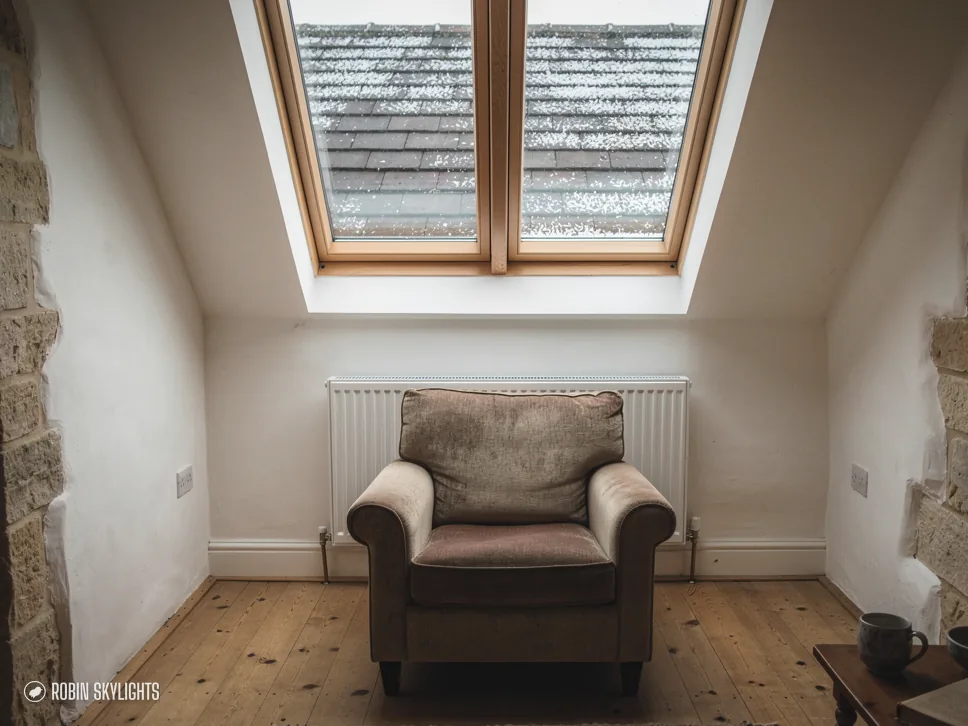
Where the roof is listed or inside the conservation area, a slim, flush conservation rooflight is the first thing we consider. It keeps a low profile and sits close to the slope. See our page on conservation rooflights.
On a back roof or an extension
A flat-roofed rear addition suits a roof lantern where there is headroom, or a wide flat roof rooflight where there is not. Both pull daylight into the part of a deep room that the back window never reaches.
| Problem | Likely fit | Page |
|---|---|---|
| Listed or street-facing roof | Flush conservation rooflight | Conservation |
| Deep rear extension | Lantern or flat rooflight | Lanterns |
| Inner stair or bathroom | Sun tunnel | Sun tunnels |
On a stair, a landing or a bathroom
A sun tunnel brings daylight down a mirrored tube from a roof dome to a diffuser in the ceiling. In an old building where cutting a large opening is difficult, it is a gentle way to light an inner room.
What we promise
The survey is free. After it you get a fixed written quote, so the price on the day matches the price on paper. Building Regulations are met as they stand today, and a ten-year workmanship guarantee comes with the job, in writing.
Newark homeowners on listing, access and planning
Our house is in the middle of Newark. Is it probably listed?
It may be. The records show 356 listed buildings inside the conservation area, so the chance is real. We check the listing status of your house at the survey and ask Newark and Sherwood District Council before a rooflight is ordered. If the house is not listed, the check takes little time and you carry on to a fixed written quote.
Newark is a long way out. Do you still come?
Yes. At 21.1 road miles, Newark-on-Trent is within our 30-mile reach, and the survey costs nothing. We come to your home, because there is no showroom, and the price goes on paper once we have looked at the roof.
Our flat-roof rooflight is old. Can it be swapped without redoing the roof?
Often, yes. A sound upstand lets the new unit go onto the opening already there, while one that has failed or leaks must be rebuilt. We see which it is when we look, and the fixed price is in writing before any work starts.
Who sorts out Building Control?
We do. If the work needs notifying, we send it to the inspector, whether that is Newark and Sherwood's own team or a registered approver. The installation meets the regulations in force when we finish, and you receive the paperwork when we finish, with our ten-year workmanship guarantee in writing.