West of Nottingham city centre, 15.3 road miles
Skylights & rooflights in Derby
A Derwent-side city of mills, railway works and houses from every decade since. Plenty of rooms in all of them never see enough sky.
A city that ran a railway
Derby became the headquarters of the Midland Railway, formed from three older companies after the North Midland Railway set up its works here in 1840. A city that grew that fast in the industrial era has roofs of many ages, so each one gets a close look before anything is cut.
Derby, read from the Derwent up
Derby is a city and unitary authority on the River Derwent, the old county town of Derbyshire before that role passed to Matlock, and home to a recorded population of 275,561. Our team travels out from skylight installation in Nottingham to the west, and the city has nine conservation areas recorded within about 1.1 km of its centre point. The chapters below take the protection first, then the housing, the railway, the river and the products that suit them.
01
Nine conservation areas around the middle
Derby City Council is both the planning authority and the unitary council, so a single office decides on planning and the local side of Building Control. What makes the city unusual is how much sits under protection close to the centre.
The areas on record
Nine conservation areas are recorded within about 1.1 km of the Derby centre point. The City Centre area covers the point itself and was designated in 1987. It holds 84 listed buildings. Friar Gate, 0.24 km away and designated in 1969, holds 79, among them eight at Grade II*. Darley Abbey, a little over a kilometre out, holds 20 and has five Grade II* buildings. Historic England's list has 258 entries inside a circle of 1.5 km radius: six at Grade I, twenty-six at Grade II*, 223 at Grade II and three whose grade is not recorded.
Some of the named areas, such as Railway and Darley Abbey, lie a little way from the centre, but all sit close enough that you can end up inside one without noticing.
| Area | Designated | Listed |
|---|---|---|
| City Centre | 1987 | 84 |
| Friar Gate | 1969 | 79 |
| Strutts Park | 1991 | 13 |
| Little Chester | 1991 | 5 |
What this means for your roof
Listed buildings need consent before a new roof opening is made. A house in a conservation area is normally still covered by permitted development, so what we look for is an Article 4 direction on the street. Before we draw up a quote we check your address against the council's records, so you know where you stand. The national rules that apply to every English house are collected in planning permission for rooflights.
02
Council estates, private estates and the decades between
Derby's housing story runs in clear phases. During the 1920s and 1930s slum clearance thinned the central area as families were rehoused on new council estates in the suburbs, and houses for private sale went up alongside them. After the Second World War the same building carried on at scale for roughly thirty years, council housing and private developments together.
That gives us a city whose outer ring was built across several decades by different hands. A ring of estates built over time contains roofs of several structures, coverings and pitches, and the only way to learn which one you have is to look at it.
What a survey reads
Before we suggest anything, we go into the loft and look at four things. The structure comes first: timbers cut by hand behave differently from factory trusses. Next is the covering, whether clay, concrete or slate, because each needs its own flashing kit. Third is the pitch, and last is the state of the ceiling below. A landing under the roof can take a different product from a kitchen under a flat extension.
Once we have an opening position in mind, we stand under it and look up. A rafter that lands exactly where you want the glass can often be avoided by moving the window along by a hand's width, and that is a far smaller job than reframing the roof around it.
- Truss
- A factory-made frame that forms the roof structure and cannot simply be cut through.
- Covering
- The outer layer of tile, slate or membrane that keeps rain off the structure.
- Pitch
- The angle of the roof slope, which decides what can be fitted and how.
- Flat extension
- A single-storey addition with a low-slope roof, often over a kitchen.
Rooms that stay dark
In a suburban house of any decade, the dull spots are consistent: a hall with no outside wall, a bathroom set in the heart of the plan, a rear room extended into the garden. A rooflight puts daylight into precisely the place a side window cannot reach.
We ask which rooms you switch the lights on in at lunchtime between November and February. Those are the rooms to start with, because that is when a house in a river valley, with low sun barely clearing the roof opposite, needs light from above the most.
Small commercial work
Derby also holds offices, workshops and small units where a flat roof is the norm. We are glad to look at those as well. The method is the same: see the roof, then quote.
03
Getting to you: 15 miles of A52 and a railway city
Derby is 15.3 road miles from Nottingham city centre, heading west, and the drive usually takes around 26 minutes. Within a kilometre of the Derby centre point run nine classified roads: the A514, A516, A5194, A52, A5250, A6, A601, A61 and B6000. Derby railway station is 1.2 km away. Our van takes the road, but the railway is the reason the city looks as it does.
The North Midland Railway set up its works in Derby in 1840. When it merged with two other lines to form the Midland Railway, the city became the company's headquarters. From 1922, the 62-acre International Combustion site on Sinfin Lane made machinery for feeding pulverised fuel to furnaces and boilers, and later steam-generating boilers for power stations.
For a survey visit
Distance is not a problem, because Derby sits well inside our 30-mile area. Before a visit we ask three things: where a van can park, how we get round to the rear, and how high the roof is. A tall house on a busy road asks different things of ladders and access than a bungalow on a cul-de-sac.
The survey is free, and what comes after it is a written quote with a fixed price. The only thing we ask in return is a clear view of the room you want lit.
15.3road miles
from Nottingham city centre
26minutes
drive time on a normal day
1.2km
from the Derby centre point to the station
04
The Derwent valley, mills and mist
Where the Pennine foothills meet the Trent lowlands.
Derby lies in the lower valley of the River Derwent, in a low area where the south-eastern foothills of the Pennines meet the Trent lowlands to the south. The River Derwent and the Mill Fleam both flow close to the centre point, inside a 1.5 km radius. The city holds the southern part of the Derwent Valley Mills World Heritage Site, and Lombe's Mill, an early British factory, is part of the story of how Derby grew from a market town into an industrial one.
Green space is easy to find. Cathedral Green is 0.2 km from the centre point, Riverside Gardens 0.3 km, Chester Green 0.9 km, Parker's Piece 1 km, Mundy Pleasure Ground 1.3 km and Derby Arboretum 1.4 km. Duesbury Nature Reserve is a little further, at 1.8 km.
What valley air does to glass
Low ground by a river collects mist and damp on grey mornings, and a room with cold glass shows it first. Water vapour from cooking or a shower settles on the glass and runs. Glass with a warm edge stays less icy on its inside face, and a rooflight that opens gives steam a way out. In a bathroom without a window, that matters more than almost anything else on the specification.
Trees and old brick
Tall trees by the river and in the older gardens drop leaves and seeds. Debris lodges on a flat roof's raised edge and holds water against the frame. We form that edge high enough to stay above standing water and we slope the roof finish away from it.
05
What tends to suit a Derby house
The best product is the one that lights the dark part of the room. Here are four pairings that suit housing like Derby's.
Listed or in a conservation area
Where the status of the building matters, our conservation rooflights page explains slim frames that sit close to the roof plane. Design does not start until we know if the house carries a listing or an Article 4 direction.
Older houses with tired units
An old rooflight with glass that has clouded, or a frame that no longer closes, is a candidate for replacing misted rooflights. Often the opening is already the right size and can be reused, which keeps the work tidy.
Rear extensions and flat roofs
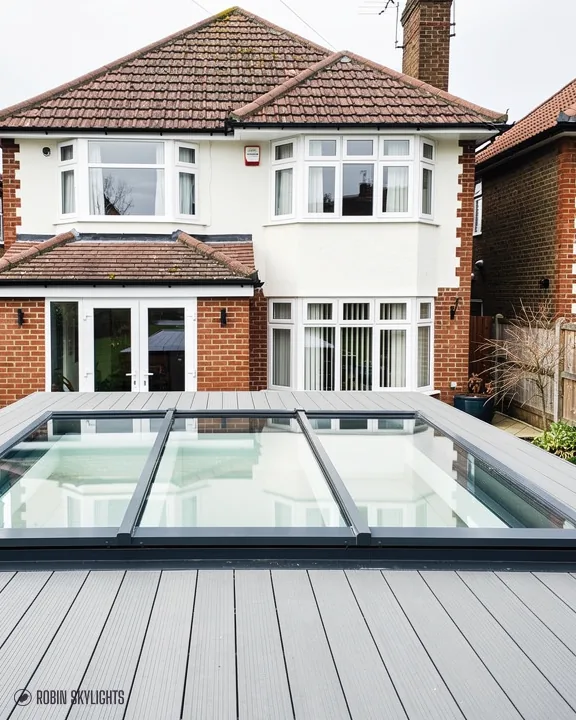
A flat-roofed single-storey extension is a case for flat roof rooflights. Set over the deep end of the room, it adds daylight from straight overhead, the strongest light under cloud.
The landing in the middle
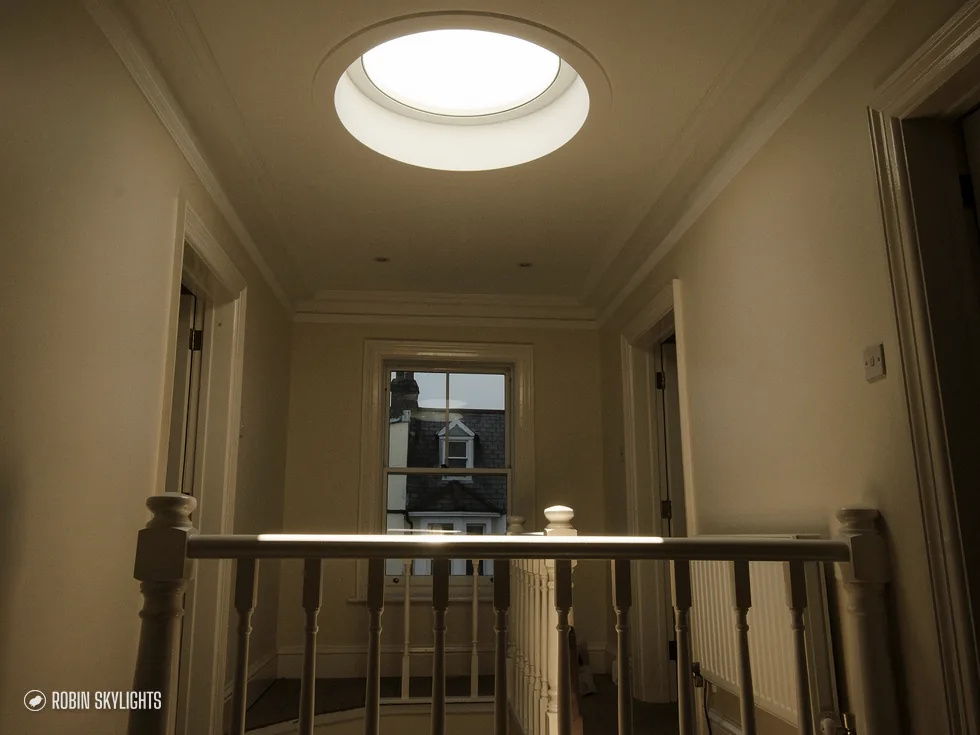
An inner landing or bathroom with no outside wall can be reached by a sun tunnel, which carries light down a mirrored pipe from the roof. It is a modest change outside and a noticeable one on a dull afternoon.
Guarantee and the next step
Every installation carries a written ten-year guarantee on the workmanship. The rest of our patch around Nottingham is mapped on the areas we cover index.
What Derby homeowners ask first
Is Derby treated differently from the rest of Derbyshire?
Yes. Derby is a city and a unitary authority, so Derby City Council handles planning for the city itself rather than a county or district council. The surrounding villages sit under other councils. We check which one applies to your address before we quote, so the right office is asked the right question.
How do I know if my street is in a conservation area?
Derby has several close to the centre, including City Centre, Friar Gate, Strutts Park and Little Chester. If you are not sure, give us your address at the survey and we check the council's records. If your house is inside one, the Article 4 list is what we read first. Where no direction applies, a rooflight there can still go in as permitted development.
Can a rooflight go into a flat roof on an old extension?
Often, yes. The roof needs to be sound enough to take a raised frame, and the finish needs to fall away from it. We look at the structure and the covering on the survey and tell you if anything needs attention first. The quote that follows is fixed and in writing.
Do you work on small commercial buildings in Derby?
Yes, small commercial jobs are welcome alongside homes. A workshop, a small office or a shop with a flat roof can all take a rooflight. We come to the building, survey it for free and give a written quote that does not change on the day.