Kilburn is 16.2 road miles out, west-north-west of the city centre
Rooflights and skylights for Kilburn homes
A Derbyshire village once spelt Kilbourne, with two conservation areas in its immediate surroundings and an old railway line in its past. Roofs here ask for a careful look before any glass goes in.
The same village, spelt differently a century ago
Until about a hundred years back the place was written Kilbourne. The name changed; the questions a roof raises before any glass goes in did not.
Kilburn, from the old line to the roof
Kilburn is a Derbyshire village of about 4,447 people, and it sits under Amber Valley Borough Council. It has two conservation areas on its doorstep, a closed railway station and a short list of amenities. We have organised this page around what we check before suggesting a rooflight on a house here. For the full service across the region, see skylight installation in Nottingham.
01
Amber Valley is the council, and it matters which side of the county line you are on
Kilburn is in Derbyshire, not Nottinghamshire, so planning sits with Amber Valley Borough Council. Nottingham City Council plays no part. Any question about consent for your roof, or about Building Control on a notifiable job, goes through Amber Valley.
That is worth saying plainly because we are based in Nottingham, 16.2 miles away. But for planning, the line on the map decides.
What we do before we order
Before any rooflight is ordered we check your address with the planning authority. That check covers listing, conservation status and any restriction attached to the property. We pass on what they tell us, in plain terms, and the written quote reflects it.
What applies in Kilburn and anywhere else
The planning exemptions that let most householders add a rooflight without a planning application, and the Building Regulations that apply to cutting a new opening, are the same in every English council area. They are set out in full in our guide to planning and rooflights, so we leave the detail there and use this page for what is local.
On notifiable work we make the Building Control submission ourselves, lodging it with Amber Valley, or using a registered building control approver, and the installation meets the rules current on the day it is built. The paperwork is handed back at the end of the job.
02
Two conservation areas close to the village point
2areas
conservation areas recorded near the village point
8listed
buildings counted 1.5 km out from the centre
The planning dataset records two conservation areas near the centre of Kilburn. The first carries the village's own name. It lies 0.27 km from the centre point and was designated on 22 February 1993. Its four listed buildings are one Grade II* and three Grade II.
The second is Horsley, about 0.87 km from the centre, designated on 5 September 1994. Three listed buildings are recorded inside it: one at Grade I, the highest grade, and two at Grade II. Horsley is a neighbouring settlement rather than part of Kilburn, but it is close enough that a house on the edge of the village could be affected by either.
Count 1.5 km out from the centre and Historic England records eight listed buildings: one Grade I, one Grade II* and six Grade II.
What this means for a rooflight
Three situations are worth separating.
- A listed house needs consent from Amber Valley before anyone cuts the roof.
- Inside a conservation area, a house keeps its permitted development right; only an Article 4 order covering the road would change that. A slim unit that suits the roof is still our first suggestion.
- If neither applies, most householder rooflights follow the national exemptions in the guide linked on this page.
A map line seldom settles which of those covers your home, so we put the address to the council. Where an old roof is in clay tile or stone slate, we also pick a rooflight whose frame and glazing bars sit quietly against it, a point covered in our guide to conservation rooflights.
| Area | Distance | Designated | Listed inside |
|---|---|---|---|
| Kilburn | 0.27 km | 1993 | 4 |
| Horsley | 0.87 km | 1994 | 3 |
03
The old Ripley branch and the roads that replaced it
Kilburn was once served by its own station on the Midland Railway's Ripley Branch. That station is now closed, as is the one at Denby, 1.7 km away, and no working station is recorded near the village. Today the roads do the work: the A38, the A609 and the B6179 all run close to the village, inside a kilometre.
We reach Kilburn by van, 16.2 miles from the city centre in a west-north-westerly direction, and the drive takes around 32 minutes with ordinary traffic. We agree the visit time with you when you book, and keep to it.
The survey at your house
The first visit costs nothing. We stand in the room you find too dark and ask when it is at its worst. Next comes the roof itself: what covers it, what holds it up and where the water goes. With that in hand we write a quote and fix the price. It stays fixed until the work is done.
For older houses with a small back lane or a shared access, we ask beforehand how we get ladders and materials to the back. It is easier to settle that on the phone than on the doorstep.
16.2road miles
out from the city centre
32minutes
drive time, ordinary traffic
What the village offers nearby
Kilburn has a local police station, a community officer and several parks for young children, though few other amenities beyond those. Pinchom's Hill, 2.2 km away, is the nearest named high point on the map. High ground nearby is a reminder that a roof here may catch more wind than one in the city.
Kilburn is one of many places in our area. Find the rest of our patch at areas we cover.
04
Two old pubs and the roofs around them
Kilburn used to have two public houses, the Hunters Arms and the Travellers Rest. Beyond those names, the character of the houses shows only on the street itself. How we approach older village roofs is easy to set out, because the conservation areas near the centre make it likely that some of them are of an age.
Clay tiles and stone slate
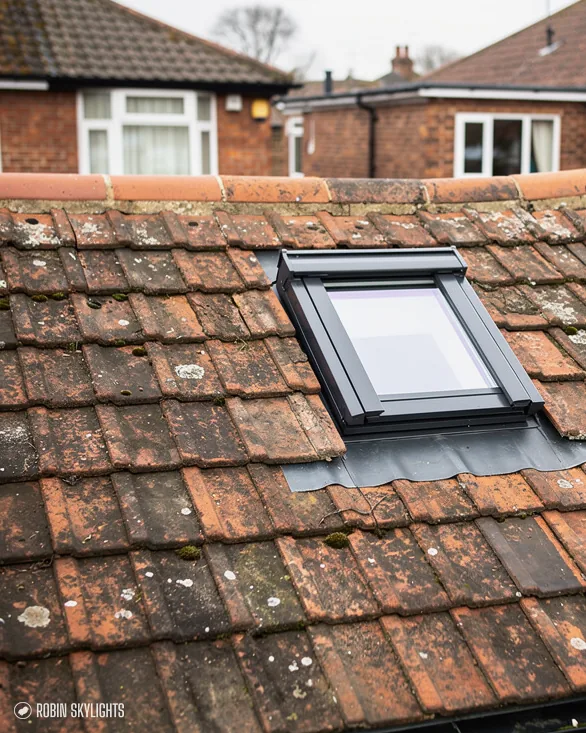
Old red clay tiles weather unevenly. Some have flaked, some have mossed, some have slipped. A flashing kit for a roof window is made for a particular tile profile, so we match the kit to what is actually on the roof rather than to a catalogue image. Where tiles need lifting to fit the frame, we relay them carefully and replace any that crack.
Small rooms and steep slopes
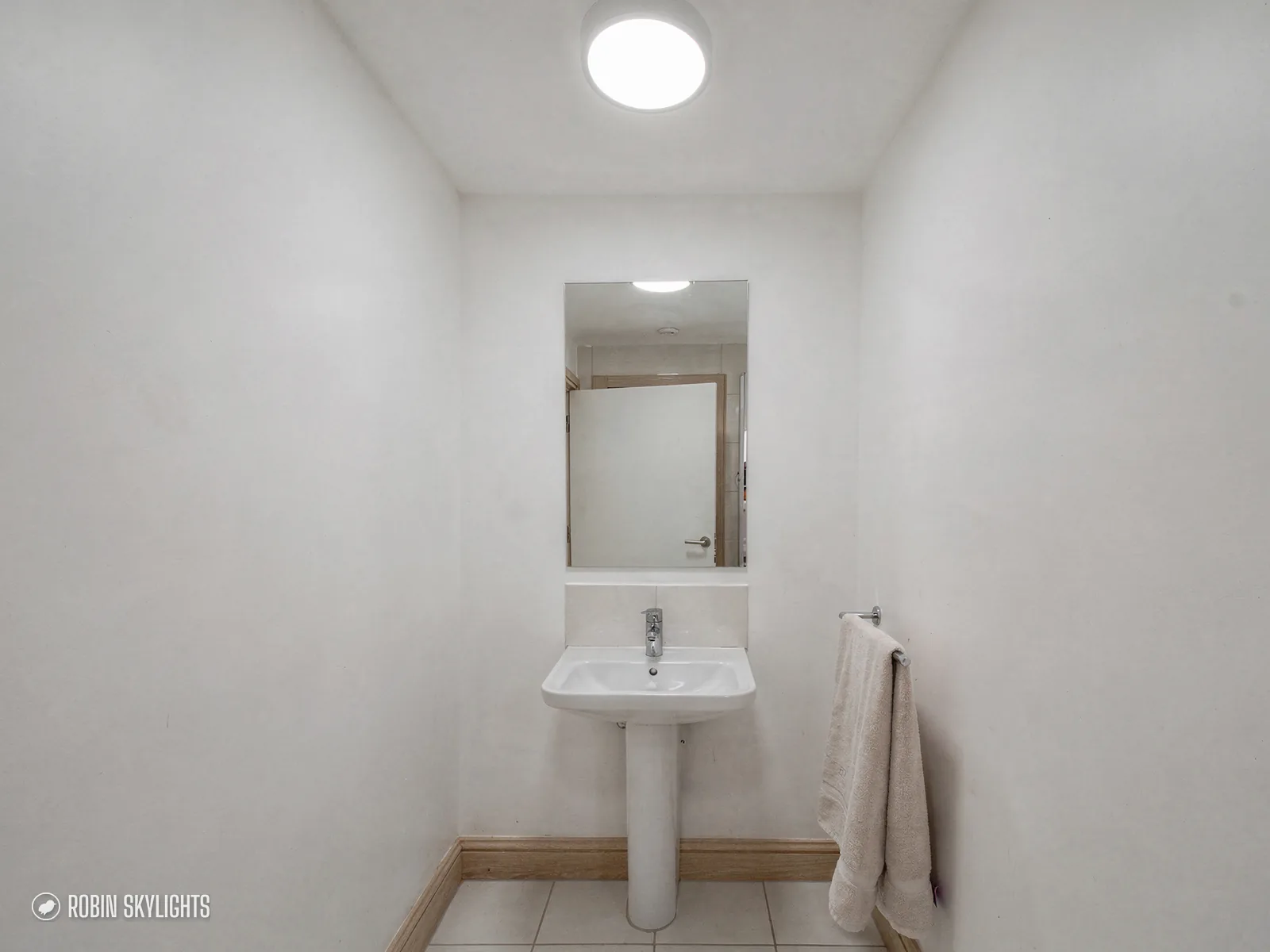
Cottages and small terraced houses tend to have attic rooms with sloping ceilings. A roof window with a centre pivot gives a good view out when you are standing and a clear view of the sky when sitting. For a cloakroom or a landing that has no window, a sun tunnel is a smaller intervention and still brings a visible lift in the middle of a grey day.
Choosing the position
We try to put a rooflight where it suits the room first and the roof second. That sometimes means setting it a little lower, or a little off the centre line, so that the light falls where you actually sit. Then we check it against the rafters and adjust.
For rooms in the roof space, our page on roof windows explains sizes and opening types.
Looking at it from the landing
Stand on the landing or in the smallest bedroom and look at the ceiling. A slope that takes a rooflight well usually shows itself from inside as a flat, even stretch with nothing awkward behind it, such as a chimney breast or a water tank. We note those, and we note which way the opening should face so the morning light reaches the bed or the stair rather than the wall. Frames and glazing bars are chosen from the same view, since you see them every day and the neighbours do not.
05
Exposure, wind and what a Derbyshire hillside does to a roof
The map names one hill within 3 km of the centre of Kilburn: Pinchom's Hill, 2.2 km away. A roof on higher ground catches the wind and rain from a different angle than one on a sheltered street.
Wind and fixings
On an exposed slope, the fixings and the flashing carry more of the load. We follow the maker's fixing instructions for the roof type and cover, and we do not cut corners with the number of clips and screws. A well-fixed rooflight is one you forget about in a gale.
- Upstand
- The raised edge of a flat roof, around the opening, that a rooflight frame sits on.
- Lapping
- Overlapping flashing pieces so water runs over each joint rather than into it.
- Warm edge
- A spacer between the panes made from a poor conductor, so the glass edge stays warmer.
Driving rain
When rain arrives sideways, joints are tested harder. We lap the flashing so water running down the slope has no route under the frame, and on flat roofs we raise the upstand and slope the surface away from it. Neither is difficult, but both must be done properly the first time.
Cold mornings
Rooms facing a hill can feel colder and damper in winter. Glazing with a warm edge and a good seal holds the inside surface closer to room temperature, and that reduces misting on the glass. A rooflight that opens, or a vent in the frame, lets steam leave the room.
Guarantee in writing
Our workmanship guarantee runs for ten years and is given to you in writing. It covers how the work was done. If you want to see the terms before you book, they are on the guarantee page.
Getting started
Message us on WhatsApp at 07880 284133 or use the form on this page. Tell us the room, the type of roof and the street, and we will arrange the survey.
Kilburn homeowners: council, conservation and access
Is Kilburn dealt with by Nottingham or by Derbyshire?
By Derbyshire. Planning for Kilburn rests with Amber Valley Borough Council, even though we are based in Nottingham. We contact Amber Valley about your address before ordering, and we cover the Building Control notification where the job needs one.
My house is near Horsley. Does that change anything?
It might. Horsley has its own conservation area, about 0.87 km from the Kilburn centre point, and Kilburn has another. A house inside either has its usual rooflight right, unless the building is listed, or a direction under Article 4 applies. We check your exact address with the council and tell you what applies to your roof before anything is ordered.
Can a sun tunnel light a cloakroom with no window?
Yes, if there is a way to run the tube from the roof to the ceiling, usually through a loft or an upper floor void. A sun tunnel brings in enough light to read by on a grey day. We look at the route on the survey and say if it works.
Do you only fit new rooflights, or replace old ones too?
Both. We install new openings and replace existing rooflights that have misted, leaked or worn out. Where a replacement can use the same opening, we say so, because it keeps the work and the mess to a minimum.