19.5 road miles out on the western side of Nottingham
Skylights & rooflights in Duffield
Ironstone, a railway from 1840 and the larger houses that came with Rolls-Royce. Duffield sits on the west bank of the Derwent where the Ecclesbourne joins it, with four conservation areas close by, so we check the status of an address before ordering.
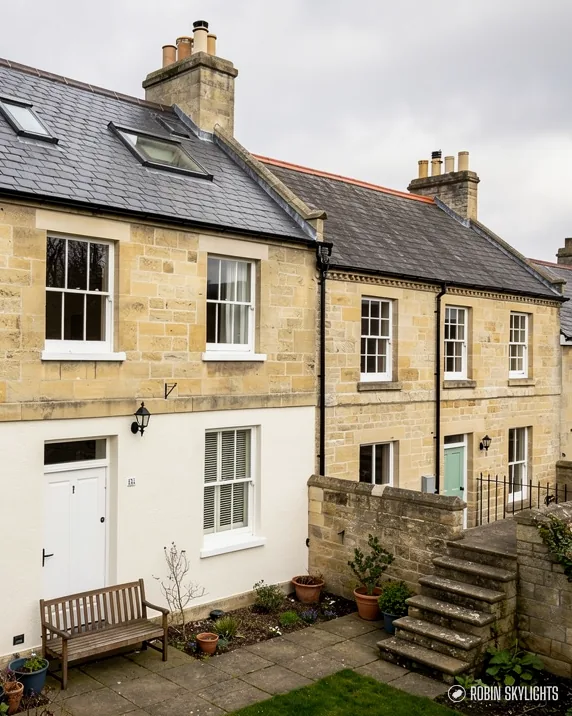
Iron in the ground, money in the houses
Ironstone surfaced here beside the coal, and in the 1910s the arrival of Rolls-Royce brought new expansion. The result is a town where grand houses and council housing were built within a few years of each other, each needing something different from its roof.
Duffield, between the Derwent and the Ecclesbourne
Duffield, small but rich in history, sits in the Amber Valley district of Derbyshire, about five miles north of Derby, on the western bank of the River Derwent where the Ecclesbourne joins it. It has a recorded population of 4,691. A small place with a big paper trail: four conservation areas, a castle site and a railway station that opened in 1840. The wider picture of our work is on the skylight installation in Nottingham page, and the five chapters here cover what is particular to this town.
01
Hazlewood Road, Holloway Road and the houses Rolls-Royce brought
Duffield grew twice over. First came the railway, which opened its station here in 1840. Then, in the 1910s, Rolls-Royce arrived and brought a new round of expansion: even bigger houses went up on Hazlewood Road, while council-provided housing was built along Holloway Road.
What is under a given tile only shows from the loft, but the pattern tells us something. Roofs put up in the same decade by different hands for different budgets differ in frame, in covering and in the room left beneath them. A town where substantial houses and modest ones were put up within years of each other has roofs of very different scale. A large house can have several slopes, dormers, long runs of rear roof and a deep loft. A council house on a smaller footprint has one pitch and not much room to move.
Big roofs, a lot of options
On a large house the question is usually which slope. A rear or side slope that cannot be seen from the road often has the most freedom, and a rooflight there can light a landing or a dressing room without changing how the house looks from outside.
Small roofs, one good decision
On a modest house we have one slope to work with. Placing a roof window a little too high or low can waste it, so we measure inside as well as out. A single well-placed opening usually does more than two awkward ones, and it costs less roof to repair if the roof is ever opened again. For reading or a desk, the opening goes over that end of the room; if you want air as well, ask for an opening sash when you book.
02
Amber Valley, four conservation areas and a lot of listed stone
For planning, Duffield belongs to Amber Valley Borough Council, a Derbyshire authority. Nottingham has no say in a rooflight here.
The heritage records here are extensive. A conservation area named Duffield covers the town centre point itself, designated in August 1969, and inside it are 29 listed buildings, which break down as a Grade I, a Grade II* and twenty-seven Grade II. Duffield Bank is 0.66 km away (designated September 1978, with no listed buildings recorded inside), Eaton Bank 0.76 km (1978, one Grade II building) and the large Belper and Milford conservation area 0.99 km (1975, with 210 listed buildings). Across the wider ring, Historic England logs 53 listed buildings: forty-eight at Grade II, four at Grade II*, one at Grade I.
What it means for a rooflight
With that much protected ground, we confirm the status of every Duffield address before planning a slope. A conservation area does not forbid a rooflight on a house, and the right usually stands, barring an Article 4 direction, yet a flush unit on the rear slope is the quietest design choice. A listed house is a separate matter: a new opening in its roof calls for listed building consent, applied for on its own.
We therefore ask Amber Valley about your address before ordering a rooflight, and we plan the opening on the least visible slope when there is a choice.
| Area | Distance | Designated | Listed |
|---|---|---|---|
| Duffield | In the centre | 1969 | 29 |
| Duffield Bank | 0.66 km | 1978 | 0 |
| Eaton Bank | 0.76 km | 1978 | 1 |
| Belper and Milford | 0.99 km | 1975 | 210 |
Rules that are the same everywhere
The national conditions are laid out on our planning permission for rooflights page. Where Building Control needs notice, we give it, whether that means Amber Valley or a registered approver. The fitting itself meets current Building Regulations.
03
Getting to you: the 1840 railway, the A6 and a long run from the city
This is a longer trip than most of our work: 19.5 miles of road westward from the city centre, around 33 minutes' drive. Two classified roads, the A6 and the B5023, run near the middle. The station is 0.3 km from the town centre point. The North Midland Railway came through from 1840 and the opening of Duffield station was the biggest change of its time.
Distance affects how we plan rather than how we price. Since the quote is fixed after the survey, a long drive does not become an extra on the day.
Planning the visit
Because we cross the county line to reach you, we like to agree a time when the roof and the room can both be seen in decent light. We begin in the room, since that is where the daylight is wanted, and then go up to the roof and, where there is one, the loft. There is no charge for the survey, and the written price follows it.
19.5miles
of road, heading west from the city centre
33minutes
of driving, in light to moderate traffic
0.3km
to Duffield station from the centre point
Which jobs suit a long run
A trip this long suits a combined job. A pair of roof windows, or one flat rooflight and a sun tunnel for the landing, can be planned together so the roof is opened and made good as one piece of work.
Neighbouring towns we also reach are listed on our coverage page.
04
Two rivers, a castle site and the hills behind
What the valley setting asks of a roof from November to March.
Duffield is centred on the western bank of the River Derwent, at the mouth of the River Ecclesbourne. Ironstone linked to coal deposits came to the surface around Belper and Duffield, and the landscape still has that valley shape. Grays Recreation Ground is 0.5 km from the centre, Duffield Millennium Meadow also 0.5 km and the site of Duffield Castle 0.7 km. Firestone Hill is the named hill 3 km off.
Low ground, slow drying
A town beside two rivers can stay damp for longer after rain. Roofs dry slowly, moss gains a hold and gutters hold water. We pay attention to how a flashing sheds water, and on a flat roof a taller kerb keeps pooled water below the glass. A rooflight that can be reached for cleaning, from inside or from a ladder, stays clear, which is why we think about access to each unit before it goes in.
0.5km
to Grays Recreation Ground and Duffield Millennium Meadow
0.7km
to the Duffield Castle site
Frost and the frame
Cold nights bring frost to the outside of the glass and condensation to the inside. We choose glazing for how cold the inner pane gets. Better glazing keeps it warmer, and in a kitchen or bathroom an opening sash adds ventilation. The same logic applies to a loft bedroom, where breath and warmth gather overnight. Our page on energy-efficient rooflights sets out how the glazing choices differ, and what the figures on a data sheet actually mean for the room.
05
What we would put on a Duffield roof
With such a range of houses, the answer is rarely the same twice. These three come up most naturally in a town like this.
Conservation rooflights for the visible slope
On a slope the street can see, a flush unit that sits low in the tiles or slates reads better than a roof window that stands proud, and it keeps within the projection limit explained in the planning guide. Our page on conservation rooflights explains the slim frames and the glazing bars they use.

Roof windows for the larger house
A tall house with space in the roof suits a roof window or two. Choose the rear slope, position the sill so that a seated person looks out, and the room under the slates becomes a place you use in winter. Think about a blind too, so that summer mornings stay manageable, and ask us to fit it at the same visit if you want one.
- Flush rooflight
- A rooflight that sits close to the roof covering with a slim frame, the type usually suggested for a slope the street can see.
- Sill
- The bottom edge of a roof window, which decides what you see from a seat.
- Glazing bar
- A slim bar that splits the glass of a conservation-style rooflight into panes.
Light for the middle of the house
The staircase and landing of a larger house are usually its darkest places. A flat or low rooflight directly above the stairwell lets daylight fall the whole way down. For a bathroom that has no window wall, a sun tunnel is the quiet answer.
New or replacement
When a rooflight has failed, fitting a new one into the opening already there can be the neater job. Where only the glass has misted and the frame is sound, a fresh sealed unit set into the same opening is the tidier piece of work. Photograph the ceiling first. Both routes carry a written ten-year workmanship guarantee.
A few things Duffield householders want to know
Which of the conservation areas around Duffield would my house be in?
It depends on the exact address and the boundary line. The Duffield area covers the middle of town, while Duffield Bank, Eaton Bank and Belper and Milford lie a little further out. We check your exact address with Amber Valley before we measure, and we tell you what we find.
Our house is on Hazlewood Road and has a lot of roof. Where should a rooflight go?
Usually on the slope that cannot be seen from the road, over the room or stair that lacks light. A large roof gives choice, so we compare two or three positions on the visit. We would sooner talk through the options than pick the one that is easiest to cut.
Is it worth getting a rooflight in a small house with one roof slope?
Yes, provided the opening is in the right place. We look at the room's use and at where the light fades in winter, and the position follows from that. One good opening is better than two compromised ones.
You are 19.5 miles away. Does that change the price?
No. We quote after the survey, and the figure in writing is the figure you pay. The distance is part of our planning, not a surcharge added on the day. The survey itself is free.