17.8 miles south-west of the city centre, in South Derbyshire
Skylights & rooflights in Melbourne, Derbyshire
A market town whose centre is a conservation area, with 133 listed buildings recorded close by. Light matters here, and so does getting the permission right before a rooflight is ordered.
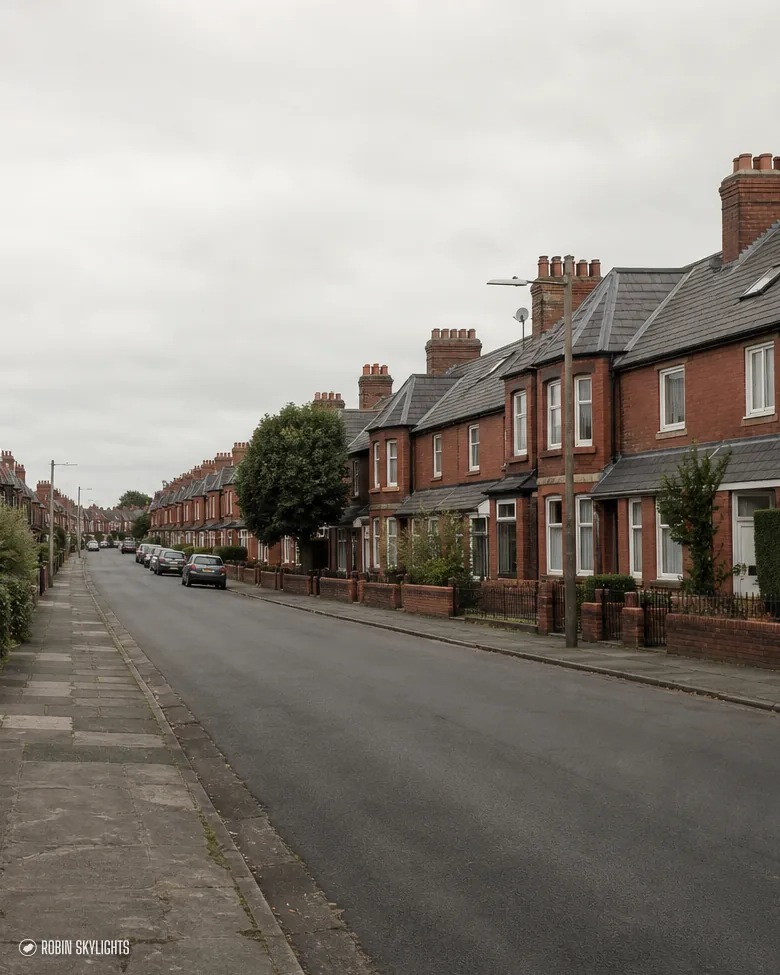
A name that means a mill by a stream
Melbourne's name means "mill stream", the mill by the stream. Its centre is now a conservation area, designated in 1969, with 104 listed buildings inside it, so many roofs here sit in a protected street.
Melbourne, a protected town read from the roof
Melbourne is a South Derbyshire market town, about eight miles south of Derby and two miles from the Trent. Its population is recorded at 4,860. Most of what you need to know before putting a rooflight in a Melbourne house is a matter of protection: three designated conservation areas lie close to the centre, and 133 listed buildings are recorded within 1.5 km. The chapters below start there, then move to the town itself, the countryside, the old railway and the units that suit a protected roof. For our wider offer see skylight installation in Nottingham.
01
Three conservation areas and a hundred listed buildings
Start with who decides: South Derbyshire District Council. Melbourne's centre sits inside a conservation area. The Melbourne Conservation Area covers the point we measure the town from, and it was designated on 12 February 1969. Inside it, the records show 104 listed buildings: 24 at Grade I, 7 at Grade II* and 73 at Grade II. Grade I is the top listing grade.
Protected areas beyond the centre
Two more conservation areas appear close by. Woodhouses lies 0.48 km from the centre point, was designated on 16 January 1992 and holds one Grade II listed building. King's Newton is 0.93 km away, designated on 21 February 1979, and it holds twenty Grade II buildings. King's Newton is probably a neighbouring settlement rather than part of Melbourne itself, so check which side of the line you live on before assuming either way.
Taking in the wider area round the town centre, Historic England records 133 listed buildings: 24 Grade I, 7 Grade II*, 101 Grade II and one with no grade entered.
| Area | Distance | Designated | Listed inside |
|---|---|---|---|
| Melbourne | Covers centre | 1969 | 104 |
| Woodhouses | 0.48 km | 1992 | 1 |
| King's Newton | 0.93 km | 1979 | 20 |
Putting a rooflight into this
If your house is listed, listed building consent has to be granted before anyone cuts the roof or orders a unit. In a conservation area, the rules for an ordinary house still allow most rooflights unless the council has removed that right with an Article 4 direction; where an application is needed, the street-facing slope gets the closest look. Our approach is simple. We find out your status from South Derbyshire first, and we choose a unit that sits as flush as the roof allows. Our guides to planning permission for rooflights and conservation rooflights go through the principles.
02
Market Place houses and what sits behind them
The Market Place is where Melbourne's main shops stand, among them an ornate building that used to house the Co-op. A town laid out around a market square tends to have shops at street level with rooms above, narrow plots running back, and a mixture of ages along each frontage. Behind the street, the houses are quieter.
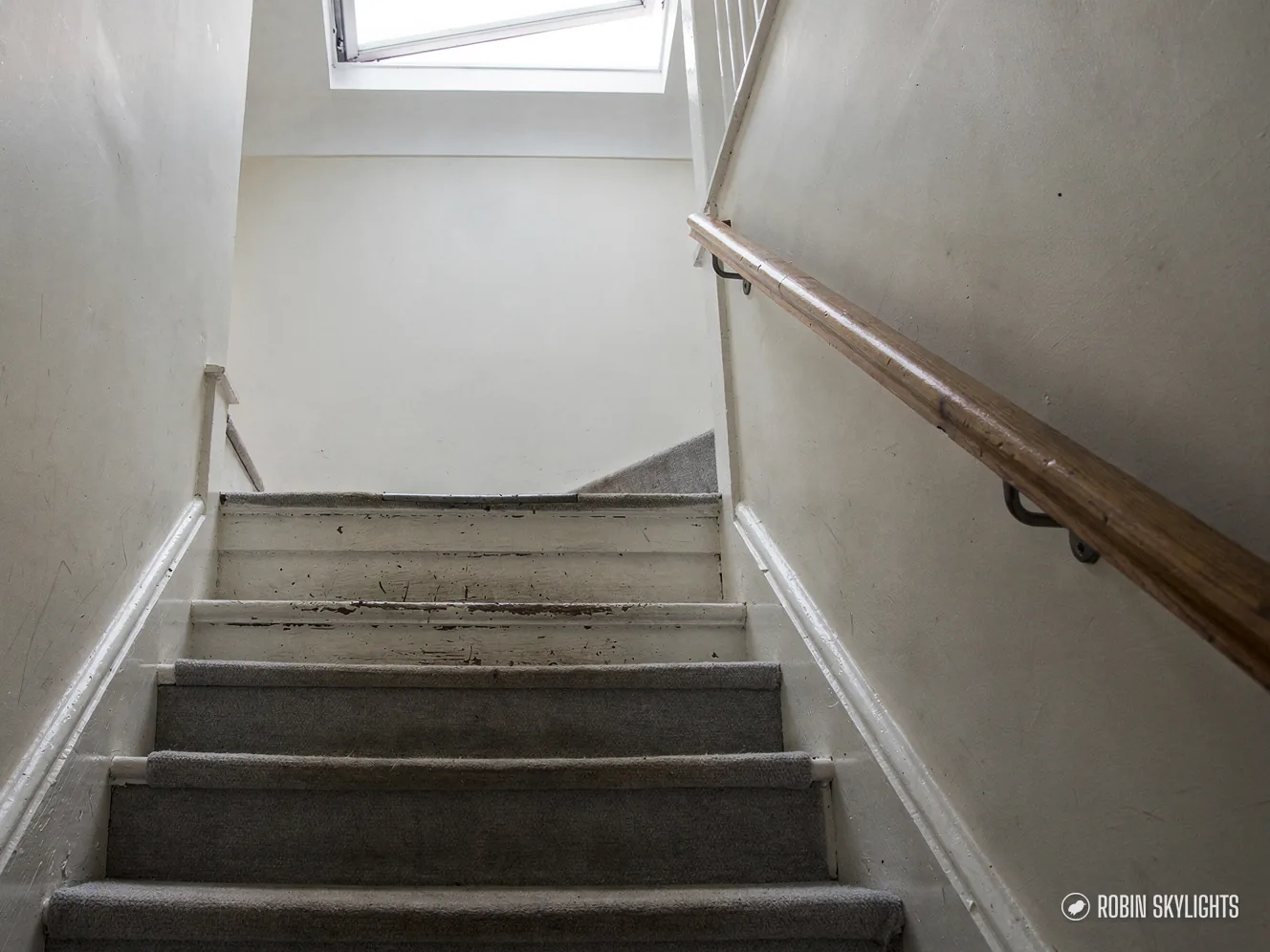
Melbourne's roofs are a mixture of ages and coverings, so the approach matters more than the label. On older buildings the rear slope is almost always the better home for a rooflight, because it leaves the front elevation looking as the street expects. The inside of the building also matters: a rooms-above-the-shop layout often has a stair running up the middle, and an inner stairwell with no window of its own stays dim all through the winter.
Rooms over shops, and stairs in the dark
A sun tunnel can bring daylight down a stair or into a landing that has no window of its own. It is a mirrored tube with a roof-top cap at one end and a frosted disc in the ceiling at the other. It needs only a modest opening and it keeps the roof surface almost unchanged. Our guide to sun tunnels shows how the tube is run past joists and insulation.
- Grade I
- Top of the three listing grades, given to buildings of exceptional interest.
- Article 4
- A council direction that removes certain permitted rights in a defined area.
- Diffuser
- The frosted panel set in the ceiling, where the light from a sun tunnel finally enters the room.
- Slope
- One flat face of a pitched roof, named for the way it faces.
Small yards and passages
Plots in a historic market town are often narrow, and access can be through a passage or over a neighbour's yard. We ask about it when we book the survey. If ladders or materials must go through a house, we plan for that, and we leave floors and walls as we found them.
Keeping the character
A well-chosen unit in the right place is almost invisible from the street. In a protected town that matters as much as the daylight, and it is the reason we spend time on the survey instead of quoting from a photograph.
Inside a protected street the staircase is often the room that suffers, so we start our survey on it.
03
Hills, woods and the Trent not far off
Setting and weather, with a hill on the skyline.
Melbourne lies about two miles from the River Trent. Breedon Hill rises 2.7 km from the centre, and Spring Wood Nature Reserve is 2.9 km away. There is a skyline here, and roofs near the edge of the settlement meet the wind from the open side.
Exposure and fixings
Roofs on higher or more open plots take more weather than those packed into a street. On a roof that looks exposed, the roof window is fixed to the rafters through the frame brackets, the flashing is lapped carefully, and a flat rooflight gets a tall enough upstand to keep driven rain off the join. If you tell us the garden is open to the west, we will look at that side first.
Trees
Near woods, trees shed on to roofs. Leaves, twigs and seeds fall on to a pitched roof and slide down. On a low pitch or a flat roof they stay put, and a rooflight with a small upstand collects them against the glass. The fix is a design choice, not a cleaning chore: more height on the upstand and a finish that falls away from the glass.
Daylight in a protected street
Many protected houses have small windows, thick walls and deep reveals. Rooms behind them tend to be dim even in July. A slim rooflight in the roof adds light from above the room instead of from the side, which is why it works well against deep walls. In winter it can make the difference between turning the lamp on at two o'clock and at four.
04
The B587, a closed station and a wartime line
Melbourne lies south-west of the city centre, 17.8 miles away by road, and the drive takes around 28 minutes in ordinary traffic. The B587 is the classified road nearest the middle of town. The old Melbourne station, 1.2 km away on the map, is recorded as closed, so there is no train to rely on and we reach you by road.
The railway has a curious footnote. The Melbourne line served during the Second World War as a military training railway, where engineers practised demolishing and rebuilding track and running a working line.
Planning the survey
Because Melbourne is among our farther towns, we try to fit visits together sensibly, and we keep the booking details exact rather than loose. When you get in touch, please tell us whether the house is listed, whether you are in the conservation area, and which room is the dim one. With that, we can arrive knowing what to measure.
Nothing is charged for the survey. The room comes first, then the roof, then the structure beneath it. After that a written quote arrives with one fixed price, and it stays put.
17.8miles
from the heart of Nottingham, on the road
28minutes
usual drive in, ordinary traffic
Before the work
If the work needs a Building Control notification, we raise it. In a town like Melbourne we also hold back on ordering until any listed building consent the house needs is on paper. Nothing is cut until that is settled.
For the other places on our map, see areas we cover.
05
What suits a protected roof
When the street is part of a conservation area, the aim is a rooflight that looks as though it belongs. Three products tend to fit that brief.
A conservation-style roof window
These are slim-framed units that sit close to the roof covering, often with a single central glazing bar and a dark frame. They are designed for slopes where a standard roof window would stand proud. The conservation rooflights page covers sizes and how they sit in the covering.
A standard roof window on the back slope
Where the back of the house is out of public view and the house is not listed, a regular roof window is simple to fit. It opens for air, and we match the flashing kit to your tile or slate. If your roof is slate, cutting it needs care, and we take it slowly.
A flat rooflight on an extension
Plenty of older houses have gained a flat-roofed rear addition. A flat rooflight on that roof, such as a fixed pane or one that opens, is low, level and rarely seen from the road. Our guide to flat roof rooflights explains upstands and sizes.
Replacing an older unit
Where an old rooflight in a protected house has failed, swapping the unit within its current opening usually changes less than a fresh cut. We still check consent first. The workmanship on every job carries our guarantee in writing, for ten years.
Melbourne: protected streets and rooflight questions
We live in the old centre of Melbourne. Will the council let us add a skylight?
Often, yes. Even in a conservation area a house rooflight is usually permitted development, the exceptions being a listed house or an Article 4 direction that removes those freedoms; then an application is needed, and the street-facing slope is where the design matters most. South Derbyshire District Council is the authority to ask. We find out what applies to your address first, then suggest a slim unit on the rear slope where that is possible.
What if the house is listed?
Listed building consent is a separate permission from ordinary planning, and it comes first. At the survey we give our view on whether the roof is a candidate. Nothing is ordered or cut until the consent is in your hands.
How does a stair with no window get daylight?
A sun tunnel is the usual answer. A cap on the roof catches daylight, and a mirrored tube carries it to a disc in the stairwell ceiling. The roof opening is small, which suits protected roofs where change should stay modest.
Do you come out as far as Melbourne for a survey?
Yes. Melbourne is well inside our 30-mile road radius, and the survey takes place at your house at no cost. We ask for a few details beforehand, such as listed status and where the van can park.