Ashbourne: the western edge of our patch, 28.6 road miles from the city centre
Ashbourne skylights and rooflights
A Derbyshire Dales market town with a brook through its middle and a conservation area over its centre. Many historical buildings and a great many listings make this the place where we check the rules before we measure the glass.
A brook through the middle of a market town
Henmore Brook, a tributary of the River Dove, runs through the centre of Ashbourne. The town grew around water and trade, and it kept its old buildings. Today a conservation area covers the middle, and more than a hundred and forty listed buildings stand inside it.
Ashbourne, listed first and measured second
Ashbourne is a market town in the Derbyshire Dales, with a recorded population of 8,854 and a reputation for historic buildings and independent shops. At 28.6 road miles it is near the edge of our area, so a survey visit here is a proper drive. This page covers the council and the heritage records first, since they shape almost every rooflight decision here, then the town itself, the roads in, the setting and the products that suit stone and slate. For the broader service, see skylight installation in Nottingham.
01
A conservation area over the centre and 149 listed buildings inside it
Start with the numbers, because they set the terms. A conservation area named Ashbourne covers the centre of the town and was designated on 1 November 1968. Historic England records 149 listed buildings inside it: three at Grade I, eleven at Grade II* and 135 at Grade II. Draw a circle of 1.5 km radius around the centre point and the total rises to 170, made up of three Grade I, eleven Grade II* and 156 Grade II.
Two more conservation areas sit close by. Callow Hall is 0.7 km from the centre, designated on 10 March 1981, with two Grade II listed buildings. Mapleton is 1.33 km away, designated on 10 February 1981, with eight listings: three at Grade II* and five at Grade II. The Mapleton area belongs to a neighbouring settlement, but it falls inside the radius a householder at the edge of town might wonder about.
What it means in practice
A conservation area does not forbid rooflights. A flush rooflight on a house there is still normally permitted development; what would change that is an Article 4 direction, a listing or the home being a flat. On a listed house, a rear slope behind the ridge is a very different matter from a front slope facing a market lane. For a listed house the position is firmer: the council must give consent before anyone cuts through the roof.
We read the heritage position before we price, and we ask the council about the specific address. Our pages on conservation rooflights and on rooflights in conservation areas and listed buildings go into the products that suit this setting, such as slim-framed units that sit close to the slates.
149listed
buildings inside the Ashbourne conservation area
170listed
entries logged in the outer ring round the centre
3areas
conservation areas recorded near the centre
02
Derbyshire Dales is the council, and Nottingham is not
The local planning authority is Derbyshire Dales District Council. That is a different county from Nottingham, and a different set of officers. Whatever we need to confirm about consent, a listing or a notifiable job is put to the Dales.
That distance is real. Ashbourne lies 28.6 road miles out of Nottingham, far enough that a different council handles everything. We are used to this and we plan for it: the first conversation with the council happens before the survey is arranged, not after.
Rules that apply here and everywhere else
Planning exemptions that apply to most house rooflights, and the Building Regulations that govern a new opening, are the same in England as a whole. We set them out once, in a guide to rooflight planning rules, so that they stay accurate. This page deals only with what is local to Ashbourne.
- Consent for a listed building
- Permission from the council to alter a listed building, needed for a new roof opening.
- Slim frame
- A narrow-profile rooflight frame made to sit low and unobtrusive on an old roof.
- Glazing bar
- A thin divider inside the glass, used to echo traditional window proportions.
Building Control on notifiable work
Some jobs call for a Building Control notification. We prepare and send it: the paperwork goes to building control, either the district council or a registered approver we agree with you, and the finished work follows the regulations of the day. Copies of the paperwork come back to you.
Fixed price, written down
Once we have seen the roof, a quote arrives in writing, and its price does not move on the day. A ten-year workmanship guarantee, also in writing, goes with the work.
03
Old railway sidings, a Victorian tunnel and the milk trains
Ashbourne has a railway past that shows up in odd places. A footpath begins at Mappleton Lane on the northern edge of town and is reached through a Victorian tunnel at the end of the leisure centre car park, which was formerly railway sidings. A joint station was built in the town to serve the London and North Western Railway and the North Staffordshire Railway, and passenger services to Buxton began in August 1899. A local factory had its own private sidings connected to the station goods yard, which let milk trains carry its products as far as London.
The station is now closed. The map still records the old Ashbourne station 0.3 km from the centre point, marked closed, and no working rail or tram stop lies near.
Why this matters for a roof survey
It tells you the town has been added to over a long time. Where a house stands on a railway or former industrial plot, the roof may be a different shape from its neighbours. We look at each roof as it is.
28.6road miles
away from Nottingham centre
49minutes
drive time, ordinary traffic
The roads in
The A515, A517, B5034 and B5035 carry classified numbers near the town centre, all inside a kilometre. The drive in from Nottingham is 28.6 road miles, around 49 minutes with ordinary traffic. We plan Ashbourne surveys with that distance in mind.
The places on the way are listed under areas we cover.
| Year | Event |
|---|---|
| 1899 | Passenger services to Buxton start from a joint station |
04
Historic stone houses, small windows and dark kitchens
Ashbourne has many historical buildings and independent shops, and a good number of pubs and social clubs as well. The character of an old market town gives us some patterns to look for.
Thick walls and small windows
Old stone houses have deep window reveals and small panes, and the best light is often the light that never reaches them. The room behind a thick wall gets a narrow slice of sky, and by late afternoon in November the back of the room can be dark. A rooflight in the rear slope or over an extension lights the room from above, where the sky is widest.

Slate, stone slate and clay
Roof coverings in older towns vary street by street. We match the flashing to whatever we find. On stone slates, which are heavy and uneven, we work gently and lift as few as the opening needs. Where a roof is natural slate, we choose a flashing kit made for it, and we align the frame with the courses.
Walk-on rooflights
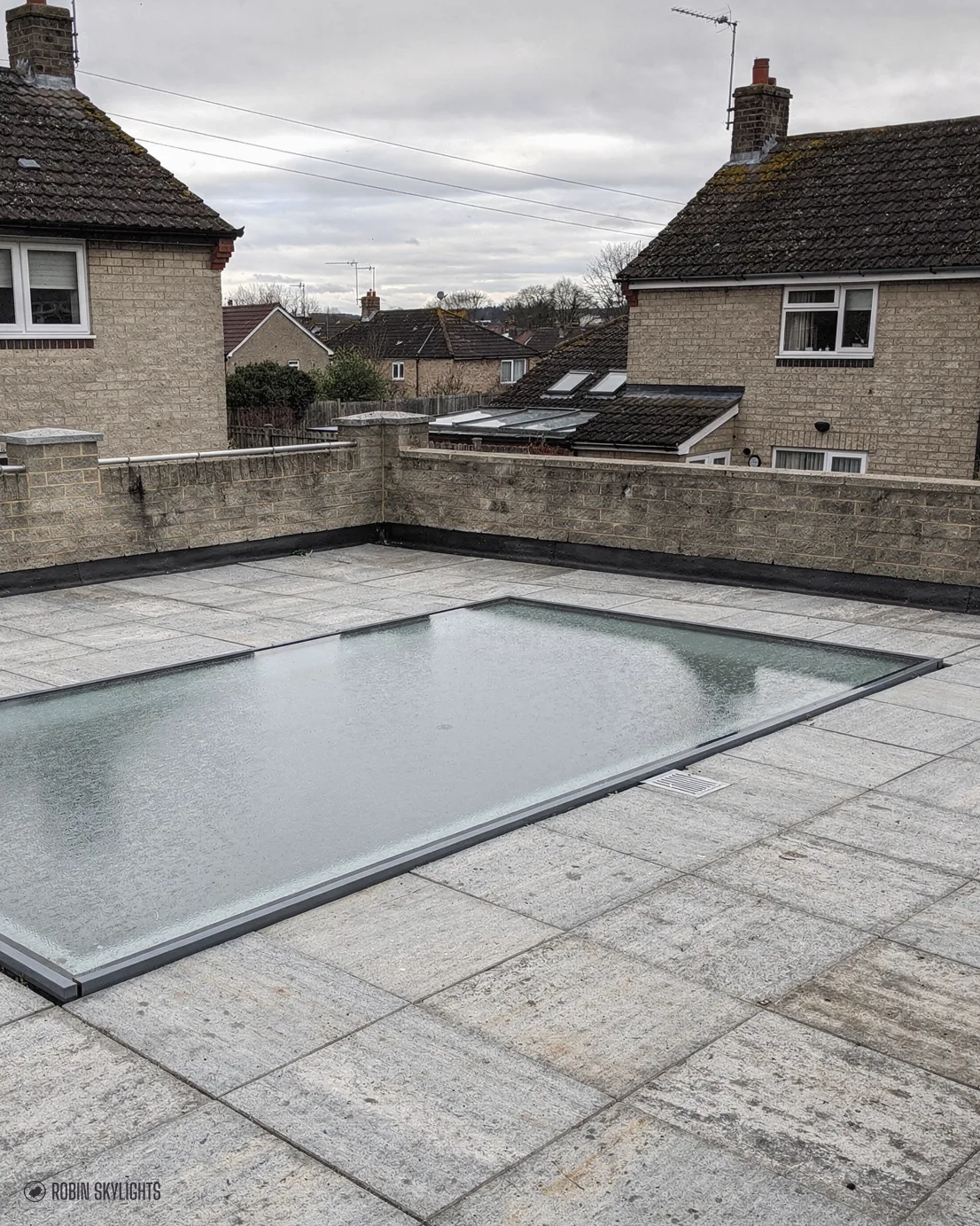
Courtyards and rear terraces in town centres sometimes sit over a basement or cellar room. A walk-on rooflight set into a terrace lets daylight down to the room below. Our walk-on rooflights page explains the glass and its specification.
Choosing the position with the street in mind
In a conservation area the placement of a rooflight can matter as much as its size. A pair of small units on the rear slope may look quieter than one large one. A slim frame in a dark finish sits better against old slate than a bright one. We sketch the options on the survey, with the room in mind first and the street view second, and on a listed house we talk them through with the council before anything is decided.
Roof windows and lanterns
Up in the roof space, a roof window brings daylight and a view of the sky. For a kitchen extension behind a listed frontage, a roof lantern brings light into the middle of the room.
Inside a stone cottage the deep reveals and small windows mean a roof opening often brightens a room more than a wall window could, and the lining can be finished to match the plaster.
05
Brooks, tourists and a Peak District wet season
Brooks, the Peak District nearby, and what a wet spell asks of a roof.
Henmore Brook runs through the middle of Ashbourne, and the map also names Bentley Brook, about 1.5 km away. Brickyard Park is 1.2 km from the centre. Tourism matters to the local economy, thanks to the town's closeness to Dovedale and the Peak District. The Limestone Way passes 2 to 3 miles away, through Tissington, Thorpe, Marten Hill and above Mayfield to Rocester.
For a roof, the lesson is exposure. A rooflight here has to cope with whatever a run of rainy days brings.
How we fit for weather
The frame is fixed to the maker's instructions, on the covering you actually have. Flashings overlap, so that each joint sheds water rather than collects it. A flat roof gets a tall upstand and a finish that drains away from it. At the end of the job we run through each joint once more before the scaffold or ladders come down.
Visitors and holiday lets
If your property is let to visitors, a bright room is a selling point in any month. A roof window or lantern changes what a guest sees in photographs and how a dark bedroom feels in November. We suggest sizes that work in that spirit.
Booking
Send a WhatsApp to 07880 284133 or complete the form here, saying which street, which room and what kind of roof. The survey is free.
Ashbourne: listings, brooks and the long drive
Our house is on a street in the town centre. Is it listed?
A street name does not settle it. The Ashbourne conservation area covers the centre and contains 149 listed buildings, so the odds that a centre house is listed or inside the area are real. We ask Derbyshire Dales District Council about your exact address before ordering a rooflight.
Is Ashbourne really within your reach?
Yes. Ashbourne is 28.6 road miles out, near the western edge of our range. The survey carries no charge and happens at your home. After it, the written quote is a fixed one.
Can a rooflight suit a stone-slate or old slate roof?
Yes, with the right flashing and a careful hand. Stone slates are heavy and uneven, so we plan the opening to lift as few as possible. A slim-framed rooflight sits low against the slates and looks quieter than a bulky frame. We explain the options at the survey.
Can a basement room under a courtyard get daylight?
Possibly, with a walk-on rooflight set into the courtyard or terrace above. The glass must be specified for the loads it will carry, and the surround must be watertight. We look at the structure and the waterproofing on the survey before recommending anything.