Quorn, down the A6 corridor: 17.7 miles south by road
Skylights & rooflights in Quorn
A Leicestershire village beside the Soar with a big conservation area at its heart and an old quarrying past. Its older roofs deserve a careful look, and so do its dim back rooms.
Stone came out of the ground here long ago
Quarrying began at Buddon Wood, on the edge of the parish, at a very early date. Whatever your own walls are made of, stone was worked on the edge of this parish, and that is a good reason to treat every roof here as an individual before we cut into it.
Quorn, read from the roof down
Quorn, a Leicestershire village and civil parish near Loughborough, is home to 5,576 people. It is a long way out of Nottingham, at the southern end of our range, and it deserves a page of its own. The five chapters ahead cover the ground we walk before proposing a rooflight: what stone and age mean for a roof, how heavily the village is listed, the river that flanks it, the roads and railway, and what we would fit. Our skylight installation in Nottingham page has the wider picture.
01
Stone country, and what it asks of a roof
Quarrying at Buddon Wood began early, and it is a fair reminder to ask what a Quorn house is built from before we plan anything. We ask, then we look.
Still, the idea of a village with a stone-working heritage is a useful prompt. It reminds us to check whether an older house has thick walls, deep window reveals and a roof covering that has weathered for generations. Those details change how a new opening should be formed.
If the roof is old
An older roof can carry a heavy covering, laid in courses that have settled over time. Lifting a section to fit a window is delicate work, and the new flashing has to marry with what is left. We examine the covering around the planned opening and say plainly if a section needs replacing for the finished job to seal.
Timbers are the next question. Old frames are not always evenly spaced, and a window made for standard gaps may not match. We measure on the day and choose the size that sits cleanly between two timbers.
- Courses
- The horizontal rows of slates or tiles that overlap down the roof.
- Soaker
- A small folded sheet of metal tucked under the courses beside a window to carry water past.
- Reveal
- The inside faces of an opening, which can be painted pale to send light further in.
If the roof is newer
Where a house is more recent, the roof frame may be factory-made, with each member doing a job that cannot be sawn away. We read the structure before any price is written, and some openings need an engineer's input.
Quarry light
A deep-set window in a thick wall lets little daylight into a room, so the roof is the better place to look for more. A pale reveal on the new opening helps spread what arrives. Satin or matt white on the reveal also avoids glare on bright days.
02
A village where heritage is the norm, not the exception
31listed
buildings recorded inside Quorn conservation area
1Grade I
the village's highest-grade listing on the records
35listed
within a 1.5 km circle of the centre
Quorn lies in the Borough of Charnwood, so your planning authority is Charnwood Borough Council. Nottingham City Council has no part in a Quorn application. Charnwood decides.
One large conservation area
On the planning records, a conservation area called Quorn sits right over the middle of the village. The designation date matters less than the boundary, so we check where your own front door falls against it. Inside it, the records list 31 listed buildings: one Grade I and thirty Grade II. A Grade I listing is rare and sits in the highest category, so a house near it deserves extra care.
Historic England counts 35 listed buildings once the circle widens to 1.5 km around the centre, again one Grade I and thirty-four Grade II. Over the river, Barrow upon Soar has a conservation area too, 1.36 km away, with 24 listed buildings of its own. It belongs to that neighbouring village, but it shows how closely the protected ground is packed here.
What this means in practice
Should yours be a listed house, cutting into its roof needs consent first. Should it be unlisted but within the conservation area, Class C normally still covers a flush rooflight, front or back. We steer new openings towards the back. We never assume. We confirm the position with Charnwood first.
The limits that apply to a house rooflight are set out in our planning permission guide, which saves repeating them on every town page. Where Building Control needs notifying, that is on us, and the finished work meets the regulations of the day.
03
A river on the doorstep and a long history of flooding
Water is the village's defining feature, and it reaches the roof too.
The River Soar forms much of Quorn's eastern boundary with Barrow upon Soar. Along it you find Pilling's Lock, part of the Grand Union Canal, the Midland Main Line and the A6 dual carriageway, all packed into a narrow strip. The map also names Lake Sara within about 1.5 km.
Quorn's history carries a blunt fact: the village has suffered extensive flooding over the centuries because the Soar falls so shallowly. A rooflight cannot be flooded, since it sits at the top of the house, but the damp that comes with a low-lying river valley is a real factor in what we choose.
Damp air and the cold pane
In a valley with this much water, the air through autumn and winter is often heavy. Cooking and showering add moisture, and glass is the coldest surface it meets. Warm-edge glazing helps, and a rooflight that can open, or has a vent built into the frame, helps more. We would rather put in a window you can crack open for a minute than leave steam with nowhere to go.
Parks and orchards
Stafford Orchard is only 0.2 km from the centre, and Tom Long's Nature Reserve 0.5 km. Trees close to a house shed onto roofs. On a flat roof the leaf-fall gathers round the kerb of a rooflight, and we build that kerb tall with the roof finish falling away from it. On a slope, the flashing is sized to match your covering.
Why the roof beats the wall
Where garden walls, hedges and trees crowd a house, windows at ground level see less sky than they should. A rooflight looks straight up, so it picks up the grey light that a wall window cannot.
04
The A6 bypass, two open stations and the drive down
Quorn lies 17.7 miles out by road, due south of the city centre, and around 31 minutes' drive when the traffic behaves. That puts it among our longer journeys, and well inside the 30-mile ring we work to.
The road
The A6 is the one classified road close to the village. A dual carriageway bypass opened on 28 October 1991 and moved the A6 to the north-eastern edge of the village.
| Station | Distance | Status |
|---|---|---|
| Quorn and Woodhouse | 1.2 km | Open |
| Barrow-upon-Soar | 1.8 km | Open |
The railway
The village has an open station, Quorn and Woodhouse, 1.2 km from the centre. It is shared with the neighbouring hamlet of Woodhouse and belonged to the Great Central Railway, the section through Quorn being preserved as a heritage line. Barrow-upon-Soar station is also open, at 1.8 km. We come by van whatever the trains do.
17.7miles
out from the city centre, due south
31minutes
in the van without hold-ups
The visit
Because Quorn is a longer run, we agree a visit with you in advance and arrive with the right ladders for the building, not the average building. The survey costs nothing. We read the room, then the roof, and only then write a price down. The price is fixed once it is on paper.
If a street is narrow, or a house sits behind a wall, tell us at booking. Our list of places we cover shows the villages around Quorn as well.
05
What suits Quorn's older houses and its newer extensions
A village with older roofs and a protected centre pushes our choices in a particular direction. Here is how we think about the room and the roof together.
Rooms under an older slope
A bedroom or study in the roof is the natural place for a roof window. In a conservation area, a modest unit set into the rear slope leaves the street front unchanged, which suits an older village. Slim frames that sit flush with the covering draw the least attention.

Extensions at the back
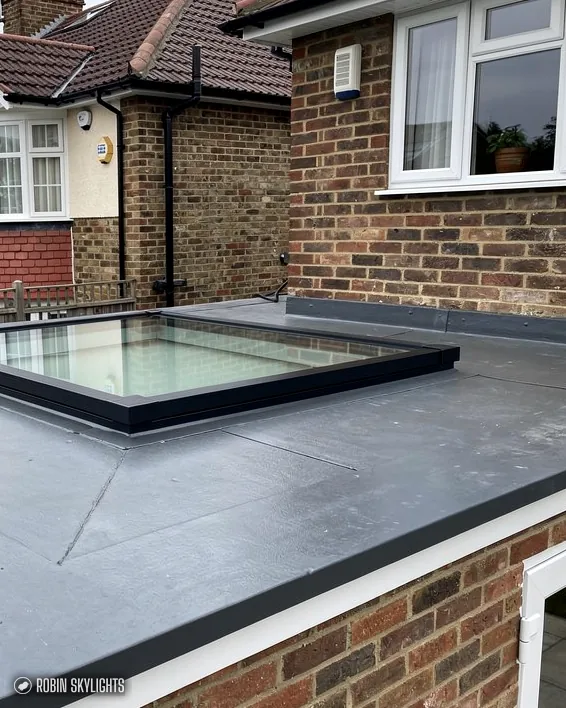
If your house has gained a single-storey extension at the back, its flat roof can leave the inner end dark. A roof lantern or a large flat rooflight solves that and is usually hidden from the road.
Inner rooms
A landing, a hallway or a bathroom in the middle of a thick-walled house may have no outside wall at all. A sun tunnel asks for a small round hole rather than a window-sized one, and it works well where the roof detail is delicate.
The order of work matters in a thick-walled house. We protect the room below with sheeting, open the roof from the outside, frame the opening between the timbers, set the unit and flash it into the covering, then line the reveal inside and clear the dust before we leave. Slate, clay tile and concrete tile each ask for a different flashing kit, so the survey records which covering you have, and the kit is ordered to match it before the first tile is lifted.
Replacing, not only adding
A rooflight you already own may have clouded between its panes or lost its seal. In many cases a new unit can go into the existing opening. The survey will tell you. All our work carries a 10-year guarantee, in writing.
What Quorn customers want to know before we visit
Will Quorn's conservation area stop me getting a rooflight?
No. The conservation area sits over the village middle, and a house there keeps its Class C right unless Charnwood's Article 4 list covers the street. We check your address with Charnwood Borough Council before ordering, and tell you straight away if a listing or a direction applies.
My house is listed. Do you work on listed buildings?
We can plan the work, but Charnwood must grant listed building consent before anyone cuts a roof opening in a listed house. We will help you work out what to apply for, and we will not start until consent is in place.
How far is Quorn for you, and do you charge extra to come out?
Quorn is 17.7 miles out by road, which is inside our 30-mile range. The survey is free and the quote we write afterwards is fixed.
We are near the river. Does damp affect a rooflight?
The roof itself sits well above any water, but damp air in a river valley can leave the inside of the glass wet on cold mornings. Warm-edge glazing and a window that opens or vents cut that down. We discuss which fits your room during the survey.