15.7 road miles due south, down the Soar valley
Skylights & rooflights in Barrow upon Soar
Water, rail and quarry stone shaped this big village on the Soar, and its middle sits inside a conservation area. Rooflights here start with the right room and a quick Article 4 check.
A gypsum plant in the village
British Gypsum has a plant at Barrow, and quarry rock still arrives along a conveyor that follows the old Mountsorrel Railway. What goes into the roofs of the village is our side of the job.
Barrow upon Soar, between the river and the railway
Barrow upon Soar is one of the larger villages of northern Leicestershire. It sits in the Soar Valley, between Leicester and Loughborough, and is home to 6,823 people. Of the five chapters below, one is about the river and one about the railway, because both decide how a rooflight job here runs. For everything we install before the local detail, see skylight installation in Nottingham.
01
On the east bank of the Soar
A river, a brook and a canal close by, and a lot of grey in the air.
The village stands on the east bank of the River Soar, at the point where the Fishpool Brook joins it. Close to the centre you also find the Barrow Canal Basin and the Grand Union Canal, so water is never far from the village centre. The parish touches Swithland Reservoir. Green patches in the village include Millennium Park, a public open space and Stafford Orchard, and Tom Long's Nature Reserve is about two kilometres off.
What a river valley does to the light
Low ground by a river gathers mist on cold mornings and tends to stay cloudy longer than the hills around it. A room facing a damp, grey view for months wants every scrap of daylight its roof can give, and that is why we think about where the opening sits before we think about the frame.
| Place | Distance |
|---|---|
| Millennium Park | 0.9 km |
| Public open space | 1.1 km |
| Stafford Orchard | 1.4 km |
| Tom Long's Nature Reserve | 2 km |
Roofs near water
Damp air sets two things to work on a roof. On a flat rooflight, moss and algae gather at the foot of the frame, where water lingers. On a pitched roof they settle in the valleys and behind flashings. Neither is a disaster. Both are easier if we leave a clear, reachable margin round each opening and use finishes that shed water instead of holding it.
Inside, a cold pane of glass meets warm kitchen air. A well-insulated unit stays warmer and mists less, and a sash that opens lets out the steam that does form. Whichever we fit, the aim is the same: a bright room that does not drip. A reachable margin also makes the first clean-up easier, since you can wipe the frame from a stepladder or the room below.
02
Getting to you: the A6, the Midland Main Line and a short walk to the station
15.7miles
by road, due south of the city centre
27minutes
behind the wheel, with average traffic
0.3km
from the village centre to Barrow-upon-Soar station
From the city centre, count 15.7 miles by road to the south and you are in Barrow upon Soar, around 27 minutes' drive. The A6 is the classified road close to the village centre. Barrow-upon-Soar station stands 0.3 km from the centre point, on the Midland Main Line, and East Midlands Railway trains call there from Monday to Saturday, with no service on Sundays.
That is useful if you are weighing the village against somewhere else, but not much use to us: we arrive by van with the kit for the job, and we agree a day with you at booking.
What we do on the first visit
The first visit is the survey, and it carries no charge. We want to see the room that is dark, then the roof above it, and the loft between them if there is one. That order is deliberate. A roof tells us what is possible, but the room tells us what is worth doing.
After the visit we write the price down. It is a fixed quote, so if a rafter turns out to sit awkwardly, that is our problem and not an addition to your bill.
The wider run of villages
The Soar Valley has villages all along it and they all fall within our reach. A list of them, and of every other place in our 30-mile road radius, is on the areas we cover page.
In the grey months, a pale reveal and a splayed lining carry light further into the room than square, dark edges around the opening do.
03
Charnwood, the conservation area and the listed list
Barrow is in Leicestershire, so the planning authority is Charnwood Borough Council. Nottingham has no say here. Charnwood is the body we ask about your address.
Heritage runs deep here. A conservation area also named Barrow upon Soar covers the village centre point itself. Inside it stand 24 listed buildings: a Grade II* and twenty-two at Grade II, plus one with no grade on file. A second conservation area, Quorn, lies 0.72 km from the centre point, and it holds 31 listed buildings of its own, including one at Grade I. In the wider circle round Barrow's centre, Historic England counts 31.
Why this matters for a rooflight
When the centre of a village is a conservation area, a house there normally still has the usual right to a rooflight, and the practical question is whether an Article 4 direction applies. If none does, the slope is chosen for the light it gives the room. If your house is on the list, a new opening in the roof also needs listed building consent, applied for separately.
We therefore establish three things at the start: whether your address is inside the conservation area, whether the building is listed, and whether an Article 4 direction covers the street.
24listed
buildings inside the Barrow upon Soar conservation area
31listed
in all around the village centre point
2areas
conservation areas recorded close by (Barrow upon Soar and Quorn)
National rules, one page
Everything that applies in every town in England is in our planning permission guide. When a Building Control notice is due, it leaves our office, addressed to Charnwood or to a registered approver.
04
Reading the house before we suggest anything
How do we find out what a roof will take? Every house is treated as its own problem, because roofs differ from one street to the next, sometimes from one door to the next.
Three things the survey settles
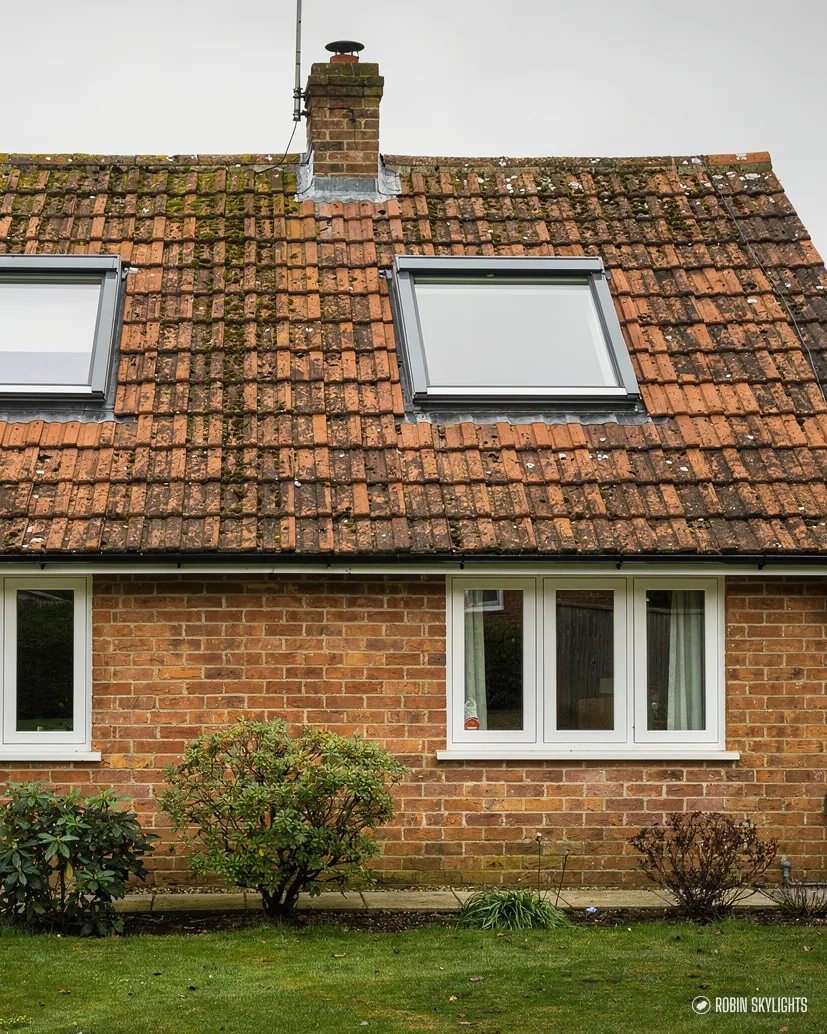
First, what is the roof made of? Clay tile, slate, concrete tile and a flat membrane each want a different flashing or kerb, and the wrong match is where leaks begin. Second, what holds it up? Cut rafters can be trimmed round an opening, while factory trusses need the load carried round. Third, what is under it? A loft with a plain ceiling below, a room made in the roof and a flat-roofed extension are three different jobs, with three different sets of flashings.
Where the light is needed
We always start with the dark room, never with the roof. Sit in it in the middle of a winter afternoon and notice where the brightest patch is, and where it fades. A rooflight earns its keep over the part that fades. In a long room that is the far end, in a stairwell it is the top landing, and in a bathroom with no outside wall it is straight above you.
Where a property is listed or in the conservation area, the answer may be a conservation-style rooflight, a flush unit built to sit close to the tiles. Our conservation rooflights page explains how those differ from ordinary roof windows.
Often the first answer is a position, not a product. Move a window two hundred millimetres up the slope and a sofa corner turns from dim to usable. We mark the line with tape in the loft, stand in the room and check the view before anything is cut.
05
What we are most likely to fit here
Three products come up in a village of this kind, and the choice always follows the room.
Roof windows for rooms in the roof
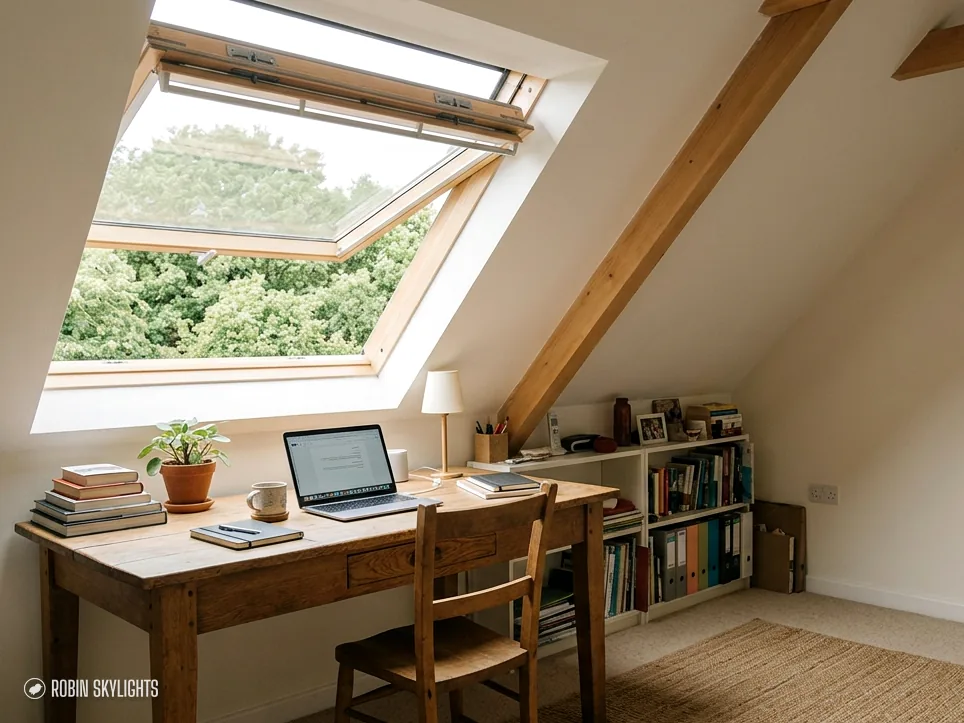
A bedroom or study under the slope gains light, air and a view of the sky from a roof window. Put it where the eye falls when you are seated at a desk or lying in bed, not where it is easiest to cut. A few centimetres up or down the slope changes what you see from the chair. A cottage roof with a deep slope suits two smaller windows better than one big one.
Flat rooflights over extensions
The back of a kitchen that was built out into the garden is the commonest dark room of all. A flat roof rooflight fixes it, and a fixed one is the plainest choice. Opening versions add ventilation.
- Kerb
- The raised edge of a flat roof, which carries a rooflight and shields the opening from rain.
- Truss
- A factory-made timber triangle that holds the roof up and cannot be sawn through at will.
- Flush rooflight
- A unit that lies close to the roof covering instead of standing proud of it.
Sun tunnels for the interior
When the dark space sits in the heart of the house, with a loft above it, a sun tunnel runs a short tube from a roof dome to a ceiling panel. It will not open or give a view of the sky, but it will light a landing, a hall or an inside bathroom well enough that the lamp can stay off at midday.
Fitted properly, guaranteed in writing
The fitting comes with a ten-year workmanship guarantee that we put in writing. If an old unit has failed, we can usually swap it on the opening that is there.
Questions from the Soar Valley
With the centre of the village in a conservation area, will a rooflight be allowed?
Usually, yes. The village designation does not remove the permitted development right for a house; an Article 4 direction or a listing would, so we check both first. Without either, the slope is picked for the room below. We confirm your address with Charnwood, and for a listed house we say at the start that separate consent applies. That avoids ordering something the council would refuse.
Does living by the river make a rooflight a bad idea?
No. Damp air means more moss and condensation, not leaks, if the kerb and flashings are right. We leave room to clean round each opening and choose insulated glazing that stays warm, so the glass mists less in a cold spell.
I work from home and the back room is dark. Where would a window go?
Where the light fades in the middle of a winter afternoon. We check that on the visit, then see if the roof structure allows an opening at that spot. If it does, we place it where it lights your desk, not just where it is easy to cut.
How do I get a firm price?
Book the survey, which is free. We study the room and then the roof, and send a quote in writing with one fixed figure. The price does not change once work starts, and the Building Control notice, where one is needed, is ours to deal with.