North-north-west of the city centre, 18.3 road miles out
Skylights & rooflights in Tibshelf
A conservation area by the middle, a common on the doorstep and the M1 not far off. Roofs here sit under wide, changeable skies, and many rooms underneath them go grey early.
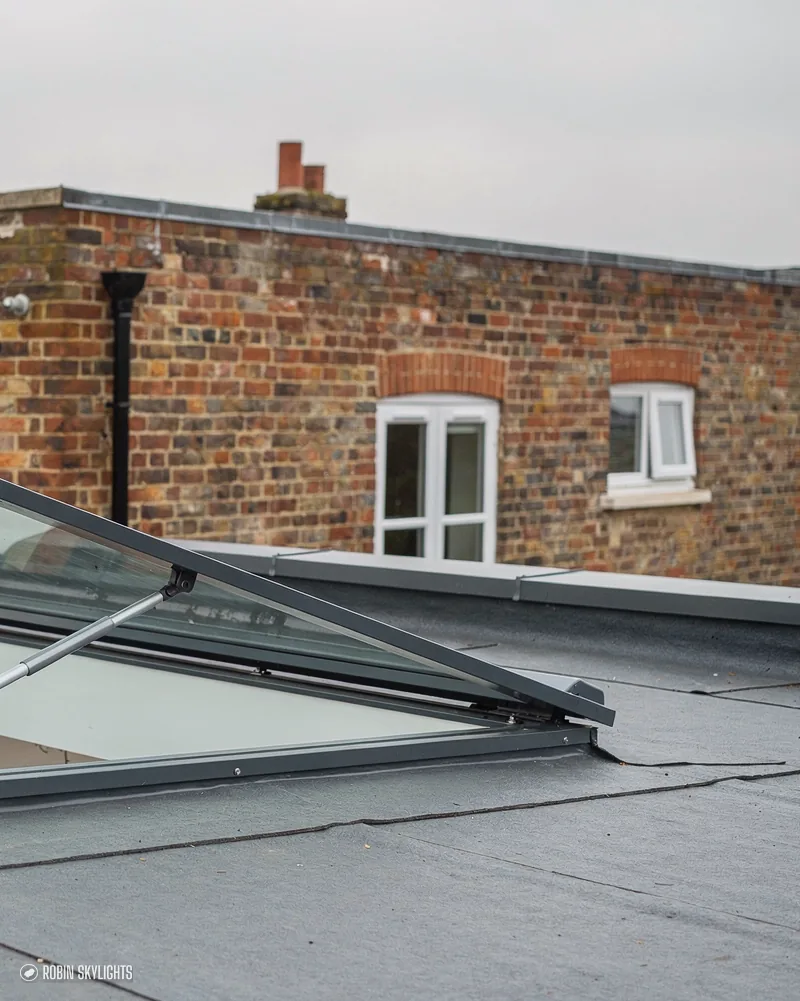
Open common, open sky, open roof
Tibshelf Common is only 0.2 km from the village centre. Open ground like that means long views of cloud and plenty of weather landing on a roof, which is the exact condition we plan rooflights for.
Tibshelf, from the pit to the present
Tibshelf, in Derbyshire, has a recorded population of 4,352. Coal mining overtook farming here, and railways followed the coal. Today it is valued as a place to live partly for its position by the M1. We start this page with the council, because Tibshelf has a conservation area just 0.15 km from its centre, and then move through the land, the railways and the roofs. If you want the firm in general terms, see skylight installation in Nottingham.
01
Bolsover District Council and a conservation area by the centre
Tibshelf is in Derbyshire, not Nottinghamshire, and the authority that decides planning here is Bolsover District Council. Nottingham City Council has no role.
The Tibshelf conservation area
A conservation area named Tibshelf lies a mere 0.15 km from the village centre point, designated on 7 February 1979, and two listed buildings, both Grade II, are recorded inside it. In plain terms, a house in the middle of the village has a fair chance of falling within the boundary.
Being in a conservation area does not by itself cancel the usual national allowance for a rooflight; only an Article 4 direction made by the council does that. So for any house near the centre, we put two questions to Bolsover before a rooflight is ordered: is your address listed, and does an Article 4 direction cover it? Without either, the slope follows the room.
2areas
conservation areas on record: Tibshelf (1979) and Newton (2002)
3listed
buildings on Historic England's list in a 1.5 km circle, all Grade II
Newton, and the listed buildings
A second conservation area, Newton, is recorded about 1.43 km from the centre. It was designated on 9 January 2002 and holds three listed buildings. Its name suggests a neighbouring settlement, so it may not touch your street. Three listed buildings, all Grade II, are on Historic England's records in a circle of 1.5 km around the centre. For a listed house, consent of a separate kind, listed building consent, is needed before a roof is opened up.
Beyond Tibshelf: the England-wide side
The national planning conditions and the building rules for a new opening sit in our planning permission page, so we need not restate them here. When the work is notifiable, we put in the Building Control notification ourselves.
02
A coal village, and a survey that starts in the loft
Tibshelf's story is the story of the coalfield. Coal mining overtook agriculture as the main industry of the area, and a local railway system grew up to carry what was dug. After the pits, the village had to remake itself, and it has done so by becoming a popular place to live.
Farm-age, mining-age and recent homes can all turn up in a village like this, so the loft is where we get the answer. A look through the hatch tells us more than any street description could.
How we find out
The loft is our first stop at the survey. Old timber roofs show sawn rafters, sometimes uneven and sometimes patched. Newer roofs show factory trusses, tidy and numerous. Rafters can be trimmed round a new opening. Trusses are structure and cannot be cut through, so for those the opening has to be planned between members or supported with extra framing.
We also look at what is above the framing: slate, clay tile, concrete tile or a flat roof covering. Each has its own flashing method, and a roof window set into the wrong kind of collar can leak long after the work looks finished.
- Truss
- A factory-made roof frame in triangles. It works as one unit, so we do not simply saw through it.
- Rafter
- A timber running down the roof slope. In older roofs it can be trimmed round a new opening.
- Collar
- The flashing set round a roof window that seals it to the surrounding tiles or slates.
- Article 4 direction
- A council order that takes away permitted development rights in a defined area, usually a conservation area.
Light from a mining-village plan
Wherever a house has a middle landing with no outside wall, or a bathroom tucked behind it, light is the problem. A sun tunnel serves those places well, since the hole it leaves in the roof is small and round. Where a loft has been boarded and made into a room, a larger roof window is likelier to suit.
03
Railway ghosts and the road we take to you
Tibshelf once had three stations in its parish. A branch of the Midland Railway, opened in 1863, ran from Westhouses and Blackwell on the Erewash Valley line to Teversal, and was later extended to Mansfield Woodhouse. In 1893 a second station, Tibshelf Town, opened on the Manchester, Sheffield and Lincolnshire Railway line to Annesley. Its name was optimistic, reflecting hopes that Tibshelf would win official town status. A third station in the parish, Doe Hill, served the villages of Stonebroom and Morton.
Those lines are history. Nowadays the nearest station site is Pilsey, about 2 km away, and it is closed, so no train or tram serves the village. The roads are what matter: the B6014, B6025, B6026 and B6039 all pass close to the centre, along with the M1. The motorway services were first named Chesterfield Services before local pressure had them renamed for Tibshelf.
The drive
Reaching Tibshelf means 18.3 miles of road from the city centre, heading north-north-west, and around 31 minutes at the wheel. That puts it in the outer half of our area, so we plan one thorough visit rather than a string of short ones. Before we come we ask three things: how to reach the roof, where to leave the van, and whether a hatch gives access to the loft.
18.3miles
by the road route into Nottingham
31minutes
mapped drive, as a guide only
What the visit gives you
The survey costs nothing. We assess the room, the roof and the route water takes, and we write the price down only after that. The quote does not move once it is agreed. Our areas we serve page lists the neighbouring towns and villages we also cover.
Parking and access are worth a word when you book. If the road is narrow or the drive is short, tell us, and we will plan where the ladders and materials go before the day.
04
A common, two ponds and the weather they bring
What open ground means for the roof over your head.
Tibshelf Common lies 0.2 km from the village centre point, and Tibshelf Ponds 0.5 km. Higher ground is recorded nearby too: Newtonwood Lane is 1.5 km off and Strawberry Bank 2.4 km. It is open, edge-of-village country, and the roofs on its fringes meet more of the weather than those packed into the middle of a street.
Wind-driven rain
On an exposed roof, rain seldom falls tidily. It arrives at a slant and is pushed into joints that would stay dry on a sheltered slope. For a roof window, the flashing therefore matters more than any other detail. We pick a collar made for your covering and fix it so the top edge carries water over the frame and the bottom edge lets it run clear. For a flat rooflight, the upstand does the same work, and we raise it high enough to keep any puddle below the seal.
| Place | Kind | Distance |
|---|---|---|
| Tibshelf Common | Park | 0.2 km |
| Tibshelf Ponds | Park | 0.5 km |
| Newtonwood Lane | Hill | 1.5 km |
| Strawberry Bank | Hill | 2.4 km |
Light under a wide sky
The upside of open land is a broad sweep of sky. Even a dull afternoon delivers a lot of scattered light, and a rooflight set where it can see plenty of that sky outperforms a small opening shaded by a chimney or a neighbouring gable. When we choose a position, we sit in the room and look up: what does this spot see?
Our page on daylight on grey days sets out how we reason about low light between October and March, which is when this village's rooms most need help.
05
What we would look at first in a village like this
In Tibshelf, as in any village, we begin from the rooms. Three starting points cover most conversations in a village of this kind.
A flat roof over a kitchen or garage conversion
Extensions built onto older houses often have flat roofs and a deep floor plan. A flat rooflight over the darkest part of the room is usually the simplest fix, as it needs no change to the main roof. You will find sizes and the watertight detailing on the flat roof rooflights page.
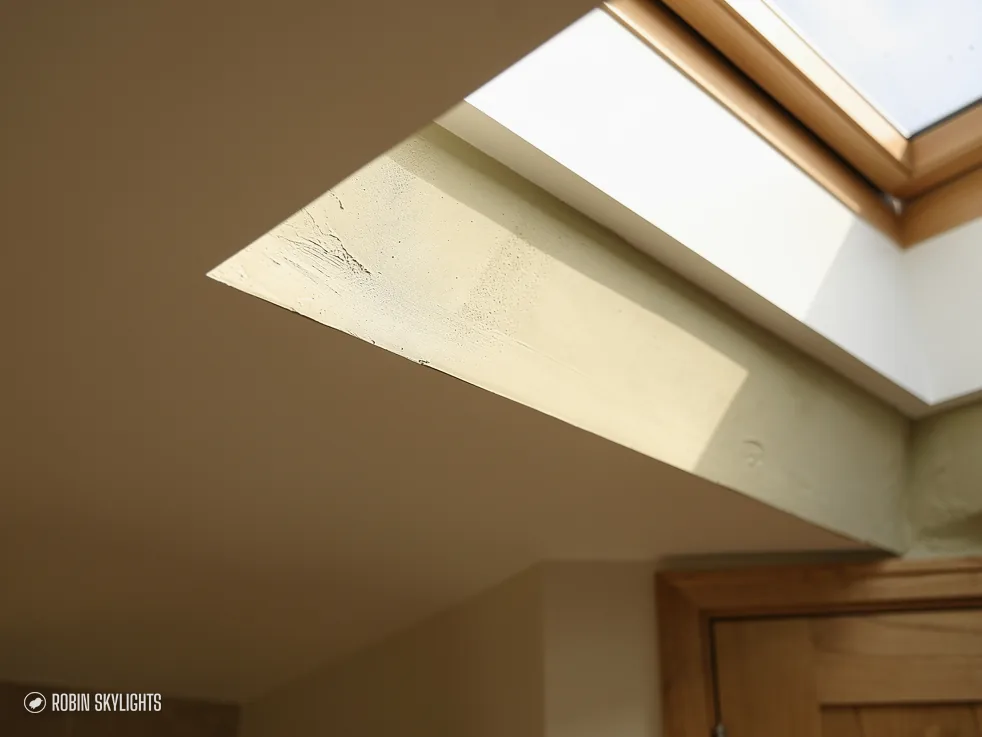
A bedroom or study in the loft
A roof window brings sky and air into a roof room. Fitting two side by side lights a long room more evenly than one large unit. The glazing decides how well a room holds its warmth, so we talk through the choice before you decide.
Replacing something worn out
A rooflight fitted decades ago may have faded seals, a cracked frame or a leak at the edge. We both install new rooflights and replace existing ones. Sometimes a new unit can be set on the same opening without touching the roof structure, and we say so after the survey.
Every job is guaranteed against faulty workmanship for ten years, in writing. A listed house gets consent first. In the conservation area, is there an Article 4 direction? We look that up first.
Tibshelf questions: conservation, councils and landings
I live near the middle of Tibshelf. Does the conservation area rule out a rooflight?
No, not automatically. A conservation area is recorded 0.15 km from the village centre, and a house there normally keeps its usual right. Permitted development often still applies, and Article 4 is the usual reason it would not. We ask Bolsover about your address before ordering, and where no direction applies the room decides the slope.
Is it Bolsover or Derbyshire County Council that I deal with?
Bolsover District Council, not the county, acts as planning authority for Tibshelf. For a rooflight, planning questions go to the district, and Building Control goes to the council's service or to whichever inspecting body takes the job. We contact them for you where it is needed and make any notification the work requires.
Our landing has no window at all. Is a rooflight possible?
Often, yes. With a loft above the landing, a sun tunnel can cross that space and end in a ceiling panel, needing only a small roof opening. If the landing sits directly under the slope, a roof window may fit. The free survey tells us which route the roof allows.
The M1 is close. Does that change anything about the survey?
It changes how you reach us, not the work. At 18.3 miles by road, Tibshelf gets one full visit from us rather than several short ones. The survey costs nothing, the quote we write afterwards does not change, and we look after council paperwork before installing.