Due north, 22.8 road miles out, at the edge of Sherwood
Skylights & rooflights in Market Warsop
The market half of Warsop, south of the River Meden and on the fringe of what remains of Sherwood Forest. Winter light arrives late and leaves early up here, and plenty of back rooms feel it.
A stone tower that lost half its sails
Warsop's windmill was a stone tower raised in 1825 and known as Forest Mill, later Bradmer Mill. A gale blew two of its four sails down in 1910, and it ran for a short time on the other two. Buildings here have been adapting to weather for a long time.
Market Warsop, under the weather
Market Warsop, with a recorded population of 6,970, is one half of Warsop, a civil parish in Mansfield District. The other half, Church Warsop, lies across the river. Between them they hold a good deal of listed building and two conservation areas, so we begin with the ground and the paperwork before we talk glass. A check made early costs nothing and saves a wasted order. After the paperwork we cover the town's history, the road in, the river and the products. Everything we do is introduced at skylight installation in Nottingham.
01
Mansfield District Council and the two Warsop conservation areas
Warsop belongs to Mansfield District, so rooflight questions go to Mansfield District Council. The Nottinghamshire address can mislead people into thinking the city decides. It does not.
Two areas, one parish
The split between the two halves of Warsop is real on the ground as well as on the map, and the paperwork follows it.
A conservation area named Market Warsop covers the town centre point. It contains five listed buildings, all of them Grade II. The second, Church Warsop, lies 0.54 km off and contains 14, ranging from a Grade I and a Grade II* to twelve at Grade II. Between them they cover the two halves of the old settlement, either side of the River Meden.
Historic England counts 21 listed buildings in the surrounding 1.5 km, and nineteen of them are Grade II. The windmill, a Grade II listed tower, stands to the south-east of Warsop near the A6075.
| Area | Distance | Listed inside |
|---|---|---|
| Market Warsop | At the centre | 5 (all Grade II) |
| Church Warsop | 0.54 km | 14 (I, II*, 12 II) |
What that means for a roof
Live in a listed building and you need consent before anyone cuts the roof. Live in either conservation area and the usual right normally stands, unless an Article 4 direction has removed it, so a direction is the first thing we look up. Neither rules a rooflight out in advance. They are conditions to read before an order goes in.
The conditions that apply to every house rooflight are explained in the rooflight planning guide. Mansfield gets asked about your address directly, because boundaries are redrawn from time to time. If the job is notifiable, Building Control hears from us, not from you.
02
A fair, a market and a pair of collieries
The settlement's layout comes from trade. Two annual fairs were granted, along with a Saturday market, and the market was held south of the River Meden. The area became known as Warsop Fair Town, and later Market Warsop. The original settlement, north of the river, became Church Warsop.
Coal followed. Two collieries were built within the parish to reach the coal seams in Nottinghamshire: Warsop Main in the north-west in 1893 and Welbeck in the north-east from 1912.
Roofs from a market town that grew in stages
Every place has a few streets that people think of as typical, and every surveyor has been surprised by what was under the tiles. Both are reasons to wait for the survey.
The history shows a place that grew in stages, around a market, a mill and two collieries. Roofs from different decades behave differently, so each one gets measured rather than assumed.
The survey starts at the ridge and works down. On a slate roof we check for slipped or flaking slates around the planned opening, on concrete tile the interlock and the battens, and on an older felt-and-batten roof the condition of the underlay, because a fault found in a dry January loft is easier to deal with than one found in a wet March. Then we measure the rafters and mark the opening from inside, so you can see where the light will fall.
A long rear extension
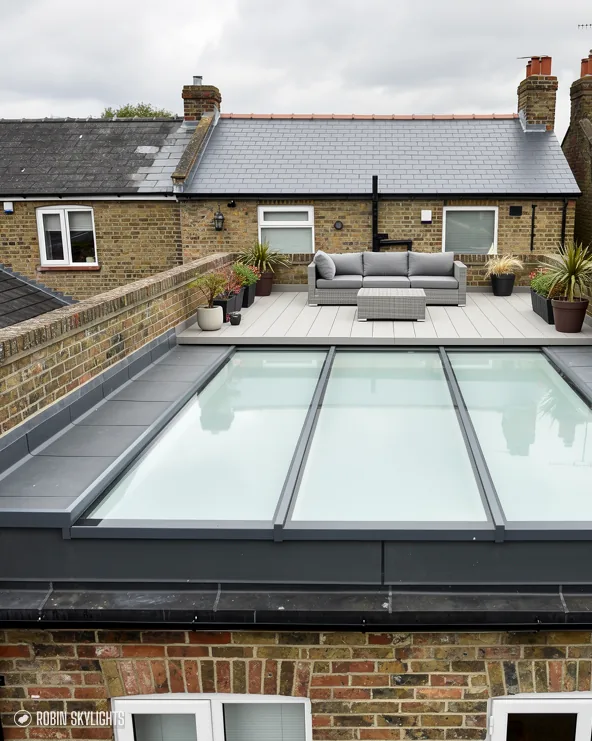
Once a house has been extended backwards, the old kitchen window can end up deep inside the plan. A long, narrow rooflight over that middle section drops light where it is needed, and the flat roof rooflights hub shows the formats.
A child's room under the slope
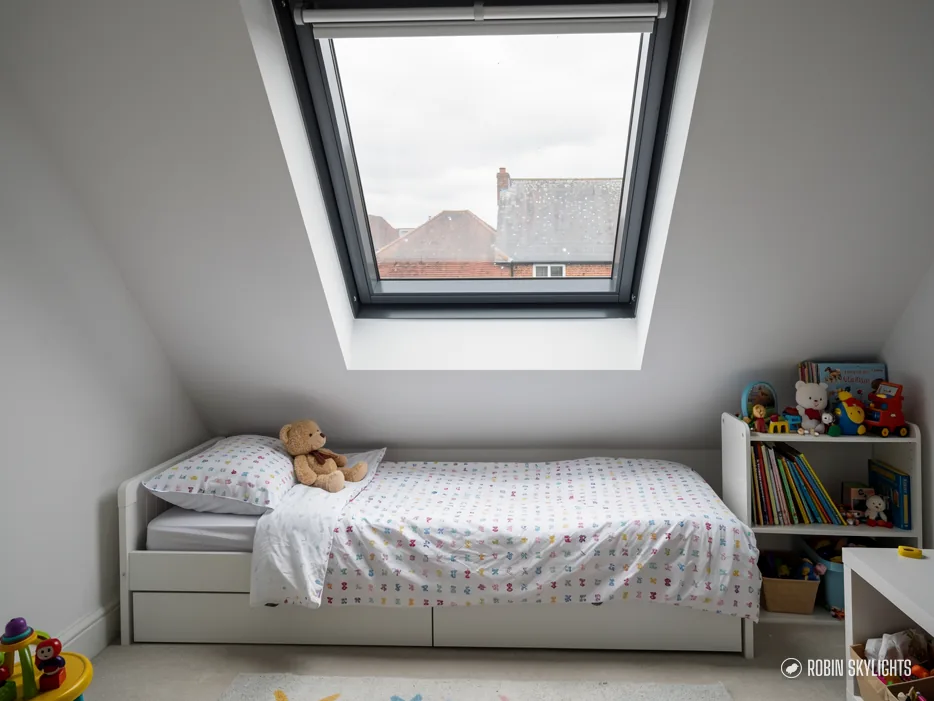
A bedroom in the roof can feel shut in during the short days. A roof window brings sky into the room and opens for air. Positioned low enough for a child to look through from the bed, it makes a small room feel larger.
Before ordering, check the room height beneath the opening, because a sloping ceiling lining can reduce how far the light spreads across the floor.
03
Getting to you: 22.8 miles north on the A60
Heading due north, the distance by road from Nottingham's centre is 22.8 miles, a drive of around 43 minutes. That is a long run, but it is inside our 30 road miles. The A60, B6031 and B6035 are the classified roads nearest the middle of town.
Rail does not help: draw a 2 km circle and it holds no station and no tram stop. Everything travels in the van.
Planning a survey visit
With a longer trip, we set the visit with you rather than squeeze it in, which leaves time to go over the room and roof properly. Nothing is charged for it. A written quote follows, and its figure is final.
22.8miles
to the middle of Nottingham, by road
43minutes
driving, in normal conditions
Parking and access
Access is the practical question that decides how smoothly a job runs, so we raise it early.
If parking near you is tight, say so. Tell us if there is a drive, a side passage or a back lane, since it affects how ladders and glass get to the roof. We would rather solve that at the survey than at nine on the morning of the job.
Unsure whether your address counts? The areas page names the neighbours we also cover, such as Mansfield Woodhouse, Edwinstowe and Shirebrook.
04
A river, a park and some Sherwood weather
Wet ground at the forest edge, and how a roof copes with it.
The River Meden runs through the settlement, dividing Market Warsop from Church Warsop. The Carrs, a park, is half a kilometre from the centre, and The Bottoms Local Nature Reserve is 2 km away. Warsop itself sits on the outskirts of the remnants of Sherwood Forest, so trees are never far.
Trees, a river and open ground make for damp, leafy air. A rooflight will cope with that if it is built to. The detailing is not difficult, but it has to be right from the first day, because a roof is not a place anyone wants to revisit.
Leaves at the upstand
A flat roof near trees collects leaf litter in the corners. At the raised frame, called the upstand, it holds water against the seal. Our upstands are built tall enough that puddles stay below the glass edge, and the roof finish is laid to fall away from the frame.
- Upstand
- The raised kerb around a flat-roof opening on which a rooflight sits.
- Flashing
- The weatherproof surround, usually metal, that joins a roof window to the tiles or slates beside it.
- Sash
- The moving part of an opening roof window or rooflight.
Condensation and the cold pane
A damp house shows it on glass. Steam from cooking and washing settles on the coldest surface in the room, and in winter that is the window or rooflight. A glazing unit built to hold the inner pane warmer helps, and so does a sash that opens. If a rooflight in a bathroom steams up each morning, we look at ventilation as well as glass.
Wind on an exposed slope
A gale took two sails off the old windmill in 1910, which says something about the weather this ground can get. A pitched slope facing the weather needs a flashing kit matched to the covering, so rain driven sideways cannot find a way in.
05
Which product for which room
The room comes first here, not the catalogue. Three rooms come up again and again in a place like this, and each leads to a different product. It helps to know which room you want to change before the survey, because it sets the order we look at things in.
Photographs of the dark spot, taken in the afternoon on a dull day, are a useful thing to send in advance. They show us what the light actually does, which is more telling than any description.
A landing or hall with no window
A sun tunnel gathers daylight at a small dome and delivers it through a mirrored tube. It barely touches the roof structure, and the tube can be short or long to suit the depth of the loft.
A kitchen at the rear
A lantern or a flat rooflight over the darker end lights both worktop and table. The roof lanterns hub shows the frame styles and how the base is built up.
A bedroom under a pitched roof
The roof window is the natural choice. A blind can be measured and fitted during the same visit, which saves a second trip up the ladder.
Swapping out a tired rooflight
A unit with fog inside the glass, or damp at its edge, gets its frame and opening surveyed, and a new unit can often go in the same place. The installation follows the Building Regulations in force, and the workmanship has a written guarantee lasting ten years.
Before you ask us to climb a Warsop roof
Does Mansfield or Nottingham deal with planning for a rooflight in Market Warsop?
Mansfield District Council. A rooflight on a house often needs no application, but flats and listed buildings are treated differently, as is any street under an Article 4 direction. Market Warsop and Church Warsop both have a conservation area recorded. We check your address with Mansfield before you order anything.
Will you come all this way for a single rooflight?
Yes. Market Warsop is inside our 30 road miles, so the survey costs nothing, whatever the size of the job. A single rooflight over a dark kitchen is a job we are glad to price, and the figure we give you in writing is the one that stands.
Our back bedroom is cold and dark in winter. Would a roof window help?
It can help with both. A roof window brings light from overhead, and modern glazing holds heat better than an old window. We check the roof structure and the insulation round the opening on the survey. Then we tell you what size fits between the rafters before quoting.
Do you replace a leaking rooflight, or only fit new ones?
Both: installation and replacement. A rooflight that leaks at its edge or has fogged between the panes has its frame, upstand and flashing checked first. Often a new unit can use the existing opening. The survey tells us which applies, and we explain it before quoting. Nothing is ordered until you have a price in writing.