At the edge of our range: 30 road miles west-south-west of Nottingham's centre
Anglesey, Burton upon Trent: skylights and rooflights for terraced streets
A Staffordshire parish south of Burton's centre, packed with late Victorian and early twentieth-century terraces and ringed by conservation areas. Daylight has to come from above, and the planning check comes before the product.
Canal basins, the Trent and a long line of terraces
Water runs close to this part of Burton upon Trent: the Trent and Mersey Canal, the Bond End Canal at Shobnall Basin and the river itself. The terraces here were put up in the late nineteenth and early twentieth centuries, long before anyone thought about winter daylight.
Anglesey, from the edge of the map inward
Anglesey is a civil parish in East Staffordshire, a suburb in the south of Burton upon Trent around Anglesey Road, with 7,843 people on record. It sits right at the limit of the area we cover, and seven conservation areas lie within about 1.4 km of its centre point. The chapters run from the drive out, through the terraces and the council records, to the canals and the Trent, and end with the products we would choose. Our work as a whole is described on the page about skylight installation in Nottingham.
01
Thirty miles out, and still on the survey list
Anglesey lies west-south-west of Nottingham, 30 road miles out, and roughly 41 minutes away in the van in ordinary traffic. That puts it at the outer edge of the area we serve, and we treat it exactly the same as a street in Nottingham: the survey is free, the quote is fixed and the guarantee is in writing.
The A5121, A5189, B5017, B5018 and B5416 are all classified roads near the middle of the parish. Burton-on-Trent railway station is under a kilometre away, at 0.9 km. Branston station, 1.8 km away, is closed. We drive to every job with the ladders and glass in the van, so the station matters to you, not to us.
Planning a visit at the limit of the map
Because Anglesey is a longer drive, we like to make one trip count. At the booking stage we ask which rooms are dark, how the roof is reached and where we can park, so the survey covers everything in a single visit. Terraced streets here can be tight for parking, and a quick call about it saves time on the day.
30miles
of road, the edge of our range
41minutes
van time, normal traffic
0.9km
to Burton-on-Trent station
What the quote contains
Distance does not change the terms. The price is set in writing once we have seen the roof, it stays fixed on the day, and the fitting is done to current Building Regulations. If the work needs notifying, the notice is ours to send, to the borough council or to a registered approver.
The area list
If you live nearby, in Shobnall or Stapenhill, the same survey applies. The areas we cover page gives the wider list of towns.
02
Late Victorian terraces and a new development
The housing in Anglesey is mainly late nineteenth and early twentieth century terraces, with a newer housing development alongside them. Both are common in Burton, and both have roofs we can read on a survey.
Terraces and what they hide
A terrace of that age is narrow and deep. The front room and the back room have windows, but the middle, the stairs and the landing, often have none. Some have been extended at the back with a kitchen or bathroom, and those added rooms run deeper into the plot than the original design intended.
The dark places are predictable. We look first at the landing, then at the back addition, then at the loft if it has been opened up. A window in the back slope lights a loft room, a small flat rooflight lights a back addition and a sun tunnel can lighten a landing if there is a roof space above it.
Roof structure in older houses
Rafters in a roof of this age may not be evenly spaced. We measure the gaps and choose a window size that fits between two rafters, which keeps the work tidy and avoids cutting timber that carries weight. Our roof windows page explains the sizes.
- Rear slope
- The roof face looking onto the back garden.
- Landing
- The floor space at the top of a flight of stairs.
- Truss
- A factory-built frame of timbers that forms the roof structure in newer houses.
The newer homes
A new development normally has factory trusses, which cannot be cut. If you are in one, we check how the roof is framed and place a window or sun tunnel to suit. A sun tunnel is often the easier choice where trusses are close together.
03
East Staffordshire and a ring of conservation areas
The planning authority is East Staffordshire Borough Council, in the county of Staffordshire. Anglesey is in Staffordshire, so the council is different from the Nottinghamshire ones, and we check the local details with them.
Seven conservation areas close by
Seven conservation areas lie within about 1.4 km of the centre of Anglesey. Clarence Street and Anglesey Road is 0.21 km away and holds two listed buildings, both Grade II. Station Street and Borough Road lies 0.82 km out (listed as designated in January 1999) and has 12 listed buildings. George Street, 0.98 km away, dates from December 1988 and has eight Grade II. The canal corridor, at 1.14 km, is the Trent and Mersey Canal area, with 16, designated in May 1988.
Also on the record is the Burton No. 2 and 3 Town Centre area at 0.68 km, with 70 listed buildings: one Grade I, four Grade II*, 64 Grade II and one with its grade unrecorded. King Edward Place and Horninglow Street and Guild Street are named for neighbouring streets. Historic England counts 93 listed buildings in all across a 1.5 km ring.
7areas
conservation areas recorded within 1.4 km
93listed
buildings on the Historic England list nearby
What it means
With that much on the record, we do not assume your street is clear. Listing means nobody cuts a new roof opening until consent is granted; being in a conservation area asks for no consent by itself, though an Article 4 direction on the street would. We ask East Staffordshire about your address before ordering. The rules for rooflights on houses are the same throughout England, and they sit on one page, the guide to rooflight permission. We send the Building Control notice for you when one is needed.
| Area | Distance | Listed buildings |
|---|---|---|
| Clarence Street and Anglesey Road | 0.21 km | 2 |
| Burton No. 2 and 3 Town Centre | 0.68 km | 70 |
| Station Street and Borough Road | 0.82 km | 12 |
| George Street | 0.98 km | 8 |
04
Canals, the Trent and the Washlands
A river and two canals nearby, and what that does to a roof in the wet months.
Three bodies of water are recorded within about 1.5 km: the River Trent, the Bond End Canal at Shobnall Basin and the Trent and Mersey Canal. The Washlands park is 1.3 km away and Stapenhill Gardens 1.4 km. The suburbs of Shobnall and Stapenhill are the nearest named neighbours, at 1.3 and 1.5 km.
Damp and cold glass
Water keeps the air close to the ground damp, especially on still, cold mornings. Indoors, the glass of a rooflight is the coldest surface in the room, and steam from cooking and washing condenses there first. We choose glazing units with a warm edge and, for a bathroom or kitchen, a window that opens. That way the moisture leaves the room as vapour and does not run down the plaster.
Flat roofs and standing water
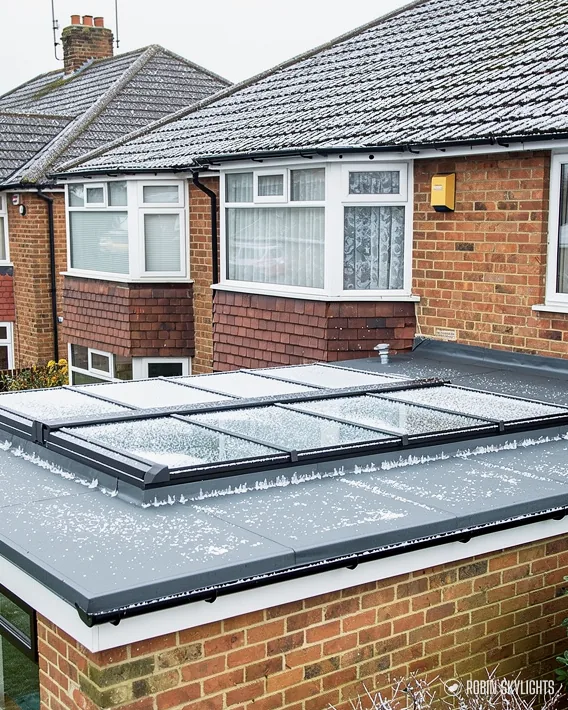
The rear additions on terraces are often flat. A flat roof holds water for days if its fall is poor. A rooflight on such a roof gets a raised kerb and a fall away from the glass, so water leaves instead of sitting. See our page on flat roof rooflights.
Choosing between fixed and opening glass
A bathroom or kitchen asks for an opening unit, since steam is the problem. A landing or a hallway can have fixed glass, which leaks less air and costs less to build. We suggest the type that fits each room, and the written quote shows the options as separate lines so you can decide.
Light off the water
Open ground such as the Washlands keeps the sky wide above nearby roofs. In the grey months, a wide sky is the best light a rooflight can have.
05
Trimming the choice down for streets like these
Terraces and conservation areas favour a few specific choices, and we begin with the dark room.
For a protected street
A slim-framed conservation rooflight sits close to the slope and keeps the roofline clean. It is the product we start with where the front slope shows, though on most houses it is a choice of look rather than a requirement. Our page on conservation rooflights shows how they are made.

For a back addition
A flat rooflight over a kitchen or bathroom extension gives daylight without a new wall opening. On a larger room, a lantern is more of a feature.
For a landing
The landing in a terrace is the room without a window. Where there is roof space overhead, a sun tunnel can drop daylight to a ceiling diffuser; if the slope runs right over the stairs, a compact roof window can sit over the stairs if the slope allows.
When an Anglesey rooflight has misted or leaks
If a rooflight has misted or leaks, it can often be replaced within its existing opening, which keeps the surrounding roof covering untouched. The survey tells us whether that applies to your roof. When the room is staying as it is, a like-for-like unit is the plain route; when it is changing, say so, and we size the new one for the new layout.
Whatever is fitted carries a ten-year guarantee on the workmanship, written down.
Terraces, listings and distance: your Anglesey questions
Which conservation area am I in, and does it matter for a skylight?
Several are recorded close by, including Clarence Street and Anglesey Road, only 0.21 km from the centre point. Whether yours is covered depends on your street, so we ask East Staffordshire Borough Council before ordering. Being in one does not by itself call for an application, an Article 4 direction aside, and a slim frame on the rear slope is the simplest route.
Our terrace has a landing with no window. What are the options?
If a loft space sits above the landing, a sun tunnel can carry daylight down through it. If the slope runs directly over the stairs, a small roof window will do. We check both on the survey and quote one fixed price.
Does Anglesey sit too far out for you?
No. At 30 miles by road it is on the limit of the area we cover, and we survey it as we would any street. Our visit to Anglesey is a free survey in your own home, nothing more to book.
The flat roof over our back kitchen collects water. Does that affect a rooflight?
It does, and it is better to know before fitting. We check the fall of the roof at the survey. A rooflight sits on a raised kerb, and if the fall is poor, the roof finish around it can be corrected as part of the work.