North-north-west of the city centre, 29.6 road miles out
Skylights & rooflights in Eckington
A Derbyshire town on the South Yorkshire border where the town centre sits inside a conservation area, with two more beside it. Here a rooflight begins with a listing and Article 4 check, not an order.
Eight sites where a brook turned the wheels
The Moss Brook was dammed at eight sites, including Chapel Wheel, Carlton Wheel and Fields Wheel, to drive the grinding of blades. The water power is gone, but the Moss Valley is now a conservation area beside the town.
Eckington, the town that needs asking first
Eckington, a North East Derbyshire town beside the South Yorkshire border, has a recorded population of 7,435. It holds a great deal of recorded heritage in and around its centre, so this page begins with that heritage. The remaining chapters follow the brook, the route in, the ground and the products. To see who we are first, start at skylight installation in Nottingham.
01
Three conservation areas and 53 listed buildings
The authority for planning in Eckington is North East Derbyshire District Council. The city council is not involved. The more important point is how much of the town centre is protected, because so much of it is designated.
The conservation areas
The first, called Eckington and Renishaw Park, takes in the very middle of town, designated on 21 August 1970, and contains 38 listed buildings: two Grade I, two Grade II* and 34 Grade II. The second, Eckington High Street, lies 0.26 km out, designated on 29 September 1994, and holds four Grade II buildings. The third, Moss Valley, lies 0.4 km away, designated on 3 May 1990, with 36 Grade II buildings inside. Its name does not mention Eckington, but it is an area within or beside the town.
3areas
conservation areas on record near the centre
53listed
buildings round the centre (2 Grade I, 2 Grade II*, 49 Grade II)
Listed buildings overall
Close to the centre, Historic England records 53 listed buildings: two Grade I, two Grade II* and 49 Grade II. For a householder, the practical reading is that the centre is protected, so your own address is worth checking first.
Effect on a rooflight job
Should your house be listed, listed building consent is required before the roof is opened up. In a conservation area, the national allowance for rooflights can still hold unless an Article 4 direction has taken it away, so that is the check we make. We take the address to the council before we order anything, then propose the slope that gives the room its best light.
Our planning permission guide holds the national tests. When the work counts as notifiable, the Building Control notice goes in from us.
Where are the dim rooms? That one answer shapes the whole job. We find the slope above them, check whether any direction covers it, and use the survey to confirm what the roof will carry.
02
The brook, the river and the valley woods
What running water and trees mean for a roof.
The Moss Brook is a tributary of the River Rother, which is also recorded close to the centre. In the Industrial Revolution the brook was dammed to give water power at eight sites, among them Chapel Wheel, Carlton Wheel and Fields Wheel, and that power ground blades. Eckington Woods, north of the town, form part of the Moss Valley conservation area. Renishaw Park, the nearest named park, is 1.2 km out.
Those details say two practical things about the air and the ground the town sits in: it is damp, and it is wooded.
Damp air, cold glass
Valley air holds moisture on still mornings. Indoors, kettle steam, shower steam and drying washing all head for the coldest surface, and under a rooflight that is often the glass. Glazing built on a warm-edge spacer keeps the inside pane warmer, and an opening rooflight, even slightly open, lets the steam out before it beads. For the rooflight's performance numbers, see energy efficient rooflights.
- Kerb
- The upstand on a flat roof that carries the rooflight and lifts its glass above any puddle.
- Warm-edge spacer
- The edge strip of a double-glazed unit, chosen so that less cold reaches the room side.
- Article 4 direction
- A council order that cancels the normal national allowance for jobs such as rooflights in a defined area.
Trees and leaf fall
Woodland edges drop leaves, needles and seeds onto roofs. On a pitched roof they gather in valleys and behind chimneys. On a flat roof they build up against the kerb. We set the kerb tall enough that a pool of rainwater stays below the glass seal, and on pitched roofs we choose a flashing that lets debris slide past.
Shade is the other effect. A tree that screens a slope in winter, when the sun is low, can make the difference between a bright rooflight and a dull one. Sitting in the room and looking up shows us what each possible spot can actually see.
Choosing for a damp brookside
Damp air meets cold glass first, so the glazing matters as much as the size. We specify a sealed unit with a warm edge, and an opening sash over a kitchen or bathroom so steam leaves the room. Beside woodland the upstand or flashing is checked for leaf build-up, and we show you where to look once the autumn fall is done.
03
Reaching Eckington, and the suburb called Halfway
Eckington lies north-north-west of the city centre, 29.6 miles away along the road network and around 43 minutes by car on the map. That puts it at the very edge of our 30-mile area, so a survey here is planned as one complete visit rather than a series of short calls, with everything we need to see taken in on the day. The A6135, B6052 and B6053 all pass within a kilometre of the centre. No railway station or tram stop is mapped within 2 km, which means we come by van.
Halfway
One named suburb sits close by: Halfway, about 1.6 km from the centre point. It is within our area, as is the rest of the town and the country round it. The border with South Yorkshire is close, but that county line is not one we draw. What counts is road distance from Nottingham, and Eckington is inside it.
29.6miles
road miles out of Nottingham centre
43minutes
map drive time, a guide only
Getting the visit right
A long drive makes preparation worth the effort. Before leaving Nottingham we ask about roof access, a parking spot for the van, and whether there is a loft hatch. If you can send a photograph of the room and the slope you are thinking about, we arrive knowing what we are looking at.
The survey itself is free. We start with the room, which means where you sit, where the light stops and which corner never brightens. Then we climb up and read the covering, the framing and the way rain leaves the roof. After that we put a price in writing, and it stays fixed through the work.
Other places on our list appear on the areas page.
04
Coal measures, ironstone and what they left behind
Eckington's geology is the coal measures, which carry both coal and ironstone. During the Industrial Revolution, coal and iron ore were mined here, and the local streams powered factories. It is a past of working ground and working buildings.
Rather than guess a style from the pavement, we let each roof show us its age. The history does hint that buildings here were altered, extended and re-roofed across many generations, which is why the loft tells us more than the street does.
What the loft tells us
In an older house we may find cut timber with uneven spacing, patched repairs and heavy coverings such as stone slate or clay tile. In later houses we find factory trusses. The question is always the same. Can a new opening be framed without weakening the roof? In a cut-timber roof, rafters can be trimmed back and carried on doubled timbers round the opening. A truss is not for cutting, so the opening is planned between trusses.
| Area | Distance | Listed inside |
|---|---|---|
| Eckington and Renishaw Park | Covers centre | 38 |
| Eckington High Street | 0.26 km | 4 |
| Moss Valley | 0.4 km | 36 |
Coverings
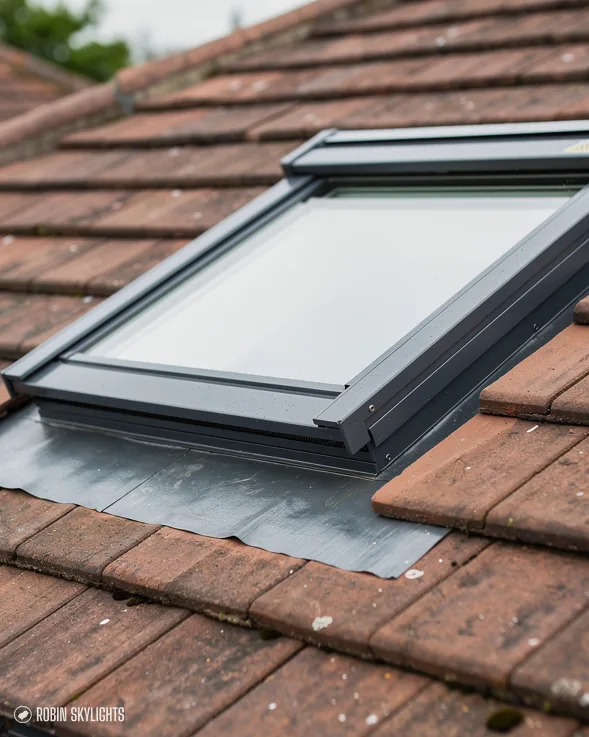
The covering decides the flashing. A roof window in clay tile needs a different collar from one in slate, and a heavy stone slate asks for a particular detail. We match the flashing kit to the covering, which keeps the roof watertight through a long wet winter. Our page on flashings for tiles and slates explains the principle.
05
Rooflights that suit a protected street
When a town has this much heritage, the product choice comes after the listing and Article 4 check. Two options tend to fit protected settings best, and a third is for the back of the house.
Conservation rooflights
A conservation-style rooflight is made to sit low in the roof, with slim glazing bars that echo older metal rooflights. It is meant to look right from the street and from the garden. Our page on conservation rooflights covers sizes, bars and how they fit.
A roof window at the back
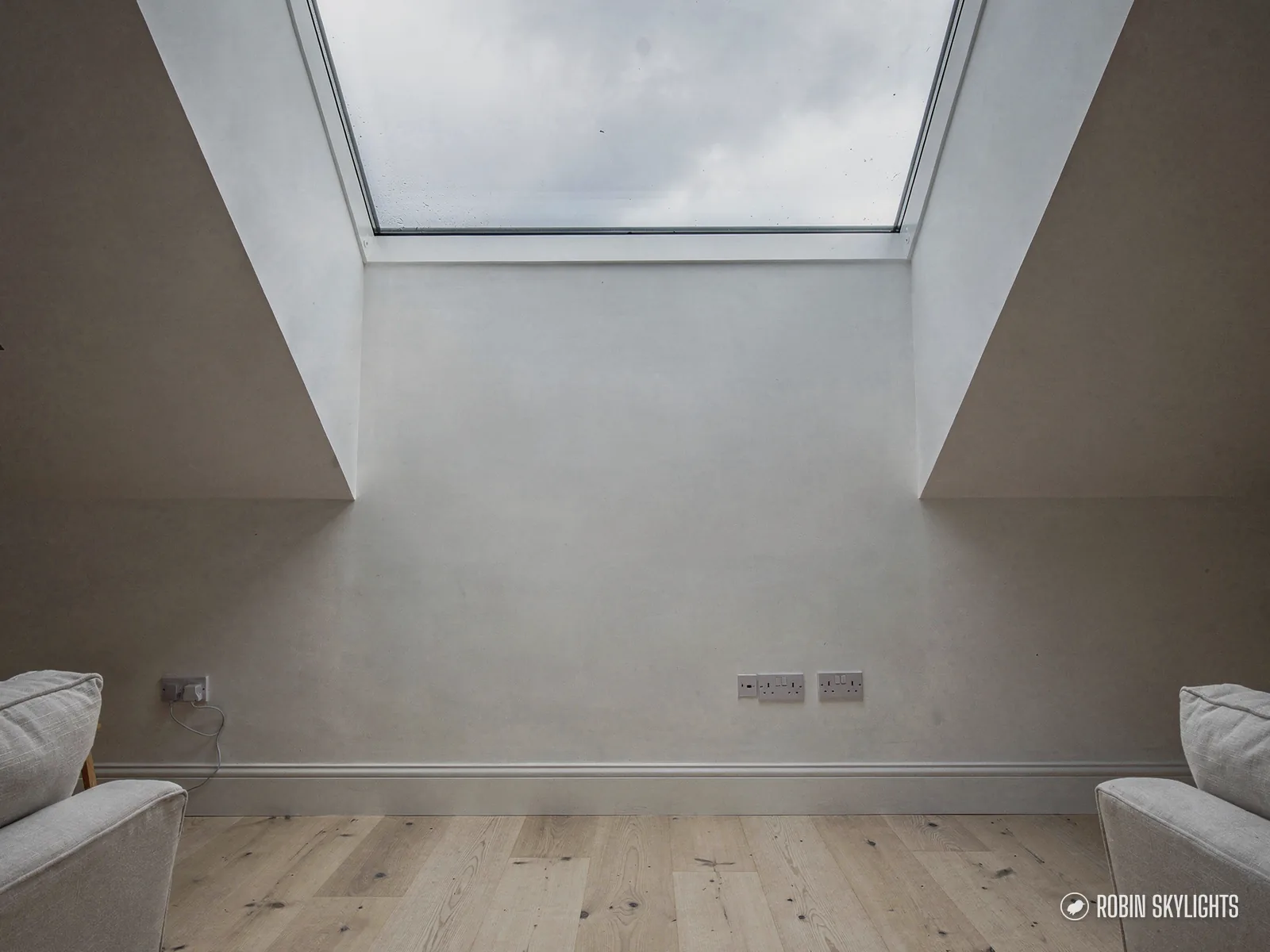
A roof window on a rear slope can bring a loft room to life without touching the street view at all. We still check the address and any Article 4 direction before we order.
A flat rooflight on an extension
A flat-roofed kitchen extension at the back often has a dark far end. A flat rooflight placed over it is the simplest cure and stays out of the street view.
New or replacing
We install new rooflights and replace worn ones, in homes first and small commercial buildings too. Where a listed or conservation-area house already has a rooflight that has misted, the survey tells us whether the glass can be dealt with on the existing opening. A written guarantee on workmanship, lasting ten years, goes with both.
Fixed or opening? A rear bedroom in the roof and a kitchen both gain from a unit that opens. A landing or a dim hall gains most from a fixed pane, since fresh air already travels through. We settle this with you at the survey and write it into the quote.
Eckington: heritage, consent and the long drive
My house is right in the middle of Eckington. Is a rooflight still possible?
Quite possibly. The town centre lies inside a recorded conservation area, with two more nearby, so we put your address to North East Derbyshire District Council first. Unless a direction applies, either slope can usually take one. A listed house also needs its own consent before the roof is opened.
Is the Moss Valley conservation area part of the town?
It lies about 0.4 km from the centre and is an area within or beside the town, with Eckington Woods forming part of it. Whether a given street falls inside is a question for the council. Pass us your address and the council gets the question before any order.
Can the glass alone be swapped in an old rooflight?
Sometimes. If the frame and the kerb are sound, a failed glazing unit can be replaced on its own. If the frame is tired or the seal around it has gone, replacing the whole rooflight is better. The free survey is where we look at the frame and tell you plainly which applies.
Is Eckington really inside your area?
Yes. Eckington is 29.6 road miles out, only just inside the edge of our area. The survey is a single well-prepared visit, and the written quote afterwards is fixed. There is nothing to drive to on your side: the visit happens at your home.