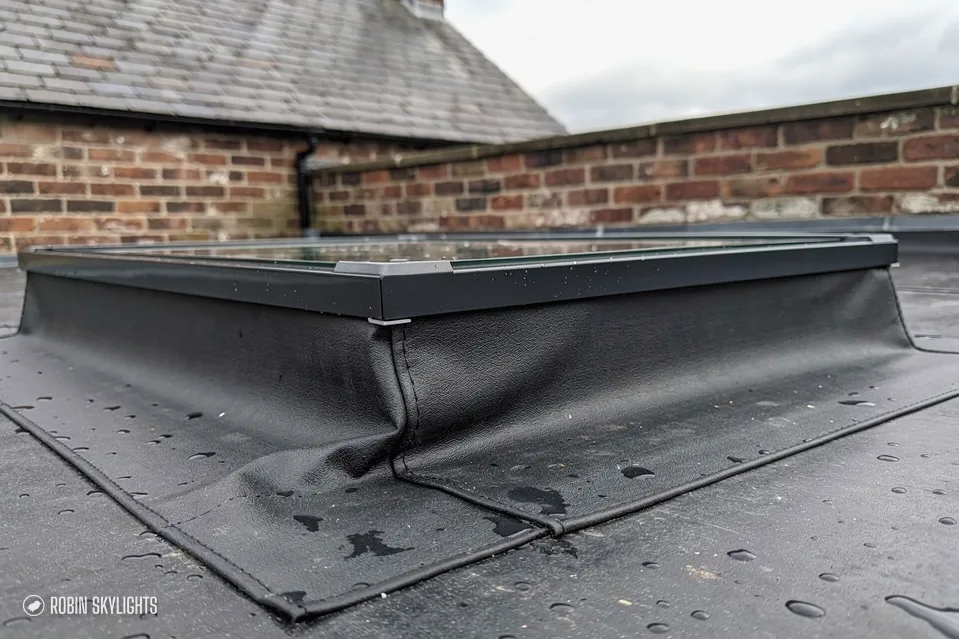
The same daylight, a different job
Start with one fact that settles half the arguments for any flat roof rooflight. A fixed rooflight and an opening one of the same size admit about the same amount of daylight. The opening version has a slightly thicker frame, because the sash has to fold back onto the kerb, so you lose a little glass. In practice you will not see the difference from the room on a dull afternoon.
So the choice is not about brightness. It is about what you want the rooflight to do on the other days. A fixed unit is a window you cannot open: it brings daylight in and nothing else. An opening unit can also let warm, damp, stale air out through the top of the room, which is where it collects.
That is the useful way to think about it. Rooms that make moisture or heat, such as kitchens, bathrooms and sunny extensions, gain from a rooflight that opens. Rooms that only need light, such as a landing, a hallway or a quiet study, are often better with the simpler fixed one.
Most of the other differences follow from the moving parts. Opening units cost more, have more to maintain, and need more care in how they are weathered and sealed. In return, they give you a way to ventilate a room without opening a wall window and losing the heat in winter. The sections below take each factor in turn so you can weigh them for your own room.
Ventilation and the stack effect
Warm air rises. In a room with a high ceiling, or a single-storey extension with a vaulted section, warm air collects at the top and stays there. A rooflight that opens lets that air leave, and cooler air is drawn in at lower level through a door or window. That movement is called the stack effect, and it can clear a stuffy room faster than any amount of opening the garden doors.
That has three practical uses. In a kitchen, it clears steam and cooking smells from above the hob without a draught across the table. In a bathroom or shower room, it helps get rid of moisture before it settles on cold surfaces. And in a sunny extension, it releases the afternoon heat, which otherwise builds up under a large area of glass.
Opening a rooflight is not a substitute for extract ventilation where the Building Regulations require it. A bathroom, for example, still needs its own extract fan or other means of ventilation, and a rooflight is a bonus on top. Our electric opening rooflights page explains how the motorised versions work.
A fixed unit gives none of this, so if the room currently suffers from damp air, adding more glass alone will not cure it. The glass can even make condensation worse in winter if it is cold. Ventilation is a separate decision, and for many rooms the opening version is the simplest way to provide it.
Manual or electric, and who can reach it
An opening flat rooflight is operated in one of three ways, and the right one is mostly a question of height and reach.
Manual. A pole with a hook, or a hinged handle, opens and closes the sash from below. It works if the rooflight is over a space you can reach, such as a landing or a low ceiling. Over a kitchen island with a high ceiling, a pole is awkward, and people stop opening it.
Electric. A small motor opens and closes the sash from a wall switch, a remote or an app. It is the practical choice for anything high, large or heavy. Most electric units can also be fitted with a rain sensor that closes the sash when the first drops land. That feature earns its place in a Nottingham autumn, when showers arrive without warning and you are out of the house.
Solar-powered. Some units use a small solar panel to charge the motor, which avoids running a mains cable. They suit a roof where cabling is hard, though they depend on the battery staying charged through a dull winter.
Electric needs a power supply to the roof. If we are cutting a new opening in a new or existing extension, bringing the cable to the right place costs little. If the ceiling is finished and sealed, the route may involve more disturbance, so we plan it on the survey. The wiring must be done by a competent electrician, and the fixed written quote says who does it.
Do not forget cleaning. A fixed rooflight needs the outside wiped from the roof. On an opening one, the sash tilts or opens so that the underside can be reached.
Heat, glare and the sunny side of the house
A large area of glass in a roof collects heat on a bright day. A fixed rooflight cannot release it, and so a south or west facing extension with a big fixed unit can get hot on a warm afternoon even with coated glass.
An opening unit gives you the release valve. Open it a hand's width in the morning, with a window or door open lower down, and the room stays cooler long into the afternoon. For a room you use mostly in the evenings it is usually enough.
It is the other half of the picture that tends to be overlooked. From October to March the same large glass area loses heat at night. A fixed unit, correctly sealed, performs well, because there is no seam for cold air to find. An opening unit, with a gasket all the way round, should do almost as well when it is closed, and a good make will. But the seal is where the quality shows, so it is worth looking at how the manufacturer describes it, and at how the sash seats onto the kerb.
Blinds help both ways. A blind fitted under the glass cuts glare in summer. In winter, a pleated blind drawn at night holds a little warmth in. Some opening and fixed units take factory-fitted blinds, which are neater than ones added later. Grey-day daylight explains why we plan around overcast weather in the first place, and the answer is usually clear glass that stays bright when the sun is not out.
Safety, escape and security
Three safety points apply to opening rooflights in flat roofs.
Falling. Part K of the Building Regulations deals with protection from falling and with glazing safety. A rooflight over a place where people walk or sit must use safety glass, and one in reach of the floor, or one that opens wide at a height, needs thought. We specify the glazing to suit the position and tell you what it is on the quote.
Escape. An opening flat rooflight is not an escape window. Escape windows are for rooms in the roof of a bungalow or chalet bungalow, within the height limit set out in Part B, and a flat roof unit over a ground-floor extension has no part in that. The only point worth making is that a fixed rooflight can never count as one, and an opening one counts only where the rules apply.
Security. A rooflight on a flat roof is reachable by anyone who can get onto the roof, so the opening sash should have a lock or be limited by the motor. Electric units are driven shut by the motor, which holds them. Manual ones come with a lockable stay. On a roof reached from a low wall or garage, ask for the locking option.
Children are the other consideration. A sash that opens wide over a low ceiling is a risk in a child's room. A restrictor that limits the opening angle solves it and still lets air through. We fit what the room needs.
Upkeep, cost of ownership and what can fail
A fixed rooflight has no moving parts. If it is well made and well weathered, it needs a wipe once or twice a year and a look at the roof around it. That simplicity is the main argument for choosing fixed wherever the room does not need air.
An opening unit has a hinge, a seal, a stay or motor, and in some cases a rain sensor. Each of those can wear. Gaskets harden with age, a motor can stall if something blocks the sash, and a sensor can get covered in leaf litter or moss. None of this is alarming, but it means you will want the installation done by someone who stands behind it. Our workmanship guarantee is written, and covers ten years of our fitting work.
Costs differ in a plain way: the opening version costs more to buy and more to fit, and the electric version more again, once the cable and controls are counted. We do not publish figures, because the price depends on size, kerb and position, and we only quote after the survey. A fixed written quote shows each choice side by side so you can see what the opening mechanism adds.
One practical tip for the grey months. Run a motorised sash open and shut occasionally through winter, even if you do not need the air. Moving parts that sit still for months in cold, damp weather are the ones that stick.
Choosing room by room
Here is how the choice usually falls, as a starting point for the survey.
- Kitchen extension. Opening over the cooking end, or a pair, with one fixed, over the dining end. Electric if the ceiling is high.
- Bathroom or shower room. Opening, ideally with a rain sensor if it is out of reach. Warmer glazing matters most here.
- Landing or hallway. Fixed is normally enough. If the stairwell traps warm air upstairs, an opening unit helps in summer.
- Living room or garden room. Opening where the glass is large and the room faces south or west. Fixed where it faces north.
- Home office. Fixed above the desk to avoid glare changes, with air from a wall window.
- Small commercial room. Depends on the use. A kitchenette or a treatment room is an opening room, and a corridor is fixed.
You can mix them in a single roof. A long extension with two rooflights in a row often takes one of each, so you pay for the mechanism only where it earns its keep. If you also want a lantern over the dining end, the roof lanterns page covers that route.
If you are torn, ask us at the free survey. We stand in the room, look at the ceiling and the aspect, and give you a straight recommendation. The fixed written quote then covers whichever you choose, and the price does not change on the day. Our page on upstands and kerbs shows what sits underneath either type.